
A security concern has just surfaced at your organisation. A manager believes an employee may have removed confidential files, a locker may contain company property, or an applicant's identity may not match the credentials on their résumé. The instinct is understandable: search first, ask questions later. In Canada, that sequence can create a larger privacy and employment-law problem than the original concern.
The practical challenge is that workplace searches in Canada now extend beyond bags, desks, and lockers. They can include company laptops, personal phones used for work, online profiles, criminal record checks, identity verification, and sensitive screening results. Each activity has a different legal context, but the same operational discipline matters throughout: define the purpose, use the least intrusive method, provide clear notice, obtain meaningful consent where required, and document the reason for access.
Table of Contents
- Understanding the Legal Reality of Workplace Searches in Canada
- Navigating Permissible Physical and Digital Searches
- Respecting Privacy Laws and Human Rights Limits
- Selecting the Right Criminal Record Check for the Role
- Designing a Compliant Screening and Search Policy
- Building a Frictionless Candidate and Employee Experience
- Auditing Your Current Workplace Search Practices
Understanding the Legal Reality of Workplace Searches in Canada
A hiring manager receives an application for a safety-sensitive role and notices a discrepancy in the candidate's employment history. At the same time, a current employee reports that confidential information may have been copied to a personal device. The manager wants a criminal record check for the applicant and an immediate inspection of the employee's phone. Treating both requests as routine “security checks” would be a mistake.
Canadian employers have legitimate interests in protecting people, property, confidential information, and business operations. Employees and applicants also have privacy interests in their personal information, devices, communications, and records. The Office of the Privacy Commissioner's 2022–23 Survey of Canadians on Privacy-Related Issues found that 87% of Canadians were at least somewhat concerned about how organisations might use information available about them online to make decisions about them, including decisions involving employment, insurance, or health coverage.
That concern reflects a practical reality. A workplace search may reveal far more than the specific item or record an employer intended to review. A phone can contain private messages, health information, family photographs, and unrelated accounts. A background check can expose information that has little connection to the duties being performed. The employer's need to know must stay connected to a defined business purpose.
Practical rule: A legitimate business concern doesn't automatically authorise unlimited access to personal information.
Canadian workplace-search principles generally require an express or implied workplace term supporting the search. Where possible, the employer should seek the employee's cooperation or consent. If consent isn't obtained, the search should be reasonable, clearly justified, conducted with notice where practicable, and limited to what the circumstances require, as summarised in Canadian guidance on searches in the workplace.
That approach applies equally to hiring workflows. PIPEDA requires meaningful consent for the collection, use, and disclosure of personal information in commercial activity. Consent should be informed and tied to a specific purpose, not buried in a general application form. A candidate should understand what the employer is checking, why the check is relevant to the role, and how the result will be handled.
For a practical compliance framework, HR teams can review Alero's Canadian compliance resources, then have employment counsel assess policies that involve searches, monitoring, or sensitive screening. Trust, transparency, and documented authority are operating requirements, not public-relations extras.
Navigating Permissible Physical and Digital Searches
The key question isn't whether an employer owns the workplace. The key question is whether the proposed search is reasonable in purpose, scope, method, and timing.
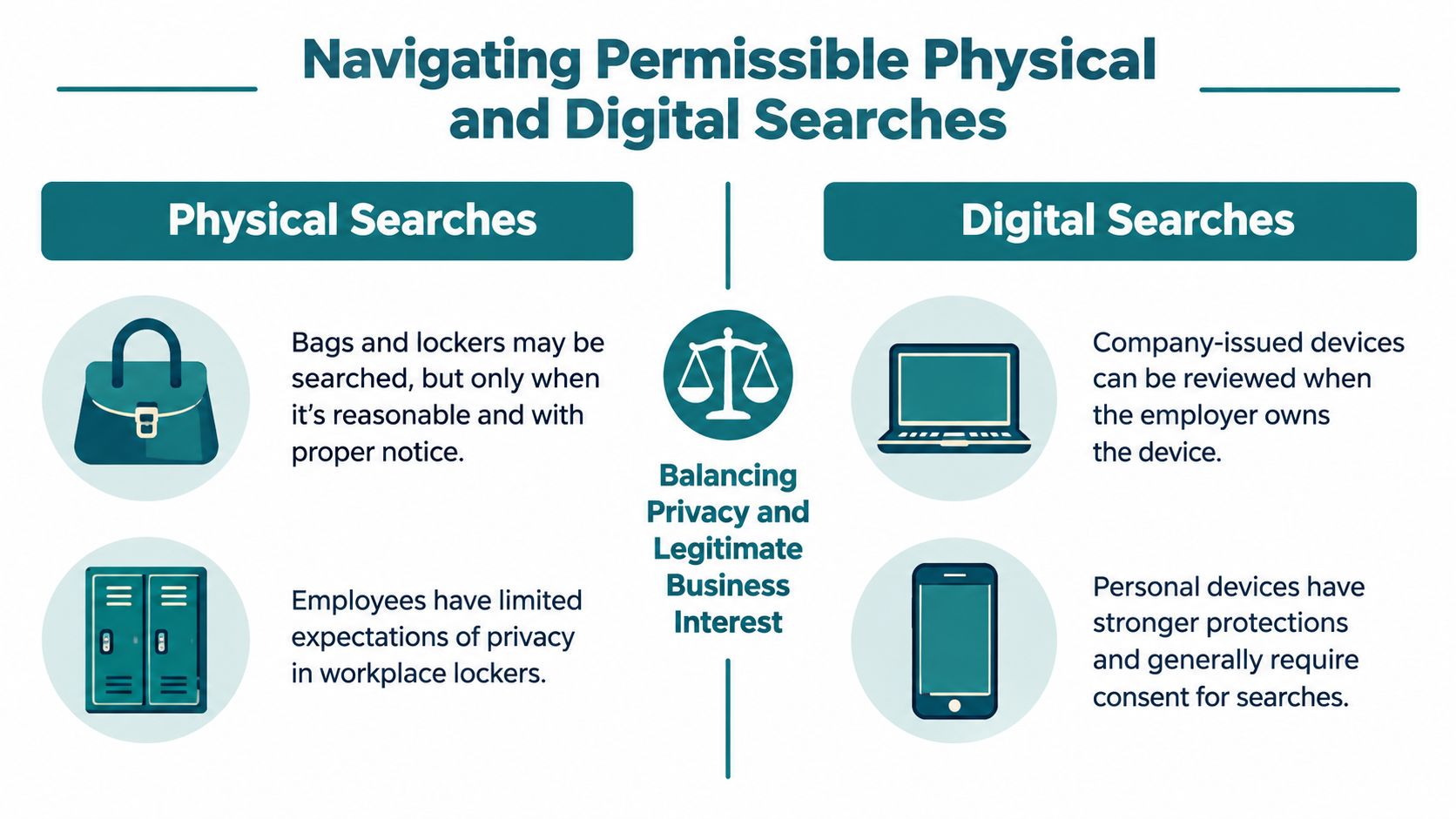
A bag or locker inspection may be defensible where a written policy gives notice, the employer has a defined safety or misconduct concern, and the search is conducted in a controlled way. That doesn't mean a policy gives managers unlimited authority. Canadian guidance describes random or universal searches as generally unacceptable without a real and substantial suspicion of wrongdoing, particularly where the process is intrusive or poorly connected to a specific risk.
Physical searches need a defined purpose
Start by separating company-controlled spaces from personal effects. An employer may have stronger grounds to inspect a company storage area, assigned locker, or work station when the policy clearly explains the expectation of privacy and the inspection relates to safety, property protection, or a documented investigation.
The risk rises when a manager searches an employee's handbag, backpack, coat, or vehicle without notice or cooperation. A defensible process should identify:
- The trigger: What specific incident, report, or safety concern prompted the search?
- The scope: What item, area, or material must be examined?
- The people present: Can the employee attend, with a witness or HR representative present?
- The record: Who authorised the search, what was reviewed, and what was found?
A public-sector employer must also consider the Canadian Charter of Rights and Freedoms, particularly where government action may engage a reasonable expectation of privacy. A private-sector employer is usually dealing primarily with provincial privacy and employment law, contractual terms, and applicable human rights obligations. The same inspection may therefore carry different risks depending on the employer and workplace.
Digital searches require tighter boundaries
Company-issued devices aren't automatically open books. A policy can establish that the employer may review business information on an employer-owned laptop, but the review should still be limited to a legitimate purpose. Searching an entire device when the concern relates to one folder or message creates unnecessary exposure.
Personal devices used for work demand greater caution. An employee's personal phone may contain business communications, but it also contains private information unrelated to the employment relationship. Ask for the specific work record or use a company-controlled account rather than copying the device wholesale. Don't rely on a vague statement that employees “consent to monitoring” if the policy doesn't explain what will be collected and under what circumstances.
A useful operational test is simple:
- Can the concern be addressed without a search?
- Is the proposed search authorised by policy or contract?
- Has the employee received clear notice?
- Is the method narrower than the risk requires?
- Can the review be completed without exposing unrelated personal information?
A routine inspection becomes high risk when the employer uses a broad search to investigate a narrow concern.
Respecting Privacy Laws and Human Rights Limits
Sensitive screening requires more than a signed form. Under B.C.’s PIPA, even consented collection, use, or disclosure must serve a purpose that a reasonable person would consider appropriate. There should also be evidence of a workplace problem creating a safety risk when an employer seeks sensitive drug or alcohol information, as outlined in the B.C. privacy guidance on drug and alcohol testing.
That standard changes how HR should handle testing, financial information, social media screening, and other intrusive checks. A candidate's online activity may be publicly visible, but public availability doesn't make every use job-related or fair. A financial check may be relevant to a role involving financial authority, but it shouldn't become a default requirement for positions with no comparable responsibility.
Apply a need-to-know model
Sensitive results should go only to people who need them to make or administer the employment decision. In practice, that may include designated HR staff and health-and-safety personnel, depending on the purpose. Hiring managers usually need a decision status and a documented exception process, not unrestricted access to raw medical, financial, or police information.
Build the workflow around these controls:
- Purpose limitation: State the specific safety, regulatory, or role-related reason for the check.
- Data minimisation: Request only information needed to assess that purpose.
- Restricted access: Separate operational decision-makers from raw sensitive records where possible.
- Retention control: Keep records only under an approved retention schedule and securely dispose of them when no longer required.
- Candidate response: Give the person a fair opportunity to correct inaccurate information or explain a result before an adverse decision.
The human rights risk is equally important. A broad search may disproportionately affect people because of disability, family status, race, religion, or other protected characteristics. Drug and alcohol testing, social media review, and criminal record screening can all become discriminatory if managers use irrelevant information or apply a process inconsistently.
Treat social media as a risk signal, not a shortcut
Social media screening should focus on defined, public, job-related risk indicators. Don't ask for passwords, require access to private accounts, or collect personal details merely because they appear during an informal search. A written protocol should explain what reviewers may consider, what they must ignore, and how the organisation prevents protected information from influencing a decision.
PIPEDA's consent requirements reinforce this discipline. The RCMP's guidance on police information checks and consent describes consent as part of a process that should identify what information is being requested and why. A signature without understandable notice is weak evidence of meaningful consent.
Selecting the Right Criminal Record Check for the Role
Canadian employers often use “criminal background check” as a catch-all phrase. That creates confusion because a basic Criminal Record Check, a Criminal Record and Judicial Matters Check, and a Vulnerable Sector Check serve different purposes and aren't interchangeable.
The Ontario Provincial Police explanation of police record-check levels distinguishes three commonly used options. The appropriate choice depends on the actual duties, not on a manager's preference for the most extensive available search.
| Check Type | Scope of Search | Appropriate Use Case |
|---|---|---|
| Basic Criminal Record Check | A basic search for criminal record information, subject to the applicable police-service process and disclosure rules | Roles where a basic criminal-record assessment is relevant and no broader judicial-information review is justified |
| Criminal Record and Judicial Matters Check | Includes criminal convictions, summary convictions for five years, outstanding entries such as charges and warrants, and certain judicial orders | Roles where the employer has a documented, job-related reason to assess broader judicial information |
| Vulnerable Sector Check | Adds sexual-offence record-suspension information and, in some circumstances, non-conviction information when a strict test is met | Specific positions involving trust or authority over children or vulnerable persons |
The VSC threshold is role-specific
The RCMP defines a Vulnerable Sector Check as a limited, purpose-specific process for people volunteering or working in positions of trust or authority over children or vulnerable persons. The RCMP explanation of Vulnerable Sector Checks says the request must explain how the duties create that trust or authority relationship.
A VSC isn't an enhanced option that employers can order whenever they want more information. It isn't appropriate merely because a job involves customer contact, access to an office, or general responsibility. HR should map the proposed duties to the vulnerable population, the nature of the authority, and the reason the check is legally permitted.
The process also matters. According to the RCMP overview of certified criminal record checks, the hiring organisation makes the request, the applicant provides consent, and the applicant doesn't submit the VSC request independently. Only the police agency or authorised body in the applicant's local jurisdiction can conduct the verification, so candidates apply through their local police service.
Match the check to the decision
A check should answer a defined hiring question. If the role doesn't justify a VSC, ordering one creates unnecessary privacy exposure and may delay the candidate. If a CRJMC is needed because the duties involve a documented concern about outstanding judicial matters, use that level rather than defaulting to a broad request.
For a more detailed operational comparison, HR teams can consult this guide to Canadian criminal record checks. The right workflow records the role rationale, consent, jurisdiction, result status, and any human review before a manager makes a final decision.
Designing a Compliant Screening and Search Policy
A strong policy joins physical workplace searches and pre-employment screening without pretending they're identical. Both require a legitimate purpose, proportionality, notice, controlled access, and an auditable decision process. The policy should distinguish the legal basis and procedure for each activity.
PIPEDA requires meaningful consent for relevant commercial collection, use, and disclosure. A candidate should see a plain-language purpose statement before starting a check, rather than finding a dense authorisation clause hidden in onboarding paperwork. The statement should identify the information category, the reason for collection, the parties who may receive it, and how the candidate can ask questions.
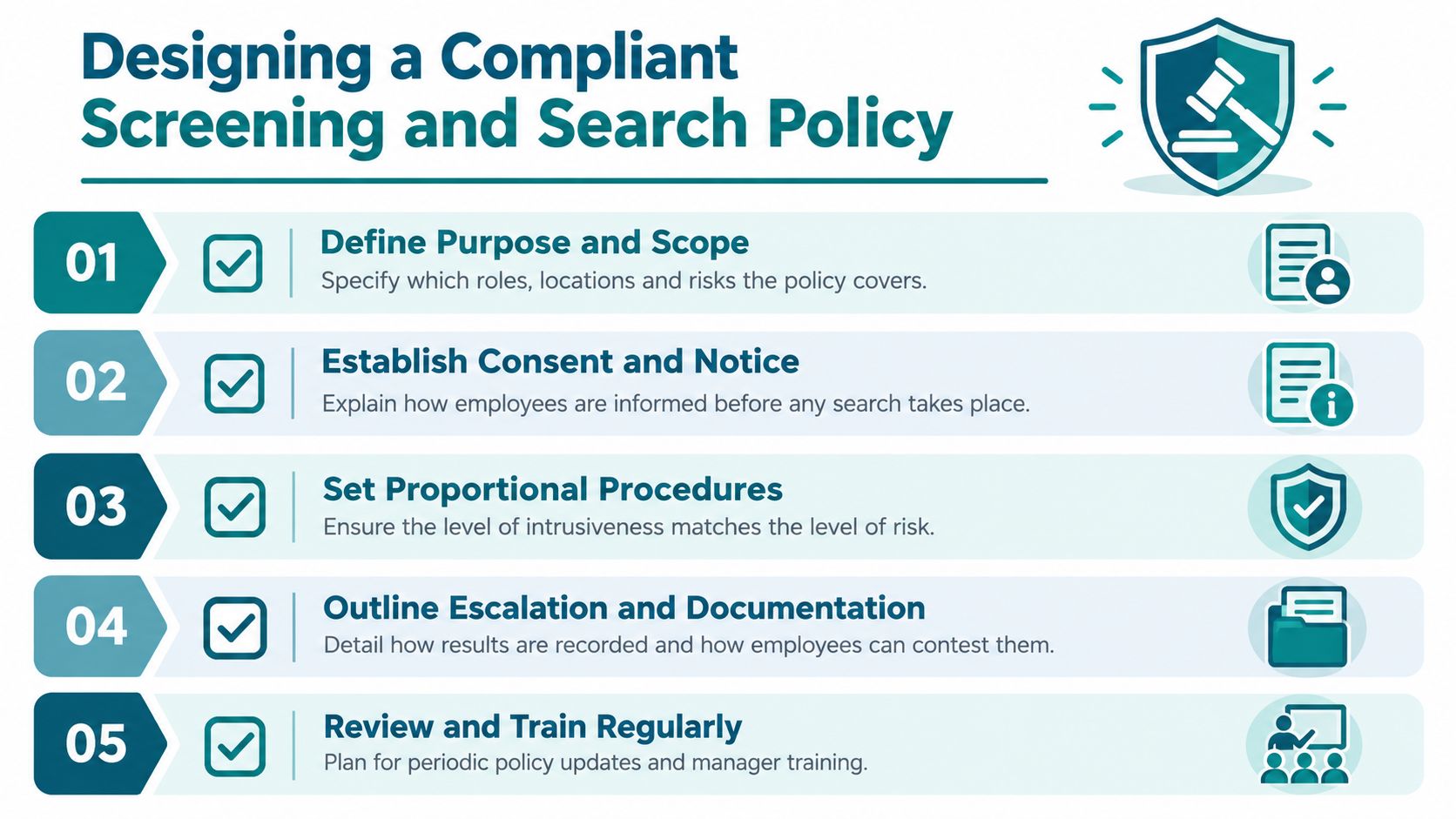
Build the policy around five controls
Define purpose and scope. List the roles, workplace risks, devices, spaces, and screening products covered. Identify what isn't covered, especially private accounts and unrelated personal information.
Establish consent and notice. Explain when employees or candidates receive notice, what consent means, and when the organisation may proceed without consent because a lawful and documented workplace process applies.
Set proportional procedures. Match the intrusion to the risk. A review of a company folder shouldn't become a full device search, and a basic record check shouldn't become a VSC without role-specific justification.
Outline escalation and documentation. Name the decision-maker, HR contact, privacy lead, and review route. Record the triggering concern, authorisation, information accessed, findings, and candidate or employee response.
Review and train regularly. Managers need practical training on bags, lockers, personal devices, social media, police checks, and sensitive results. Update the policy when law, technology, or workplace risks change.
Keep the policy usable during pressure
A policy that nobody can follow during an incident won't protect the organisation. Add a short manager checklist and require HR or privacy review for personal-device searches, sensitive testing, VSC requests, and adverse decisions based on screening. Separate emergency safety action from later evidence collection, and document why immediate steps were necessary.
Your policy should also describe vendor oversight. Ask where applicant data is stored, who can access it, how the vendor supports corrections, and whether the workflow creates a clear audit trail. Good policy design makes the compliant action the easiest action for a busy manager to take.
Building a Frictionless Candidate and Employee Experience
Compliance doesn't require a slow, paper-heavy hiring process. Candidates are more likely to understand and complete screening when the organisation asks for only relevant information, explains the purpose clearly, and provides a mobile-friendly workflow.
Fragmented processes create avoidable problems. A candidate may receive one email for identity verification, another for a police check, and separate requests for education, employment, and licence information. Every handoff introduces opportunities for incomplete data, duplicate entry, phishing confusion, and inconsistent consent records.
A modern workflow can combine:
- Mobile-first intake: Let candidates review notices, provide consent, and submit information from a phone or computer.
- Identity proofing: Match a government-issued identity document to a live selfie where the role and process justify that assurance.
- Direct verification: Request education or employment confirmation from the relevant institution or prior employer instead of relying solely on candidate-uploaded documents.
- Integrated status tracking: Give hiring managers a clear “Clear” or “Review” status while restricting access to underlying sensitive details.
- Human exception handling: Route mismatches, missing records, and candidate disputes to a trained reviewer rather than allowing an automated rejection.
A Canadian provider such as Alero Background & Identity offers criminal record checks, identity verification, credential and employment verification, bilingual workflows, HRIS and ATS integrations, and Canadian data residency. Those features don't replace the employer's responsibility to choose a lawful purpose, but they can reduce manual handling and make consent, status tracking, and review steps easier to audit.

Candidate experience principle: Tell people what you're checking before you ask them to provide it, then give them a clear route to question or correct the result.
Speed matters, but speed without accuracy creates rework. A fast process that sends the wrong check, exposes unnecessary information, or loses consent records isn't efficient. The better target is a frictionless, purpose-limited workflow that helps HR reach a reliable decision while respecting the person being screened.
Auditing Your Current Workplace Search Practices
An audit should test what managers do, not just whether the organisation has a policy PDF. Review recent hiring files, search authorisations, vendor workflows, and access logs. Compare written rules with the forms, emails, and software screens that candidates and employees encounter.
Start with the policy and consent documents. Confirm that each screening activity has a job-related purpose, that notices use plain language, and that consent identifies the information being collected and how it will be used. Check whether physical and digital searches explain notice, employee attendance, authorisation, scope, and documentation.
Then test role alignment:
- Check the requested level: Does each role receive a basic CRC, CRJMC, or VSC based on actual duties?
- Confirm VSC eligibility: Does the role involve trust or authority over children or vulnerable persons, with a documented explanation?
- Review sensitive checks: Are drug, alcohol, credit, social media, and health-related processes tied to an appropriate purpose?
- Test consistency: Do managers follow the same process for comparable roles and circumstances?
- Examine adverse decisions: Can the candidate see or challenge inaccurate information before the organisation decides?
Audit the technology and vendor relationship
Ask where applicant information is stored, who can view raw results, how long records remain accessible, and how the organisation handles corrections or deletion. Verify that the vendor provides an audit trail for consent, status changes, reviewer actions, and disclosures. If data moves between an ATS, HRIS, screening platform, and email, map each transfer and access point.
Run a practical incident exercise. Give HR a hypothetical report of missing property, a suspected personal-device disclosure, and a candidate identity mismatch. See whether staff know who approves a search, which evidence they may collect, when they need consent, and how they document the decision.
Finish with a written remediation plan. Assign an owner to each gap, set a review date, update manager training, and remove screening products that the roles don't justify. The objective isn't to search more. It's to make every search and verification decision necessary, proportionate, explainable, and defensible.
Alero Background & Identity provides Canadian criminal record checks, identity verification, credential and employment checks, and integrated screening workflows designed for Canadian privacy requirements. Visit Alero Background & Identity to build a faster, clearer screening process that supports meaningful consent and gives HR teams practical control over every check.