
A criminal history check in Canada queries the national RCMP repository to verify criminal convictions and, depending on the check, charges or other police information. The result's depth depends entirely on whether the search is name-based or fingerprint-certified.
A hiring manager may be ready to make an offer when a candidate's screening result arrives with an unexpected “possible match.” The candidate says the record isn't theirs, the name is common, and the start date is approaching. That situation is why Canadian employers need to understand what a criminal history check proves, which check is appropriate for the role, and what to do when identity remains uncertain.
A criminal history check isn't one uniform local search. It can be a name and date-of-birth query, commonly called a CPIC check, or a fingerprint-based certified check that searches the RCMP's Canadian Criminal Real-time Identification Services, known as CCRTIS. The distinction affects identity assurance, candidate experience, turnaround, and whether the result meets a regulated screening requirement.
Table of Contents
- Defining the Criminal History Check in Canada
- The Three Tiers of Canadian Police Record Checks
- Name-Based Queries Versus Fingerprint Certification
- Navigating Consent and Privacy Compliance
- Integrating Screening into a Frictionless Hiring Workflow
- Building a Compliant and Efficient Screening Strategy
Defining the Criminal History Check in Canada
A healthcare worker is ready to start, a contractor needs access to a secure facility, or a driver is being considered for a safety-sensitive role. The hiring decision depends on two separate questions: does the applicant have relevant criminal history, and does the result belong to that person? A criminal history check addresses the first question. The method used determines how confidently you can answer the second. Employers can review criminal record check options in Canada before selecting a screening path.
The RCMP's explanation of criminal record checks describes a process connected to the national criminal records repository and Canadian Criminal Real-time Identification Services, or CCRTIS. Local police agencies and other authorized channels use that infrastructure to verify records and identity. The RCMP guidance describes a repository containing millions of records, which is why a result should not be treated as a simple search of the employer's city or province.
What the check is designed to establish
At a basic level, a criminal record check determines whether information exists about an individual, subject to the check's scope, disclosure rules, and the person's consent. A basic check generally focuses on criminal convictions and findings of guilt under the Youth Criminal Justice Act. Broader police record checks may include additional judicial information, such as outstanding charges or warrants.
The practical purpose is risk-informed hiring, not automatic exclusion. Employers should assess whether disclosed information relates to the actual duties, protect the result as confidential, and apply the same review process to candidates in comparable roles. A record by itself does not determine suitability for every position.
Practical rule: Match the check to the role's genuine risk. A blanket policy can over-screen low-risk work while failing to provide the identity assurance required for regulated roles.
Identity assurance is the operational dividing line. A name and date-of-birth query can return a possible match, particularly where names or birth details overlap. A fingerprint-based certified check provides a stronger basis for confirming whether the applicant is connected to a record. That difference affects candidate experience, processing steps, and whether the result satisfies a role-specific requirement.
Why the infrastructure matters to HR
A compliant workflow separates four decisions:
- Role assessment: Identify the access, authority, safety exposure, or vulnerability involved.
- Check selection: Choose a CRC, CRJMC, VSC, or fingerprint-based certified check where the role requires it.
- Identity confirmation: Decide whether name and date of birth provide enough assurance or whether fingerprints are necessary.
- Fair evaluation: Review relevant information consistently and give the candidate a reasonable opportunity to address an apparent error.
The definition is therefore operational. A criminal history check is a consent-based process connecting the candidate, an authorized screening channel, police services where applicable, and Canada's national criminal records infrastructure. Choosing the right process helps hiring teams avoid both unnecessary screening and decisions based on an unconfirmed identity match.
The Three Tiers of Canadian Police Record Checks
Canadian police record checks are commonly organised into three tiers. The names can vary slightly by police service, but the practical distinctions are important. Requesting a VSC for an ordinary office role may be excessive and impermissible, while ordering only a basic CRC for a position of trust may leave the employer with an incomplete result.
| Check Type | Data Included | Ideal Use Case |
|---|---|---|
| Criminal Record Check, CRC | Criminal convictions and findings of guilt under the Youth Criminal Justice Act | Standard employment or volunteer screening where a basic conviction search is appropriate |
| Criminal Record and Judicial Matters Check, CRJMC | CRC information, plus absolute and conditional discharges, outstanding charges, arrest warrants, and certain judicial orders | Roles where an organisation needs more current judicial information than a basic CRC provides |
| Vulnerable Sector Check, VSC | CRJMC information, plus specific vulnerable-sector disclosures, including certain findings of not criminally responsible on account of mental disorder, record suspensions related to sexually based offences, and limited non-conviction information when the disclosure test is met | Work or volunteering involving trust or authority over children or vulnerable persons |
Ontario's official police record check backgrounder draws the distinction between these three standard checks. The Toronto Police Service guidance also describes the CRJMC as a middle tier for employment or volunteer screening where a basic check isn't sufficient but a VSC isn't justified.
Choosing the right tier
Use the CRC when the role requires a basic review of convictions and YCJA findings of guilt. Many standard corporate positions fall into this category, provided the employer's risk assessment supports that choice.
Use the CRJMC where the organisation needs information about current judicial matters, such as outstanding charges, warrants, discharges, or relevant court orders. The check can be appropriate for roles involving greater responsibility, but its use should still relate to the position rather than a desire to collect every available data point.
A VSC is narrower than many hiring teams assume. The RCMP says it is intended for people who work or volunteer in positions of trust or authority over children or vulnerable persons. It isn't a general-purpose enhanced check for any job that an employer considers sensitive.
The hiring organisation must make the VSC request, and the applicant must provide consent. Under RCMP vulnerable sector check guidance, the check is available only when the role involves vulnerable persons. The applicant requests the check through the appropriate local police agency, because the RCMP's policy on dissemination of criminal record information makes vulnerable-sector verification jurisdiction-specific.
The most reliable policy is role-based. Document why the position requires a particular tier, and don't let a vendor's menu determine the legal scope of your screening programme.
Name-Based Queries Versus Fingerprint Certification
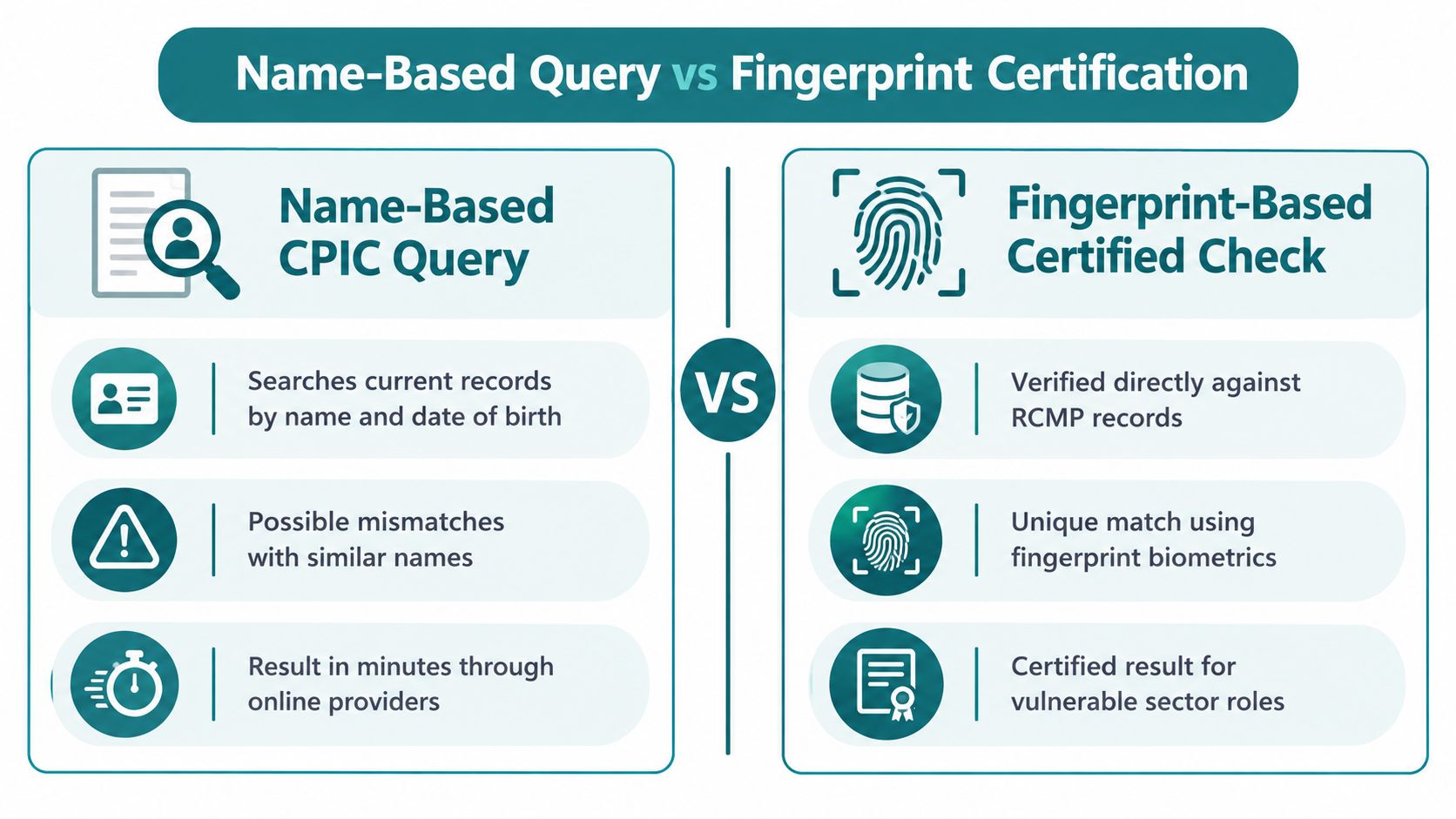
A name and date-of-birth search is useful for initial screening, but it doesn't positively identify the applicant. The RCMP describes name-based checks as CPIC checks, and explains that a possible match may require fingerprints to confirm identity. That difference is central to regulated hiring.
A name-based query compares identifying details against available records. If the applicant's name and birth date resemble information in a record, the result may require review. Similar names, spelling variations, incomplete information, or identity changes can create ambiguity. The search can indicate that further investigation is necessary, but a possible match isn't proof that the candidate has a criminal record.
What fingerprints change
A fingerprint-based certified check compares the applicant's biometric identifiers with the RCMP and CCRTIS National Repository of Criminal Records. The RCMP's description of how personal information is used distinguishes this higher-assurance process from a name-based screening query.
For HR, fingerprinting solves a specific problem: identity ambiguity. It doesn't make the hiring decision for you, and it doesn't remove the need for consent or human rights compliance. It does provide stronger evidence that a record belongs, or doesn't belong, to the applicant.
The workflow generally looks like this:
- Name-based screening: The provider submits identifying information and receives a result that may be clear or may require follow-up.
- Possible match review: The provider or police service determines whether more information is required.
- Fingerprint submission: The candidate attends an accredited provider or authorised location and submits electronic fingerprints.
- Repository search: The fingerprints are transmitted electronically to CCRTIS for comparison against the national repository.
- Certified result: The issuing process produces the relevant check output for the employer's documented screening purpose.
A name-based result answers, “Is there a record that may correspond to these details?” Fingerprint certification answers, “Does this record belong to this person?”
This distinction matters especially in federal personnel security screening and other regulated contexts. Public Services and Procurement Canada states that the RCMP retired the older name-check process for personnel security screening in favour of a criminal record check requiring electronic fingerprints. The result and document control number remain valid for 1 year from the fingerprint date, as explained in the federal electronic fingerprinting process.
The trade-off is friction. Fingerprints require candidate coordination and an appointment, while a name-based check can be easier to initiate. For a low-risk role, starting with a name-based check may be operationally sensible. For a federal contract, identity-sensitive position, or role where a possible match would cause serious disruption, collecting fingerprints at the outset can prevent a second screening cycle.
Navigating Consent and Privacy Compliance
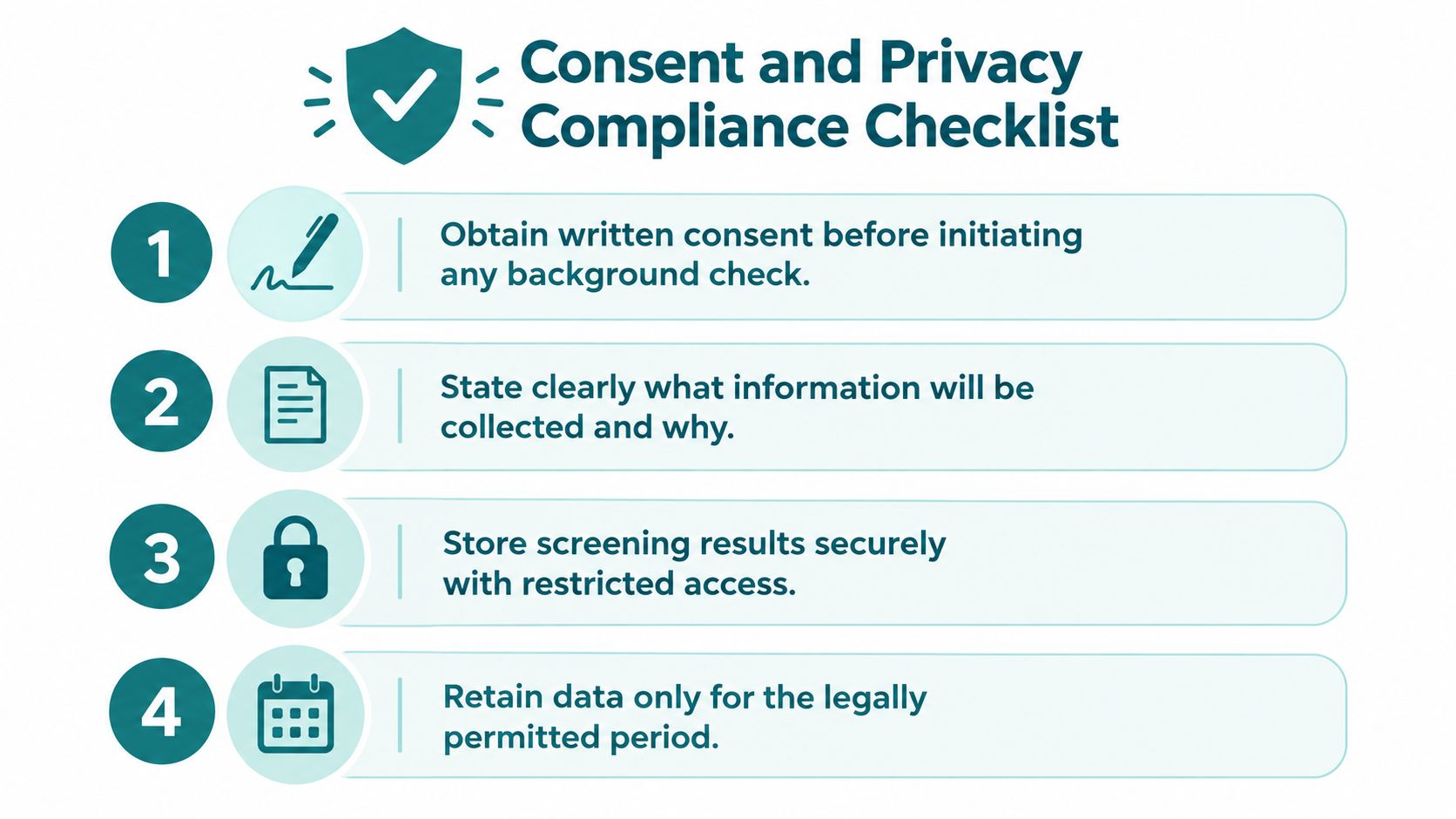
A candidate signs a consent form, but the hiring team still needs a controlled process. Consent should explain what information the employer will collect, why the position requires it, how the result will be used, and who may access it. Under PIPEDA and applicable provincial privacy legislation, those details should be clear and specific rather than buried in a general application form.
The check type also needs to match the documented purpose. A name-based CPIC query may be appropriate for an initial, lower-risk review, while a fingerprint-based certified check provides stronger identity assurance for regulated or identity-sensitive roles. Consent authorises the search, but it does not turn an unsuitable check into a compliant one.
Employers should collect only role-related information, restrict access, protect reports from unnecessary circulation, and define when records will be destroyed. Rules differ between provincial public-sector and private-sector organisations, so a national employer should map its workflow to each jurisdiction instead of applying one policy everywhere.
A practical consent sequence
- Explain the purpose before collection. Identify the check being requested and connect it to the position.
- Obtain informed consent. Use clear written authorisation before starting the search.
- Verify identity appropriately. Apply proportionate controls and move to fingerprints when the role or check requires positive identification.
- Limit internal access. Keep the report in a restricted HR or screening system, not broadly accessible recruitment files.
- Document the decision. Record the check type, consent, result status, review steps, and employment decision.
- Retain only as long as justified. Follow applicable privacy, employment, contractual, and records-management requirements.
VSC requests require extra care
A VSC cannot be ordered solely because a candidate agrees. Employers should provide the organisation's formal request and role information rather than telling candidates to obtain a VSC independently. That approach can send the candidate to the wrong police jurisdiction and create a result that does not meet the screening requirement.
A documented Canadian screening compliance workflow can help HR teams standardise consent, identity verification, access controls, and exception handling. It does not replace legal advice, but it makes the process easier to audit and explain.
Integrating Screening into a Frictionless Hiring Workflow
Screening works best when it starts after the employer has identified the preferred candidate and completed the role-based assessment. Waiting until a new hire is due to start, however, creates avoidable pressure. The candidate may need fingerprints, additional identity documents, or clarification of a possible match, and those steps can take longer than a standard digital intake.
Build screening into the hiring sequence as a visible, predictable stage:
- Set the scope early: Decide whether the position needs a CRC, CRJMC, VSC, or fingerprint-certified check before sending the candidate an invitation.
- Use digital intake: Let the candidate provide consent and identity details through a mobile-friendly workflow rather than exchanging sensitive documents through ordinary email.
- Give clear instructions: Explain what happens next, especially if fingerprints or a local police service are involved.
- Separate status from judgement: A “review” status means HR must investigate, not that the candidate has been rejected.
- Keep the hiring team informed: Share only the status and decision-relevant information with managers who need it.
Speed and assurance need a deliberate balance
Fast processing is valuable, but speed doesn't justify selecting a weaker check for a role that needs positive identity assurance. Conversely, requiring fingerprints for every position can add unnecessary candidate effort and slow hiring without improving the decision.
The right workflow uses automation for routine steps and human review for exceptions. A provider can collect consent, validate required fields, track candidate progress, and route possible matches for controlled follow-up. HR should still make the employment decision using documented, role-relevant criteria.
Canadian data residency can also matter to procurement, security, and privacy teams. A vendor's storage location, subprocessors, access model, and deletion process should be part of supplier due diligence. Alero Background & Identity, for example, offers criminal record checks, identity verification, and HRIS or ATS integrations with applicant data stored on Canadian servers. Employers can review screening integration options alongside their own security and privacy requirements.
The candidate experience is part of compliance in practice. Plain-language instructions, mobile access, transparent status updates, and a clear contact path reduce confusion and make it less likely that a candidate abandons the process or sends sensitive information through an unsafe channel.
Building a Compliant and Efficient Screening Strategy
A workable Canadian screening programme begins with the job, not the vendor catalogue. For every position, document the duties, access, authority, population served, regulatory expectations, and consequences of an identity error. Then select the narrowest check that addresses the documented risk.
Audit the policy using these questions:
- Is the check role-specific? Can you explain why this position needs a CRC, CRJMC, VSC, or fingerprint-based check?
- Is the request authorised? Confirm that the organisation, police service, and provider each have the proper role in the workflow.
- Is consent specific? The candidate should understand the information collected and the purpose of collection.
- Is identity assurance sufficient? A name-based CPIC query may be appropriate for one role but inadequate where positive identification is required.
- Is the result interpreted fairly? A record should trigger a structured, job-related review rather than an automatic rejection.
- Is the process documented? Keep evidence of consent, check type, review, communication, and decision rationale.
What effective programmes do differently
Effective teams don't treat “clear” as the only acceptable outcome. They distinguish a clear result from a possible match, incomplete identity information, candidate dispute, or result requiring police-service follow-up. That status discipline prevents managers from making decisions based on an ambiguous screening output.
They also avoid asking for more information than the role requires. Over-collection increases privacy exposure and can create inconsistent treatment between candidates. Under-screening creates a different risk, especially when a regulated client, government contract, or vulnerable population requires a particular identity or record-check standard.
Use a provider as workflow infrastructure
A screening partner should make the process easier to control, not obscure it. Look for clear report statuses, Canadian data handling, documented consent, secure candidate intake, integration with the systems your recruiters already use, and human support when a result doesn't fit a standard path.
Review the programme periodically. Changes in job duties, client contracts, provincial requirements, police-service procedures, or internal data-retention rules can make an old screening policy unsuitable. HR, privacy, security, and legal stakeholders should know who owns each part of the process.
The practical conclusion is straightforward: choose the check that proves what the role requires, confirm the applicant's identity at the appropriate level, and treat every result as protected personal information. That combination supports defensible decisions without turning screening into an unnecessary barrier.
Alero Background & Identity provides Canadian criminal record checks, identity verification, consent-led screening workflows, and HRIS or ATS integrations for employers that need a more organised process. Visit Alero Background & Identity to review options for matching check type, identity assurance, privacy controls, and candidate experience to your hiring needs.