You're hiring for a role that looks routine on paper, maybe an administrator, coordinator, or office assistant, and someone on the team says, “Let's get the most complete background check we can.” That instinct is common, but in Canada it can create the wrong kind of risk. A criminal record check is not a single universal report, and asking for more data than the job calls for can pull in information you didn't need, shouldn't have collected, or can't use safely.
In Canadian screening, the central question isn't whether a person is “clear” in some absolute sense. It's what does a criminal record check show for this job, in this jurisdiction, under this legal purpose. The answer depends on the check level, who is requesting it, and how the result is disclosed under Canadian privacy and human rights rules. For employers, the safer approach is usually narrower, not broader, because data minimization is a compliance tool, not just a privacy slogan.
Table of Contents
- Why Screening Depth Must Match the Role
- Understanding the Three Tiers of Police Record Checks
- Specific Findings Revealed at Each Screening Level
- The Compliance Risks of Over-Screening Candidates
- Interpreting Results and Managing Fingerprint Requests
- Streamlining Workflows with a Canadian Screening Partner
Why Screening Depth Must Match the Role
A hiring manager may want the widest possible check for a bookkeeper, a receptionist, or a driver because it feels safer. In practice, that can create more privacy exposure than risk reduction. A request that reaches beyond the duties of the role can collect sensitive information the employer does not need and may not have a clear basis to use.
Canadian criminal record checks are meant to show whether a person has relevant criminal history, but the result depends on the level of check ordered. The RCMP describes these checks as searches against the national repository of criminal records RCMP criminal record checks, so the report you receive is shaped by the check level and the legal scope of the request. That distinction matters in day-to-day hiring, because the same applicant can produce different disclosures depending on the position and the screening authority.
For HR teams, the safer approach is to match the depth of screening to the actual job risk. A receptionist, a delivery driver, a school volunteer, and a finance manager do not justify the same request. PIPEDA, provincial privacy laws, and human rights obligations all point toward collecting only what is needed for a lawful, job-related purpose.
Practical rule: if you cannot explain why a particular check level is tied to the duties of the role, do not order it.
A record in one search is not an automatic disqualification, and a clean result at one level is not a full clearance. Canadian screening is tiered, so the decision still turns on the role and the disclosure rules.
Understanding the Three Tiers of Police Record Checks
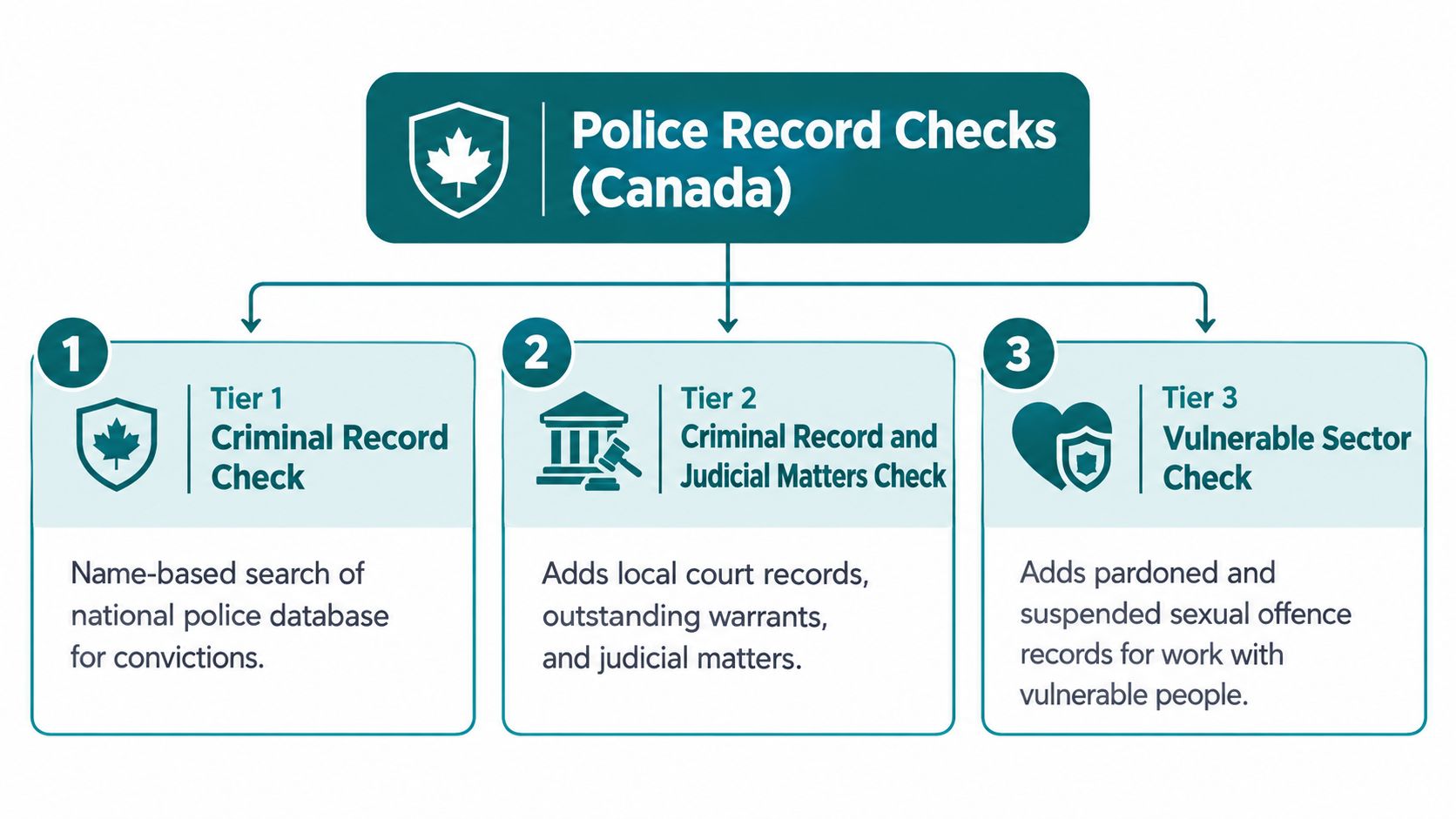
Canadian screening works best when the check level matches the job risk. Order too much, and you create privacy exposure and extra compliance work without adding much hiring value. Order too little, and you may miss information that matters to the role.
Criminal Record Check
A Criminal Record Check is the basic tier. Ontario's guidance says it covers applicable criminal convictions and Youth Criminal Justice Act findings of guilt Ontario police record checks. Toronto Police describes its Level 1 check as indicating whether an applicant has criminal convictions in the RCMP national repository Toronto Police criminal record check.
Use this level for roles where the hiring question is straightforward, for example many office, administrative, customer service, or general labour positions. It fits jobs that do not involve direct authority over vulnerable people and do not need deeper judicial information.
Criminal Record and Judicial Matters Check
The Criminal Record and Judicial Matters Check is the middle tier. Ontario's guidance adds outstanding charges, arrest warrants, and certain judicial orders at this level, which is why York Regional Police positions it as the middle option York Regional Police CRJMC.
This level is useful for board members, administrative staff, contractors, and people working in schools, hospitals, or care facilities who are not in a position of trust over vulnerable persons. It gives hiring teams more decision-relevant context without jumping to the most sensitive screen.
Vulnerable Sector Check
A Vulnerable Sector Check is reserved for positions of trust or authority over children or vulnerable persons. The RCMP says the hiring organization must request it, the applicant gives consent but does not make the request, and the request has to be tied to that kind of role RCMP vulnerable sector checks.
A vulnerable sector check serves a different legal purpose from a regular check, and ordering it outside a position of trust is hard to justify. If the job does not involve vulnerable people, asking for one adds privacy risk and weakens your compliance position.
Alero Background & Identity's criminal record check service fits this tiered model, which is how Canadian employers should approach screening.
Specific Findings Revealed at Each Screening Level
The useful question is not what each tier is called, but what a hiring manager will see on the report. The table below consolidates Ontario's disclosure guidance Ontario police record checks.
What a basic check can show
A basic Criminal Record Check usually shows convictions and Youth Criminal Justice Act findings of guilt. In practice, a report can show more than many employers expect when the request was ordered at a higher level or the jurisdiction's disclosure rules allow it. That is why the label on the form should never be treated as the full story.
What a middle-tier check adds
The Criminal Record and Judicial Matters Check adds outstanding charges, arrest warrants, and certain judicial orders. For a hiring team, that matters when unresolved court matters affect reliability, attendance, or access to sensitive work, but the role still does not call for the most sensitive level of screening.
What the vulnerable sector check can add
Ontario's guidance says a Vulnerable Sector Check can add NCRMD findings, eligible record suspensions related to sex offences, and, in limited cases, non-conviction information when the strict test is met. That is a major jump in sensitivity, so the request has to match a real position of trust or authority over vulnerable people.
The table below is the practical readout:
| Data Point | Basic CRC | Judicial Matters | Vulnerable Sector |
|---|---|---|---|
| Criminal convictions | Yes | Yes | Yes |
| Youth findings of guilt | Yes | Yes | Yes |
| Outstanding charges | No | Yes | Yes |
| Arrest warrants | No | Yes | Yes |
| Court orders | No | Yes | Yes |
| NCRMD findings | No | No | Yes |
| Eligible record suspensions for sex offences | No | No | Yes |
| Non-conviction information in limited cases | No | No | Yes |
In practice, a report can also show more than employers expect when the request is made at a higher disclosure level or the local rules permit it. That is why screening decisions should stay tied to the job, not to a habit of asking for maximum visibility.
A final report needs careful reading. Treat Clear as “nothing disclosed at this level,” not “the person has no history anywhere.” Treat Review as a prompt to confirm the result, the identity match, and the job relevance before any hiring decision is made.
The Compliance Risks of Over-Screening Candidates
The safest hiring move isn't always the most aggressive one. Over-screening can create a bigger compliance problem than the one it was supposed to prevent. If you ask for higher-sensitivity data on a low-risk role, you increase the amount of information you collect, the number of people who may see it, and the chance that a decision will drift away from what the job requires.
That's where privacy and human rights issues collide. Under Canadian privacy principles, unnecessary collection is hard to defend. Under human rights rules, overreaching can look like a shortcut to exclusion, especially if the record has little connection to the duties of the role. If you need a practical framing for this, keep the question narrow: what facts do I need to assess this job safely and fairly?
A common error is to treat the most complete check as a default. That can delay hiring, trigger unnecessary candidate concern, and expose the employer to complaints if the information collected goes beyond the role. A better approach is to define the risk first, then pick the least intrusive check that still answers the hiring question.
Compliance mindset: ask for the smallest lawful set of data that still lets you make a sound hiring decision.
For policy design, job descriptions matter. If the duties don't involve trust over vulnerable people, don't write screening rules as if they do. If the role doesn't involve court-sensitive responsibilities, a middle-tier or basic check is usually the more defensible option. You can align the intake form, consent language, and internal adjudication process around that narrower scope, which lowers privacy exposure and makes the candidate experience cleaner.
If you need a framework for the consent side of this, Alero's overview of PIPEDA and background checks is a good reference point for Canadian employers trying to keep screening lawful and proportionate.
Interpreting Results and Managing Fingerprint Requests
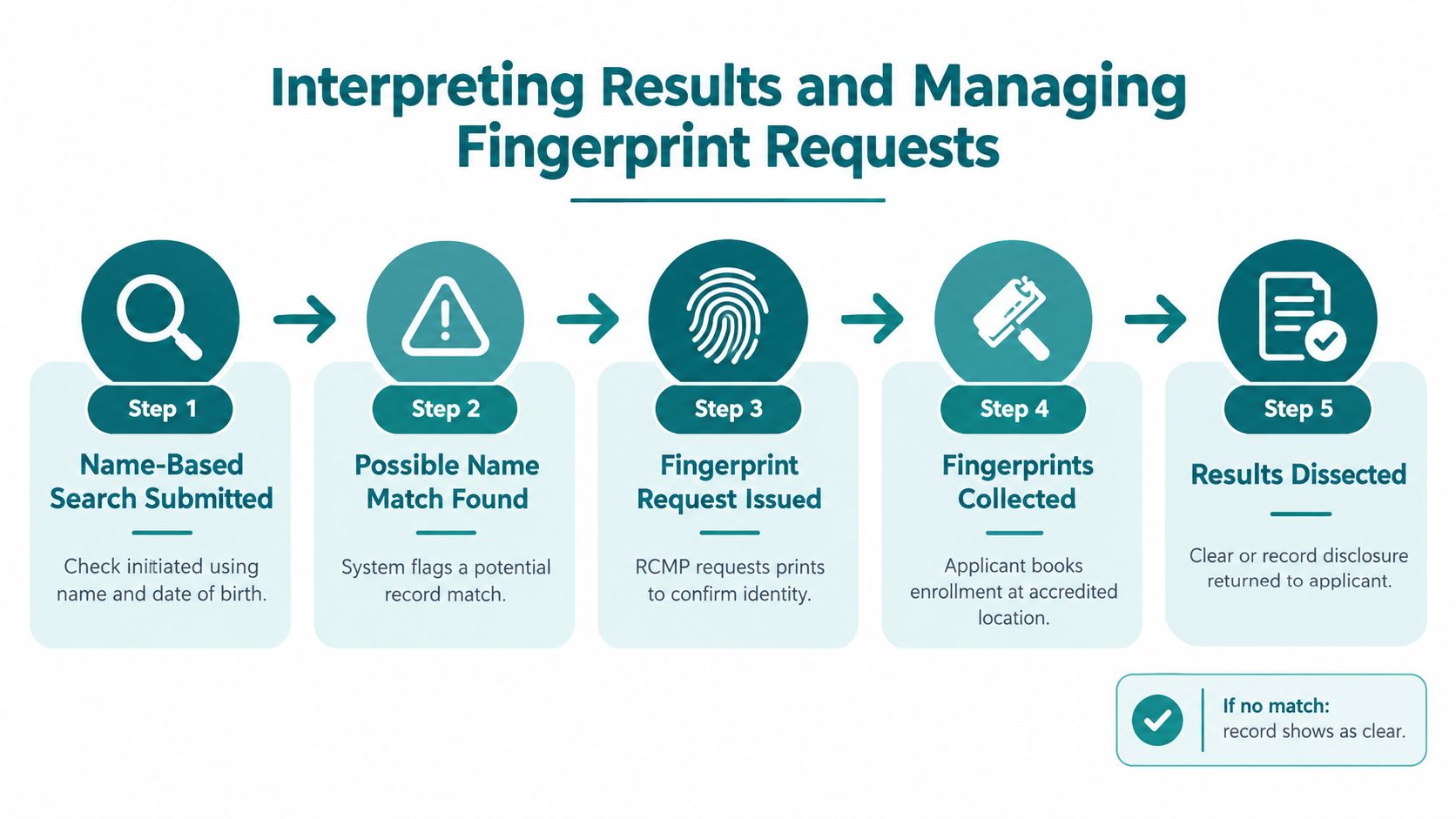
A name-based check is often fast, but it doesn't end the conversation if the system flags a possible match. The RCMP explains that if a name-based search can't confirm identity, fingerprints may be required because they're the most accurate way to verify the person matched to the record RCMP criminal record checks. That's a normal part of the process, not a sign that something is wrong.
A workable workflow
- Submit the name-based check. Start with the least invasive request that matches the role.
- Watch for a possible match. If the report flags one, don't jump to conclusions.
- Request fingerprints if needed. The police or RCMP use them to confirm identity.
- Collect the prints through the proper channel. Keep the candidate informed about the next step and timing.
- Read the final disclosure carefully. Separate identity confirmation from hiring relevance.
If there's no match, the report may come back clear at that level. If there is a match, the point is to confirm the identity, then assess whether the information disclosed is relevant to the job. That's where employers need discipline.
A practical note on adverse findings: don't make an automatic decision in the moment. Canadian hiring decisions should be individualized, especially when the result could affect a conditional offer. You want to look at the nature of the finding, how old it is, and how closely it relates to the duties of the role before acting on it.
For teams that want a more structured identity workflow, Alero's biometric hiring guidance is relevant because it helps reduce misidentification before a screening issue turns into an HR decision.
Streamlining Workflows with a Canadian Screening Partner
The screening process works best when the partner understands Canadian rules as a design constraint, not a post-check correction. That means consent flows should be clear, the request should match the role, and the reporting should be easy for HR to interpret without guesswork. It also means keeping applicant data within Canada and avoiding sloppy handoffs between systems.
A well-run screening platform should make the candidate experience easier, not harder. Mobile-friendly intake helps people complete the process without chasing paper forms or re-entering details. Clear status labels like Clear or Review reduce confusion for hiring managers, which matters when you're trying to move a candidate through the process without unnecessary back-and-forth.
Speed matters too, but only if it doesn't compromise the legal scope of the check. In Canadian hiring, the goal is usually a quick result on the correct screening type, not a broad report that creates more questions than it answers. The right partner should also fit cleanly into your HRIS or ATS, so compliance steps happen inside the workflow instead of being managed in separate spreadsheets and email chains.
If you're evaluating vendors, keep it practical:
- Consent and privacy handling
- Canadian data residency
- Role-appropriate screening levels
- Plain-language reporting
- Integration with HR systems
- Support for exceptions and follow-up questions
Alero Background & Identity is one Canadian option that supports criminal record checks, identity verification, and HR workflow integration for employers that need screening aligned with Canadian privacy and hiring requirements.
If you want a screening process that matches Canadian legal boundaries without slowing hiring down, Alero Background & Identity can help you order the right check level, interpret the result correctly, and keep candidate data handled in a way that fits your compliance obligations. Visit the site to review screening options and build a workflow that's accurate, faster, and easier for candidates to complete.