You've probably seen this happen already. A candidate is ready, the manager wants a start date, and the file stalls because someone sent the person to the wrong police service, missed the employer letter, or assumed a vulnerable sector check in Newfoundland and Labrador works like a standard online background screen. In NL, those small routing mistakes can cost days, sometimes much longer, because the process is tied to local policing jurisdiction, not a generic national portal.
That's why vulnerable sector check NL workflows trip up even experienced HR teams. The check isn't just a form to fill out. It's a police-issued screening process that can move from a name-based review to fingerprint verification when identity details overlap with pardoned sex-offence records, and in Newfoundland and Labrador the employer has to get the routing right from the start. The Royal Newfoundland Constabulary's public process includes a dedicated Criminal Record Screening and Vulnerable Sector Certificate service, while province-facing guidance points applicants to the municipality where they live, not where the job happens to be.
Practical rule: if the candidate starts with the wrong detachment or the wrong portal, treat the file as if it were starting over.
There's also a second layer HR teams miss. Some regulators are changing their own screening rules, which means a role that clearly needed a vulnerable sector check last year might now call for a different combination of checks. In regulated hiring, assuming the old pattern still applies is one of the fastest ways to create rework.
Table of Contents
- Why NL Vulnerable Sector Checks Trip Up Even Experienced HR Teams
- What a Vulnerable Sector Check Actually Includes in NL
- RNC vs RCMP and Where the Split Actually Happens
- Who Qualifies for a Vulnerable Sector Check Under the Criminal Records Act
- Step by Step NL Vulnerable Sector Check Application Process
- Processing Times Fingerprint Escalations and Where Delays Hide
- Common Mistakes That Reject NL Vulnerable Sector Applications
- Putting It Together A Practical NL VSC Workflow
Why NL Vulnerable Sector Checks Trip Up Even Experienced HR Teams
A St. John's candidate applies for a youth-care role and gets told to use the RCMP route because their postal code looks rural on a form. Days later, the file gets rerouted because the address sits in an area handled by the Royal Newfoundland Constabulary, and the candidate now has to resubmit, rebook, and wait for identity verification all over again. That kind of mistake is exactly how onboarding slips, especially when the hire is urgent and the manager is already counting on a start date.
The core problem is that many national screening teams treat Newfoundland and Labrador like a single-channel province. It isn't. The RNC and RCMP split changes who receives the application, how the request is submitted, and whether the candidate can finish in one pass or gets pushed into a fingerprint appointment later. The RCMP's own guidance says the vulnerable sector process is jurisdiction-bound and tied to the police agency or authorised local body where the applicant lives, not where the employer is located.
Why the delay shows up late
The biggest frustration is that the failure usually appears after work has already been done. The candidate may have completed one set of forms, the employer may have drafted a letter, and then the police service says the request has to be filed elsewhere. By the time the error is discovered, the candidate is already disengaged or the manager has started asking why a “simple check” is taking so long.
That's why the operational gap matters more than the legal definition. In NL, the right workflow depends on address routing, jurisdiction, and whether the role really qualifies for a vulnerable sector search under the Criminal Records Act. If any one of those is off, the file slows down.
The check fails less often because of the candidate and more often because the employer's intake process wasn't built for NL's policing map.
What a Vulnerable Sector Check Actually Includes in NL
A vulnerable sector check in Newfoundland and Labrador is not just a standard criminal record check with a different label. Federal RCMP guidance describes it as a police information check plus a search for record suspensions, also called pardons, for sexual offences, with the national policy noting that vulnerable sector verifications were created in 2000 under paragraph 6.3(3) of the Criminal Records Act. The applicant may also have to provide fingerprints if the name-based search is incomplete because of a possible match to the pardoned or suspended sex-offender databank. See the RCMP's explanation of vulnerable sector checks and the related federal policy on criminal record background checks and vulnerable sector pardons.
For NL employers, the result is a police disclosure, not a narrative report. Police services do not hand over fingerprints or offence files to the employer. The employer gets the check result in the format the police service uses, typically a letter stating whether the search returned relevant information, not a detailed case file. That matters because managers often expect more detail than the law allows.
CRC, VSC, and CRJMC are not the same thing
A basic criminal record check looks for standard criminal history information. A vulnerable sector check adds the pardoned-sex-offence search and, where authorised, local police information. A Criminal Record and Judicial Matters Check is a separate product with its own scope and disclosure rules, and the RCMP now issues criminal record checks in three levels. Don't swap one for another just because a job posting says “background check.”
| Screening Type | Records Searched | Includes Pardoned Sex Offences | NL Employer Receives |
|---|---|---|---|
| Vulnerable Sector Check | Criminal record search plus authorised vulnerable-sector review | Yes | Police-issued result letter, not narrative detail |
| Criminal Record Check | Standard criminal history search | No | Police-issued result letter |
| Criminal Record and Judicial Matters Check | Broader RCMP check category with judicial matters scope | No, not as a VSC does | Police-issued result letter |
If your team needs a broader refresher on national check types, keep this Canadian criminal record checks guide handy. The key point for NL is simple, the VSC is a narrower legal tool than many employers assume, but it goes deeper on the one risk dimension that matters for trust-based roles.
RNC vs RCMP and Where the Split Actually Happens
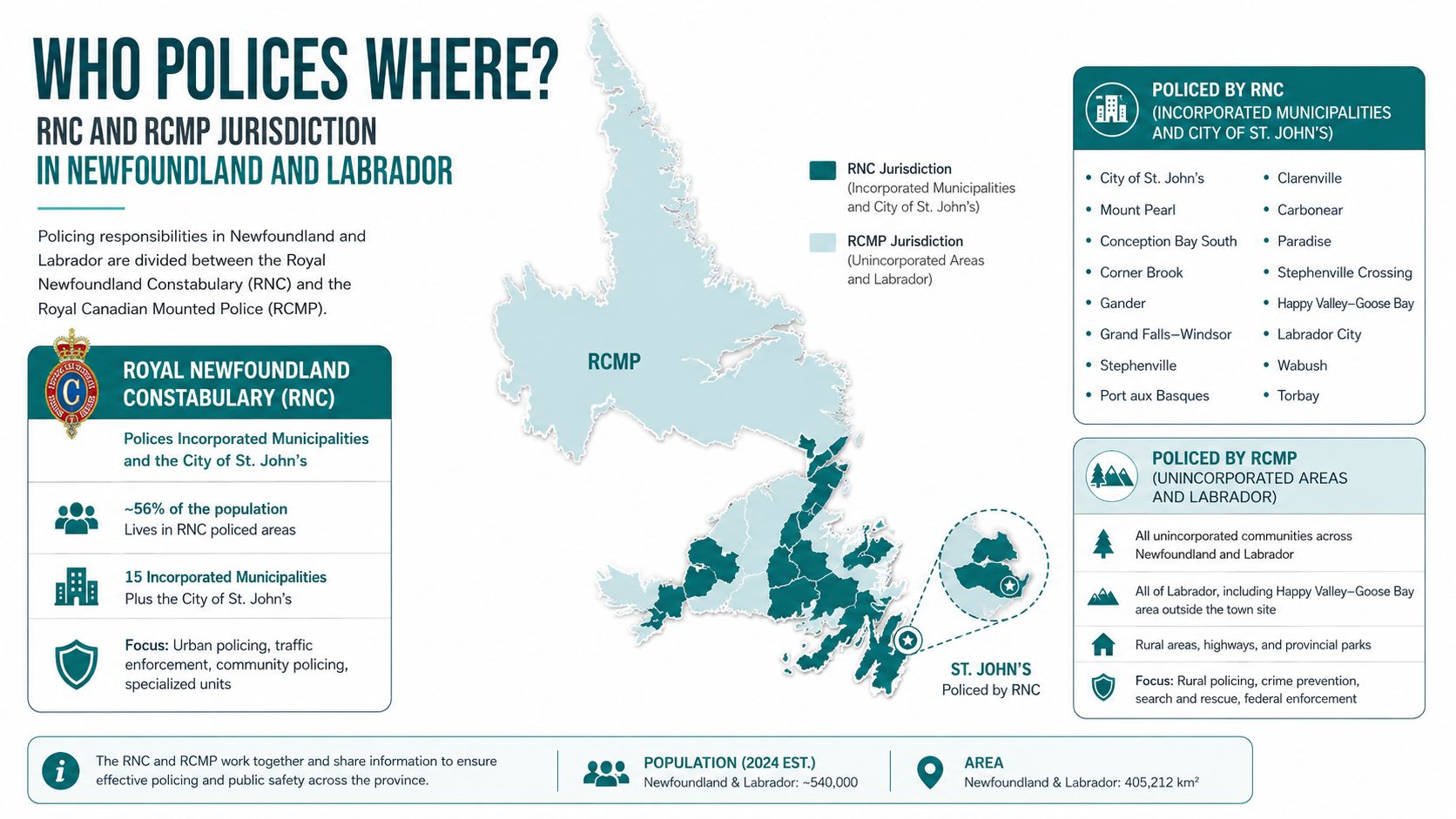
Newfoundland and Labrador screening breaks at the municipal border, not at the province line. The Royal Newfoundland Constabulary polices St. John's, Mount Pearl, Conception Bay South, and Corner Brook, while the RCMP covers the rest of the province through detachments in places such as Gander, Grand Falls-Windsor, Carbonear, Clarenville, Happy Valley-Goose Bay, and Labrador City. If the candidate lives in an RNC municipality and files through an RCMP route, or the reverse, the file doesn't just slow down, it can come back rejected after the candidate has already waited.
Why third-party platforms hit a wall
National screening vendors often overpromise. They can help organise the workflow, but they can't complete the vulnerable sector check directly under RCMP rules because the candidate has to authorise the request with the police body that has jurisdiction over the home address. In practice, the platform can route, prepare, and track, but it can't replace the local police service.
The RNC also runs its own records process and accepts applications through its online service, while RCMP detachments rely on local submission processes and, where required, detachment-specific fingerprint scheduling. That difference sounds small until a candidate in a remote community is told to attend a specific appointment window and the nearest biometric slot is not next week, but much later.
For employers, the split means the candidate's municipality of residence is the first decision point. Job location matters for hiring, but it doesn't decide which police service processes the check. Address does.
Who Qualifies for a Vulnerable Sector Check Under the Criminal Records Act
The legal test matters more than the job title. Under the Criminal Records Act, a vulnerable sector search is for roles involving contact with vulnerable persons, and the employer has to explain the authority and the trust relationship that makes the check necessary. A title like “assistant” or “co-ordinator” doesn't automatically qualify. The request has to match a real duty of care.
That usually includes roles such as child and youth workers, teachers, coaches, healthcare aides, social workers, shelter staff, and long-term care employees. The common thread is direct or regular access to children, vulnerable adults, or both. If the position doesn't have that access, a VSC may be improper even if the workplace itself serves vulnerable people.
The CLPNNL shift is the cautionary example
The most useful recent warning for HR teams in NL is the College of Licensed Practical Nurses of Newfoundland and Labrador decision effective December 1, 2025, which removed the vulnerable sector check requirement for certain licensure pathways and kept only a criminal record check. That change matters because it proves sector rules can narrow even when a role still feels “care related” on paper.
If you're screening nursing applicants, check the current regulator requirement before sending a VSC request. A mismatched request can come back for re-submission, which burns time and usually creates a second round of candidate follow-up. For schools and hospitals, even volunteer or probationary roles can still qualify if the actual duties meet the Criminal Records Act test, so don't assume unpaid means non-eligible.
| Role Category | VSC Required? | Rationale | Common NL Setting |
|---|---|---|---|
| Direct care with vulnerable persons | Usually yes | Regular trust-based contact | Schools, home care, shelters |
| Regulated nursing pathway after policy change | Not always | Some licensure routes now require a CRC only | LPN registration |
| Administrative role with no vulnerable contact | Usually no | No authority or trust relationship | Back office, scheduling |
| Volunteer role with direct contact | Often yes | Duty of care can still exist without pay | School volunteers, hospital volunteers |
Step by Step NL Vulnerable Sector Check Application Process
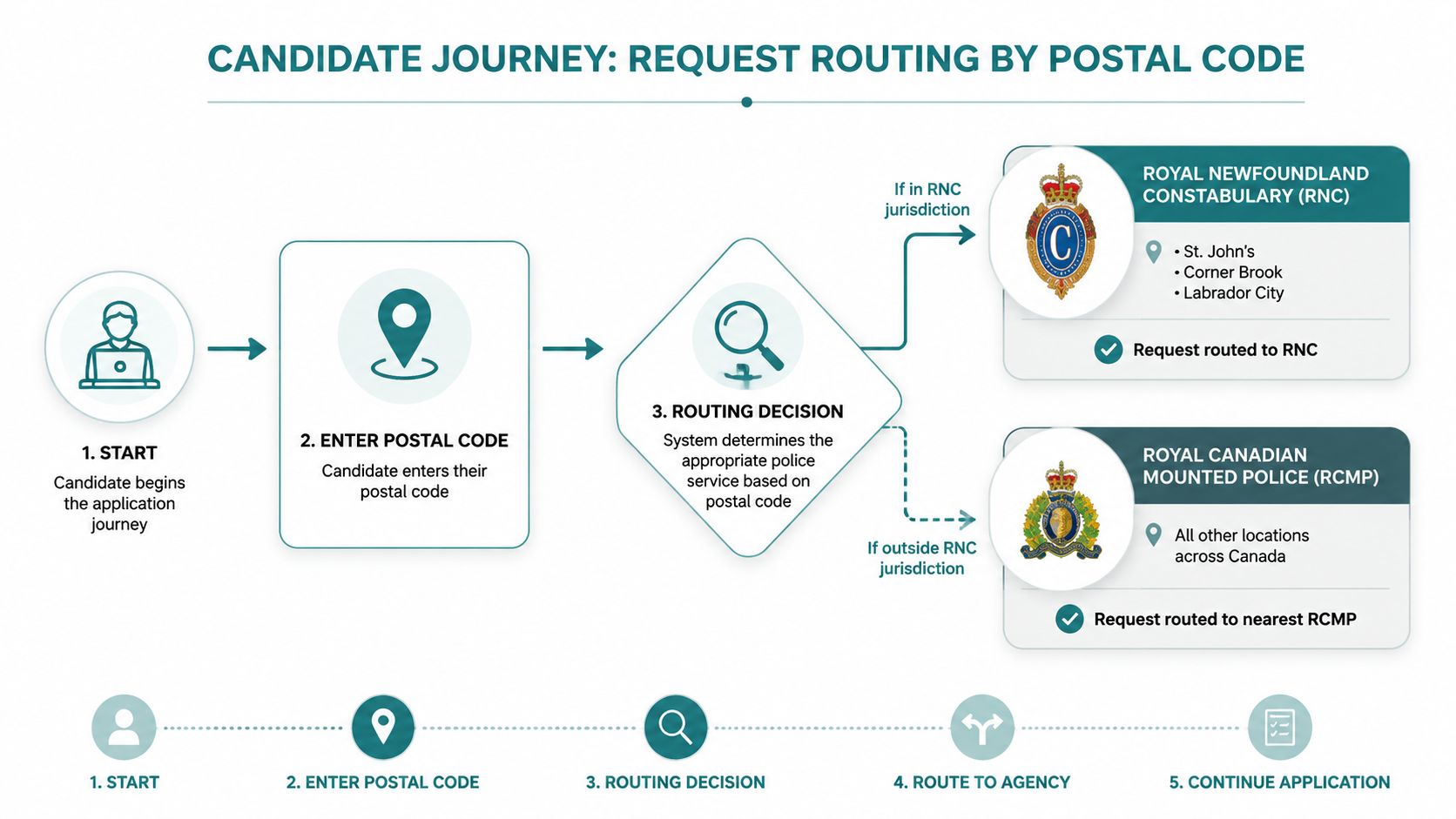
The cleanest NL files start with routing, not paperwork. The candidate's postal code determines whether the request goes to the RNC or to the correct RCMP detachment, and that should be locked in before anyone submits a form. If the employer guesses wrong, the rest of the file is built on sand.
The sequence that actually works
Employer letter first. The employer issues a signed letter on company letterhead naming the candidate, the position, and the vulnerable-sector justification under the Criminal Records Act. This is the most common intake failure point, and skipping it is the fastest way to get rejected.
Candidate consent and submission. The candidate completes the relevant consent form, either through the RNC online portal or by submitting the RCMP form at the proper detachment.
Identity check. Two pieces of government ID are presented, and the applicable fee is paid. If the identity details don't line up cleanly, expect delays.
Fingerprint escalation only if needed. If the name-based search suggests a possible match, the applicant is scheduled for fingerprinting at the nearest RCMP fingerprint site or an accredited private livescan provider where available.
Result returns to the candidate. The completed check is mailed or couriered back to the candidate, who then forwards it to the employer.
For teams that want a repeatable intake path, a structured service model helps. Alero Background & Identity offers Canadian criminal record checks and vulnerable sector checks as part of a broader screening workflow, which can support the routing and tracking side of the process alongside the police-issued check itself. If you need a baseline reference for screening services, see Alero's criminal record checks service.
Processing Times Fingerprint Escalations and Where Delays Hide
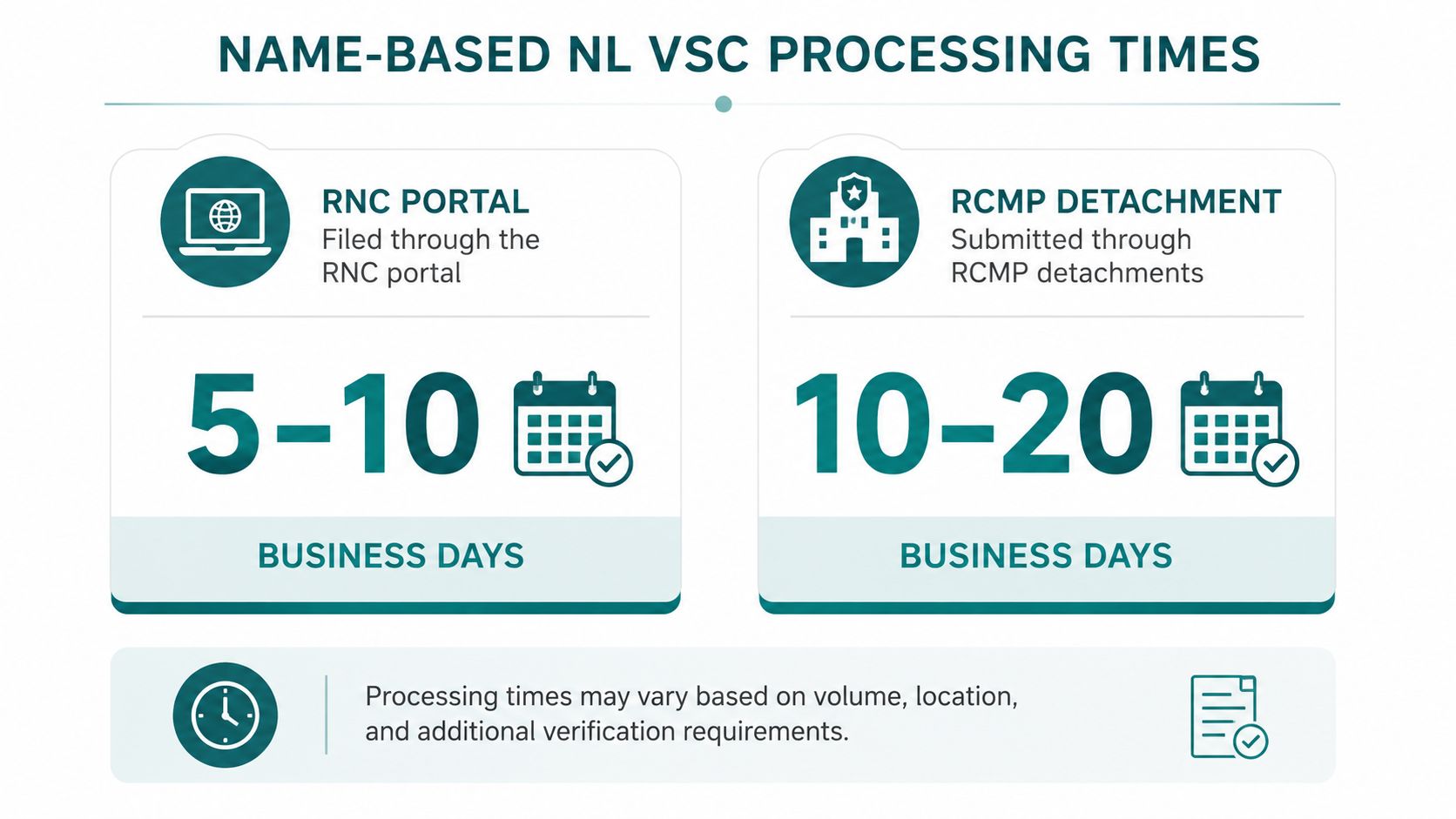
The fastest NL files are the ones that stay clean from intake to result. A name-based vulnerable sector check filed through the RNC portal typically comes back in about five to ten business days, while RCMP detachment submissions usually take about ten to twenty business days because the files move through the detachment and into the national repository in Ottawa. Once fingerprints are needed, the clock changes completely, and completion can stretch to eight to twelve weeks. These timeframes are best treated as operational benchmarks, not promises, because local capacity and file quality both matter.
The three main fingerprint triggers
Fingerprint escalation usually shows up for one of three reasons. The candidate has a common-name or near-match that needs biometric confirmation, a record suspension only resolves after fingerprint comparison, or the declared address doesn't match RCMP records cleanly enough for the check to proceed. Calgary Police also notes that a match on date of birth and gender can be enough to trigger fingerprinting, which is why false matches happen even when the name looks unusual to the employer.
Where HR can see delay coming
The most reliable delay signals are easier to track than most realise. Peak quarter-end hiring volume creates backlog, staffing shortages in coastal detachments slow intake, and incomplete employer letters force resubmission. If you're running a healthcare or education hiring cycle, monitor those three signals together and stop promising a five-day outcome for every file.
For a broader national comparison on turnaround, keep this background check timing guide bookmarked. The practical move is to give candidates a realistic start-date window before the check begins, not after the detachment has already asked for more information.
Common Mistakes That Reject NL Vulnerable Sector Applications
Most rejected NL files don't fail because the candidate is disqualified. They fail because the intake packet doesn't match the policing pathway. The usual culprits are simple, but they're still expensive.
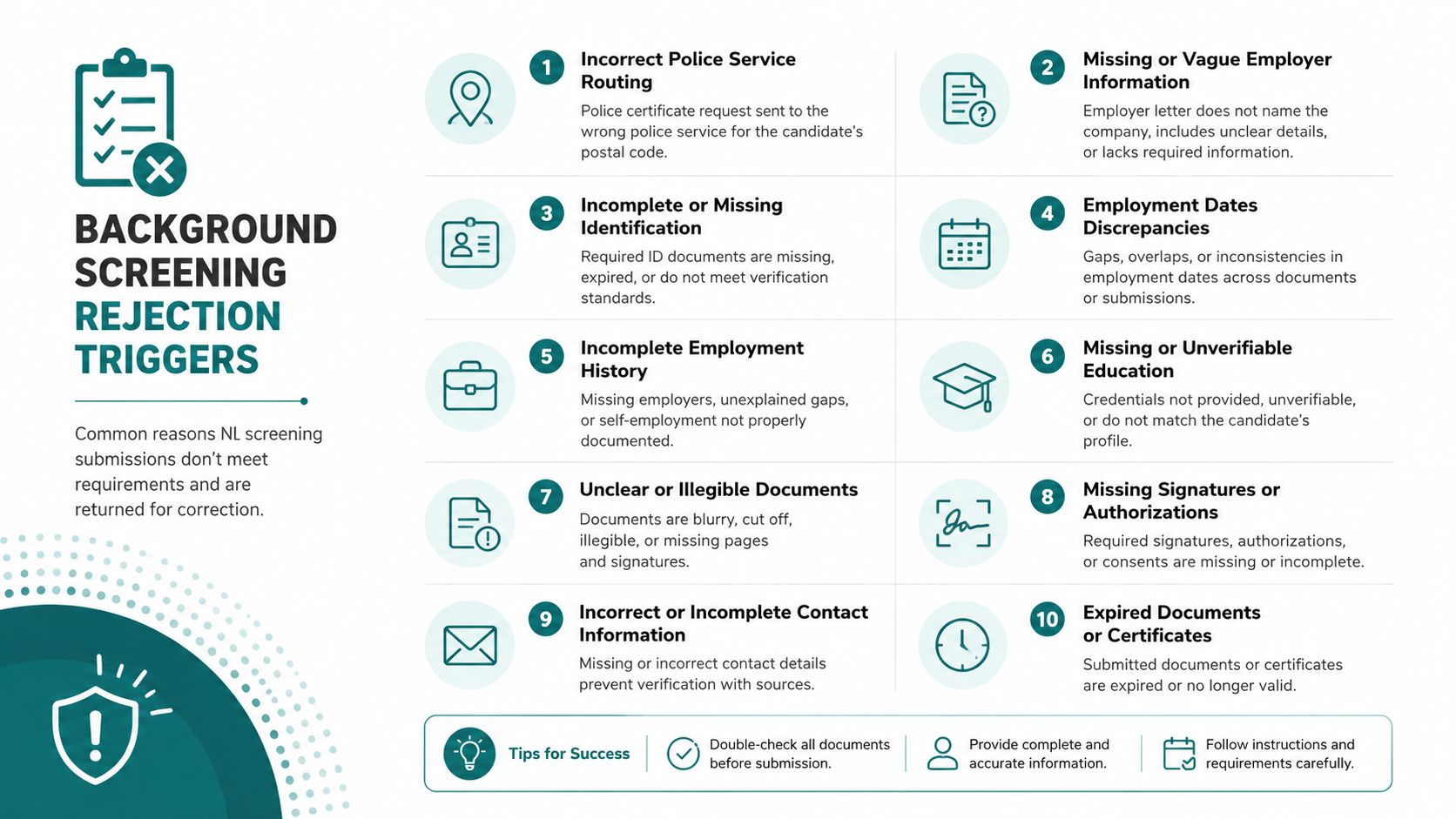
- Wrong police service routing: The candidate's municipality points to the RNC, but the file goes to an RCMP detachment, or the reverse.
- Missing employer letter: The check has no clear vulnerable-sector justification on company letterhead.
- Vague role description: The request says “support staff” instead of describing direct care or trust over vulnerable people.
- Unsigned consent: The police service won't proceed without the candidate's proper authorisation.
- Expired ID: Identification is no longer current when the applicant attends.
- Outdated role classification: The job no longer fits the current regulator or Criminal Records Act criteria.
The fix is process control, not more chasing. Use postal-code routing, a standard employer-letter template, and a pre-submission candidate checklist. For roles that sit near the line, review the classification every quarter so a regulatory change doesn't break your hiring workflow.
Putting It Together A Practical NL VSC Workflow
The clean workflow is straightforward. Confirm that the role qualifies under the Criminal Records Act, route the candidate by postal code to the RNC or the correct RCMP detachment, issue a role-specific employer letter, and only escalate to fingerprints if the name-based result creates a possible match. That sequence keeps the process legal and cuts avoidable rework.
Track routing accuracy, first-pass acceptance rate, and average days to result on every NL file. If those metrics are drifting, the problem is usually intake quality or jurisdiction handling, not candidate reluctance.
For HR teams, the best one-page SOP is the one that tells recruiters what to ask, tells candidates where to go, and tells managers what delay really means. Get that right, and Newfoundland and Labrador stops feeling like a special case.
If your team needs a cleaner way to route NL vulnerable sector checks, Alero Background & Identity can help with Canadian screening workflows, candidate guidance, and identity verification built for local compliance. Visit Alero Background & Identity to set up a process that sends candidates to the right police route the first time and keeps your hiring timeline moving.
Composed with the Outrank tool