There is no single Canada-wide vulnerable sector check fee. In Ontario, most police services charge between $35 and $75, and the exact amount depends on the jurisdiction and whether the application is for employment or volunteer purposes.
A hiring manager can discover this at the worst possible moment. The candidate has accepted the offer, the start date is approaching, and the police-service application shows a different charge from the amount used in the hiring budget. In another municipality, the check may have a volunteer exemption, while fingerprinting or federal processing may create a separate cost.
The practical answer is to treat the vulnerable sector check fee as a locally administered, purpose-based price stack, not a national rate. The amount can depend on the applicant's home jurisdiction, the role category, proof of volunteer or student status, and whether fingerprints are required.
That distinction matters for more than accounting. Clear fee instructions reduce candidate confusion, prevent onboarding delays, and help employers apply screening requirements consistently. A compliant process also starts with ordering the right type of check for the role, rather than requesting the most detailed screening automatically.
This guide explains when a VSC is appropriate, how published Ontario fees compare, why employment and volunteer charges differ, who should pay, and what HR teams should retain. It closes with a practical workflow for budgeting and communicating the cost without creating avoidable friction.
Table of Contents
- Introduction What to Expect From a Vulnerable Sector Check Fee
- Understanding Vulnerable Sector Checks and When They Are Required
- How Much a Vulnerable Sector Check Costs Across Canada
- Why Volunteer and Employment Fees Differ
- Who Should Pay and How to Handle Recordkeeping
- Next Steps for a Compliant and Candidate Friendly Screening Program
Introduction What to Expect From a Vulnerable Sector Check Fee
A hiring manager has a candidate ready to start, but the police-service application shows a different vulnerable sector check fee than the amount in the hiring budget. The difference may come from the candidate's local jurisdiction, the role's purpose, volunteer or student status, or an added fingerprinting requirement.
The fee is best understood as a locally administered, purpose-based price stack, not a single Canadian rate. Ontario professional guidance explains that charges are not standardised across police services: Ontario social work guidance on vulnerable sector checks notes that the applicant's jurisdiction is the starting point for a reliable estimate.
Published schedules can vary sharply by service and purpose, as the comparison below shows. One applicant may qualify for a volunteer or student category, while another applying for paid employment may face a different charge. Fingerprinting or federal processing can add another layer when the police service cannot complete the search through a name-based application.
The practical rule is simple: confirm the local police service, the application purpose, the applicant's eligibility category, and any extra processing before quoting a price.
For HR teams, the useful budgeting question is not, “What does a vulnerable sector check cost?” Ask instead, “What will this applicant pay in this municipality for this purpose, and could fingerprinting create an additional charge?” Clear instructions help candidates prepare, reduce onboarding delays, and support consistent screening decisions. They also help employers request the check that matches the role rather than treating the most detailed screening as the default.
Understanding Vulnerable Sector Checks and When They Are Required
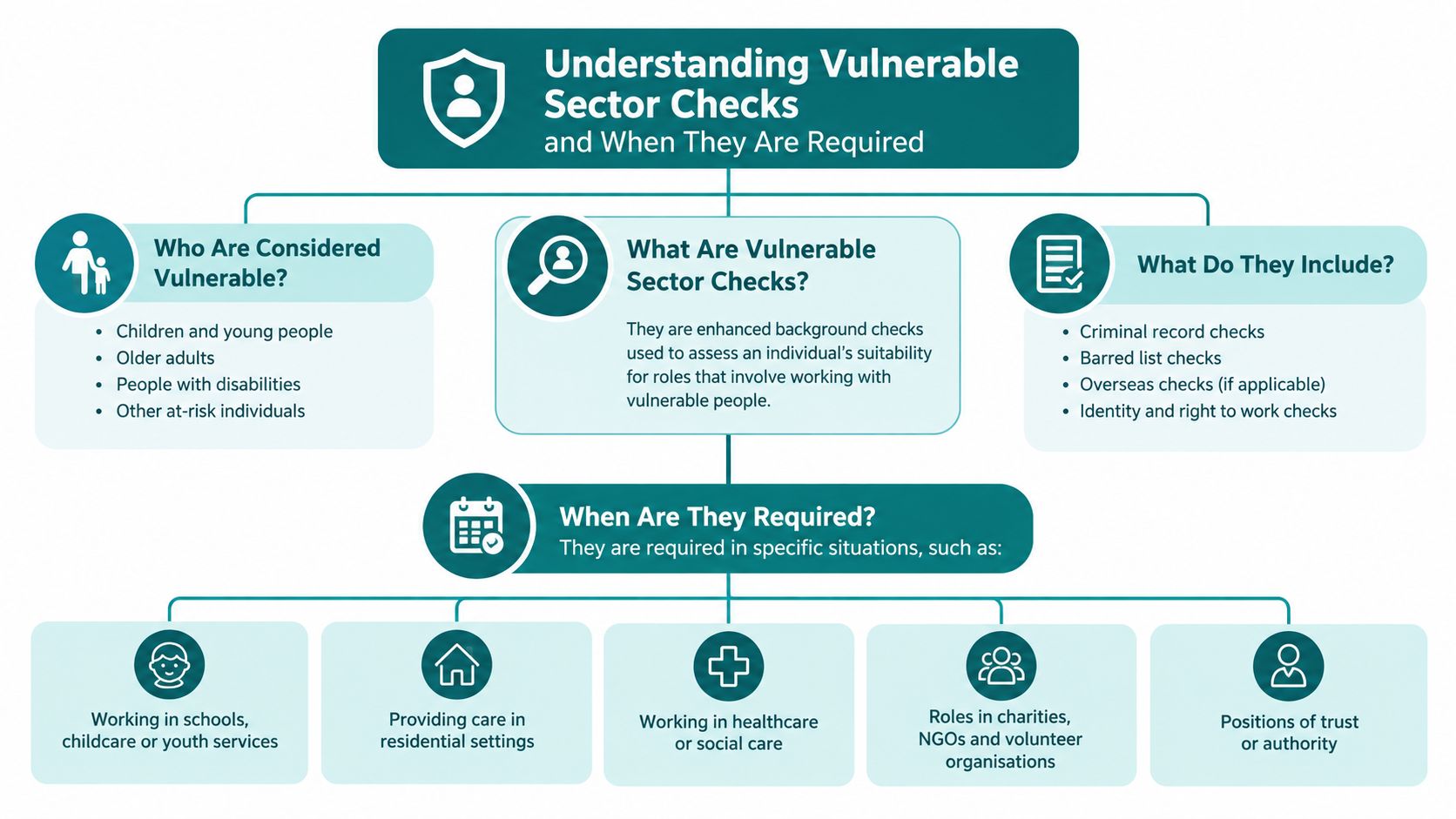
Canadian screening starts with matching the check to the role. A Criminal Record Check, or CRC, generally addresses criminal convictions and is commonly used where the position calls for basic criminal-history screening. A Judicial Matters Check can provide additional information about certain court outcomes and judicial orders. A Vulnerable Sector Check, or VSC, is more restricted and is intended for a position involving trust or authority over children or vulnerable persons.
Think of these checks as different levels of role-related screening, not a ladder where every employer should select the deepest option. The employer should first identify the actual duties, the level of supervision, and whether the worker will hold the kind of trust or authority that justifies a VSC. Requesting a VSC for a role that doesn't meet that threshold can create privacy and human rights concerns.
The Canadian criminal record check guide can help HR teams distinguish the main screening categories before they build a hiring workflow.
The organisation starts the VSC request
The RCMP's policy on the dissemination of criminal record information states that a vulnerable sector check is requested by the hiring organisation, not by the applicant alone. The check is limited to positions of trust or authority over children or vulnerable persons.
The applicant must apply through the local police agency where they live. A police agency is prohibited from completing the VSC for an applicant who lives outside its jurisdiction. That rule explains why an employer's office location doesn't necessarily determine the fee or application route.
Match the check to the position
Before sending an invitation, document:
- Role duties: Identify direct contact, supervision, care, transport, or authority over vulnerable people.
- Screening purpose: Decide whether the role calls for a CRC, Judicial Matters Check, or VSC.
- Applicant location: Confirm the police service responsible for the candidate's residence.
- Supporting documents: Determine whether the applicant needs an employer, volunteer, or placement letter.
This approach controls cost while reducing over-screening risk. It also gives candidates a clear explanation of why the check is required and what they'll need to complete it.
How Much a Vulnerable Sector Check Costs Across Canada
A hiring manager in Mississauga may budget differently from one in Waterloo, even when both request the same type of check. Police services set their own schedules, and the total depends on the applicant's purpose, local jurisdiction, and application route. Employers should check the police service responsible for the applicant's residence, then confirm the current fee schedule on that service's records-check or vulnerable-sector-check page. Ontario professional guidance on VSC fees is also available here.
| Police Service | Employment Fee | Volunteer Fee | Notes |
|---|---|---|---|
| Waterloo Regional Police | Not specified in the cited data | $20 | Published volunteer VSC example |
| Peel Regional Police | $35 | Not specified in the cited data | Published fee schedule |
| Hamilton Police | $55 | $28 | Volunteer or student category |
| London Police | $65 | $28 | Employment, unpaid student placement, or volunteer category |
| York Regional Police | $81 in person, $75 online | Not specified in the cited data | Employment price depends on application route |
| Toronto Police Service | Not specified in the cited data | $6.72 for government employment or volunteer applications | Applicant category affects the fee |
The table makes the pricing structure clear. A vulnerable sector check fee is not one national amount. It is a local, purpose-based price stack. The same province can have different charges by police service, applicant category, and channel.
Budget the complete fee stack
The listed check fee may cover only the base transaction. Fingerprinting, RCMP-related processing, taxes, or a third-party service charge can change the final amount. Hamilton, for example, lists a $25 separate fingerprinting or RCMP fee in some cases, as reflected in Peel Regional Police's records and check guidance.
Before sending a candidate to apply, record four items: the police service, employment or volunteer category, online or in-person route, and whether fingerprints may be required. York's different online and in-person employment prices show why the application channel belongs in the hiring budget, not as an afterthought.
Check refund rules and any processing charge before payment. A candidate who needs fingerprints can have a different total from one whose application follows the standard route.
If your organisation uses a third-party workflow, separate the police charge from the provider's service charge, tax treatment, and identity-verification component. Alero's pricing information provides a reference for reviewing how screening costs are presented alongside other hiring checks.
Why Volunteer and Employment Fees Differ
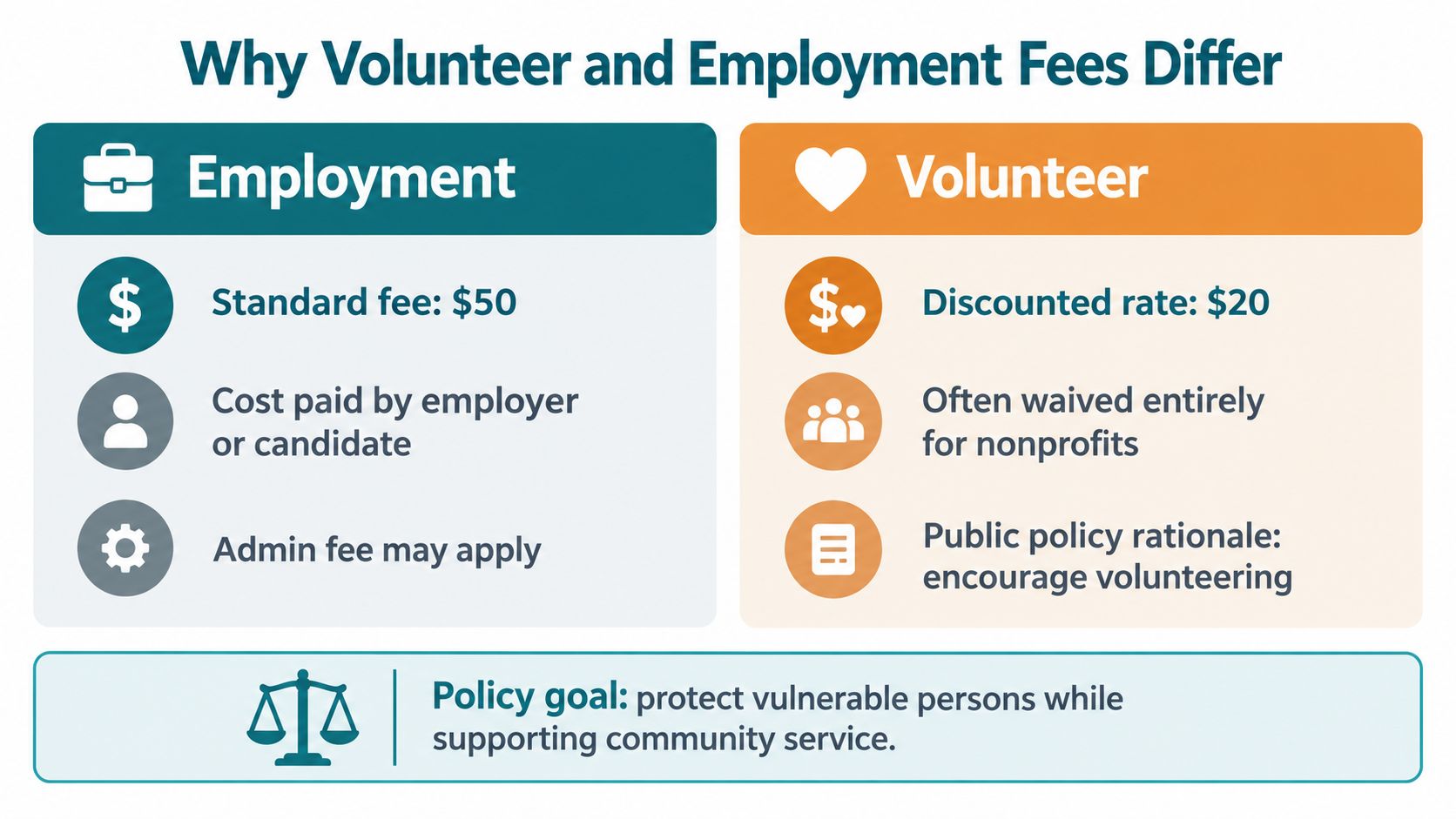
Police services often distinguish between paid employment and unpaid community service because the two situations create different cost burdens. A paid employer may have an established screening budget, while a volunteer may be supporting a school, charity, sports organisation, or care programme without compensation. Discounted rates and exemptions are designed to reduce barriers to those roles.
The distinction isn't universal, though. Ontario's police record check guidance says that volunteers are still required to pay any fee charged by the police service. Local policies can then reduce, waive, or retain that charge.
| Employment application | Volunteer or student application |
|---|---|
| Usually uses the standard employment category | May qualify for a reduced rate or exemption |
| The employer may pay, reimburse, or require candidate payment | The organisation may need to provide proof of the unpaid role |
| Fingerprinting or additional processing may create a separate charge | A waiver may depend on bona fide volunteer status and documentation |
Toronto Police Service states that its fee exemption applies to bona fide volunteer applications only. Its fingerprinting fee may also be exempted when the organisation provides correspondence. Hamilton lists $55 for employment and $28 for volunteer or student checks, while Durham lists $58.90 for employment and $21.42 for volunteer checks. Halton Police says fees are waived for volunteer positions requiring vulnerable sector screening.
Documentation determines eligibility
The same candidate may pay different amounts depending on the police service and the evidence supplied. A volunteer letter, student-placement confirmation, or organisation correspondence can determine whether the applicant qualifies for a lower rate or waiver. Employers should provide the required document before the candidate begins the application, not after a payment problem appears.
A useful instruction includes the role title, unpaid or placement status, organisation name, and contact details for verification. Avoid telling every volunteer that the check is free. The accurate message is that the local police service may charge a reduced fee or provide an exemption, subject to its own requirements.
Candidate communication should answer three questions: Why is the check required, which police service should process it, and what document or payment category applies?
This small step helps candidates budget for the application and reduces incomplete submissions. It also prevents recruiters from applying a volunteer exemption to a paid role or treating a student placement as ordinary employment.
Who Should Pay and How to Handle Recordkeeping
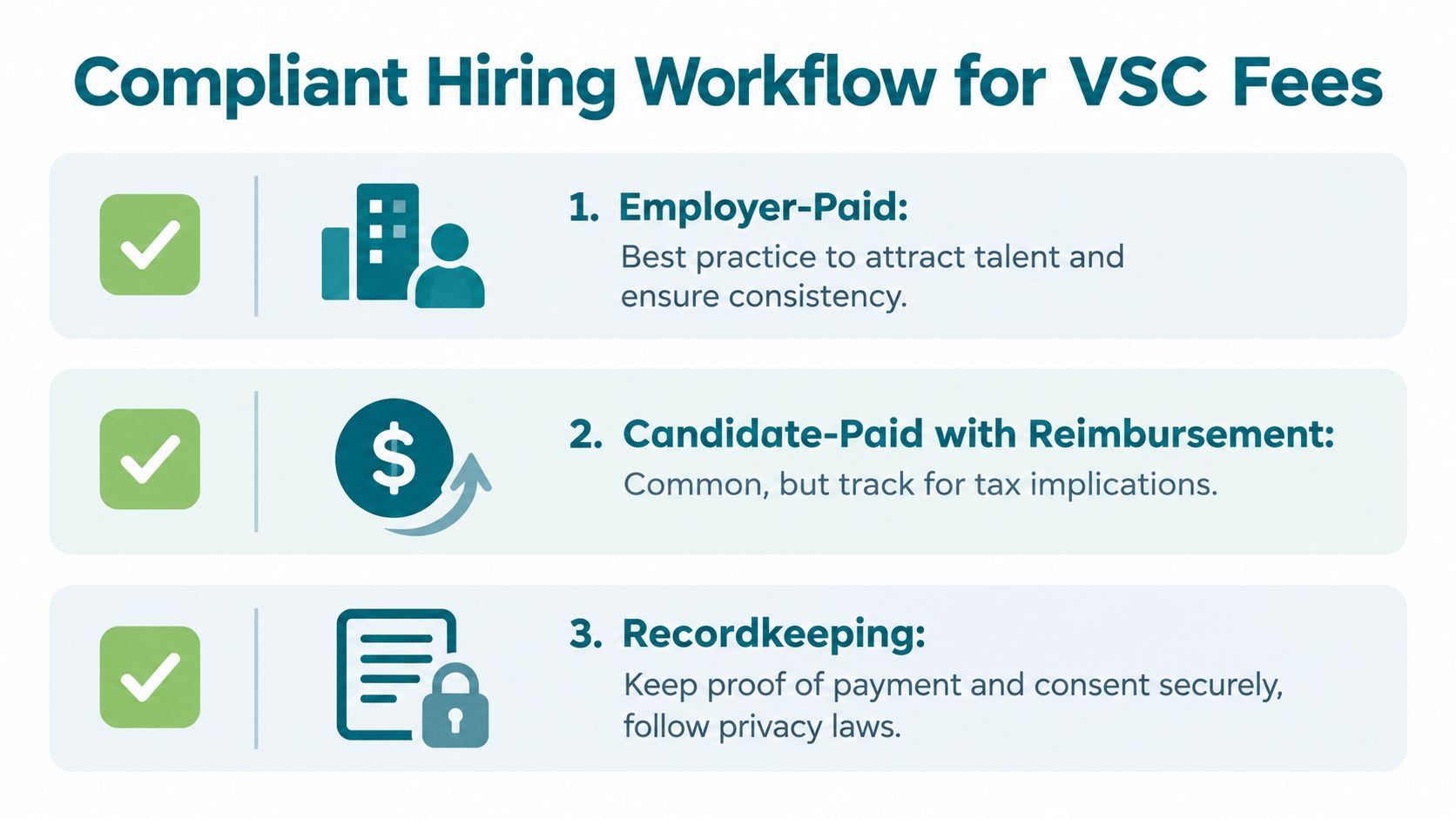
A Canadian employer can pay the vulnerable sector check fee directly, require the candidate to pay and reimburse it, or use a separate arrangement for volunteers. The choice should be written into the hiring process and applied consistently. Give candidates advance notice, obtain documented consent, and handle receipts separately from screening information.
Employer-paid screening usually creates the clearest process. The organisation selects the required check, confirms the applicable local fee, and prevents a qualified applicant from delaying the application because an unexpected charge appeared.
Reimbursement can work just as well when the rules are clear. Tell the applicant the approved amount, state whether reimbursement covers only the police charge or the full fee stack, and identify the receipt required. Finance and HR should ask their adviser about tax treatment rather than assuming every reimbursement follows the same rule.
Keep a narrow record
Privacy obligations under PIPEDA and applicable provincial privacy laws require organisations to collect, use, disclose, retain, and safeguard personal information for appropriate purposes. A receipt is usually less sensitive than a screening result, but it can still identify the applicant and show details about the transaction.
Keep only the records needed to show that the request was authorised, the payment was handled correctly, and the hiring decision followed the stated process:
- Consent evidence: Retain the applicant's consent and the explanation of why screening was required.
- Payment evidence: Store the receipt or reimbursement record when accounting or audit requirements call for it.
- Status evidence: Record the screening status and hiring decision instead of retaining unnecessary report details.
- Access controls: Restrict records to staff who need them for hiring, compliance, or finance.
- Retention rules: Use a documented schedule and securely dispose of records when the purpose ends. See Alero's compliance overview for retention and access-control workflows.
A receipt cannot replace consent. A full report also should not remain indefinitely just because it arrived with payment documentation. Tell candidates where their information is stored and which staff or vendors can access it. This explanation matters when a screening provider manages ordering, identity verification, or status tracking.
A Canadian provider such as Alero Background & Identity can centralise screening orders, identity verification, candidate intake, tracking, and privacy-oriented recordkeeping in one workflow. That arrangement can help recruiters manage applicants across police jurisdictions, while the employer remains responsible for confirming that the requested check fits the role.
Next Steps for a Compliant and Candidate Friendly Screening Program
Treat every VSC request as a small compliance workflow, not a one-line expense. Three decisions determine the likely total: where the applicant lives, why the check is required, and whether fingerprinting or another processing charge applies.
Before opening an application, complete this checklist:
- Confirm the role: Document why a VSC is necessary and ensure the duties involve the required level of trust or authority.
- Identify the police service: Use the applicant's residential jurisdiction, not the employer's address.
- Check the category: Select employment, volunteer, student, or another applicable purpose.
- Review the fee schedule: Confirm the base fee, payment method, refund policy, and possible extra charges.
- Prepare supporting proof: Give the candidate the correct volunteer letter or placement documentation before they apply.
- Set the payment rule: State whether the employer pays, reimburses, or uses another documented arrangement.
- Track completion: Provide plain-language status updates and record only the information needed for the hiring decision and audit trail.
This approach makes budgeting more accurate and gives candidates a predictable experience. It also helps recruiters avoid the two common errors that create delays: ordering a VSC when a less intrusive check would fit the role, and quoting a fee without confirming the applicant's local process.
A consolidated Canadian screening and identity-verification workflow can support faster decisions, consistent consent collection, and clearer status communication. Keep the fee explanation simple, verify the local details early, and make the applicant responsible for as little administrative guesswork as possible.
Alero Background & Identity offers Canadian criminal record screening, vulnerable sector processing where applicable, identity verification, and centralised ordering and tracking for hiring teams. Visit Alero Background & Identity to review a candidate-friendly workflow for managing screening costs, consent, and jurisdiction-specific checks.