
You've got three solid applications on the kitchen table, and one of them looks clean except for one problem, there's no verifiable credit history. That's the exact moment when a lot of landlords get lazy and make a bad call. The right move is to treat the tenants credit check as one part of a regulated decision, not a shortcut, because Ontario Regulation 290/98 still lets landlords request credit references and credit-check permission, and PIPEDA still governs consent and use of personal information Ontario Regulation 290/98, Ontario Human Rights Commission housing policy.
The practical mistake I see most often is simple, landlords use the report like a yes-or-no button. That's sloppy screening. In Ontario, there's no legal minimum credit score for renting, and a thin file is not the same thing as a bad file, especially for newcomers, students, and people rebuilding after hardship Wowa landlord credit bureau guide, Ontario Human Rights Commission housing overview.
Table of Contents
- Why a Tenants Credit Check Matters for Canadian Landlords
- Getting Consent Before You Pull a Tenants Credit Check
- What a Tenants Credit Check Report Shows
- Combining Credit With Rental History and Income the Right Way
- Soft Pulls Versus Hard Pulls and Alternatives to a Hard Inquiry
- PIPEDA Aligned Retention, Access, and Disposal of Credit Reports
- Key Takeaways for Running a Fair Tenants Credit Check
Why a Tenants Credit Check Matters for Canadian Landlords
A tenant walks in with solid income, good references, and a thin credit file. That is not a red flag by itself. It is a signal to slow down and screen properly. A tenants credit check gives you one objective data point before you hand over the keys, but it only makes sense beside income proof, rental history, and references.
What a thin file actually tells you
Ontario housing guidance is clear, landlords can request credit references, rental history, and permission to run a credit check, but they cannot treat a lack of credit history as a negative by itself Ontario Human Rights Commission housing policy. That matters for newcomers, students, and first-time renters, where a thin file often reflects life stage, not risk.
A score is only part of the picture. Landlords who fixate on it end up rejecting workable applicants and creating avoidable human rights problems.
Ontario's screening model is built on consent, relevance, and fair housing limits. It is not a permission slip to collect whatever you want Ontario.ca landlord and tenant guidance. Under PIPEDA and bureau access rules, a landlord needs consent before sharing personal information with a credit reporting agency, and must have at least the tenant's name, address, and date of birth to run the check Office of the Privacy Commissioner.
What the check really predicts
A credit check tells you how someone has handled prior credit obligations. That is useful, but narrow. It will not tell you whether their current income is stable, whether their rental history is clean, or whether a past problem was a one-off hardship.
Treat the report as one input alongside income and references.
That approach is the difference between fair screening and lazy screening. If you use the report as the whole decision, you will lose good tenants and make your own file harder to defend later. If you use it properly, it helps you separate real payment risk from empty assumptions.
Getting Consent Before You Pull a Tenants Credit Check
A tenant says they are “fine with a credit check” during a viewing, then later complains after you run one. That is exactly how screening files get challenged. Get written consent first, before any bureau contact, and make the form clear about whether you are pulling Equifax, TransUnion, or both, and that the purpose is residential tenancy screening. You can pre-qualify on basic fit, like rent range or pet rules, but you cannot pull a report without signed authorization under privacy rules PIPEDA fair information principles.
What belongs on the consent form
Keep the form plain and specific. It should list the applicant's full legal name, date of birth, current address, the exact report you are ordering, and the landlord or property manager's name and contact details. It should also say the information will be used only for tenancy decisions and kept according to your retention policy.
A lease add-on buried in small print is weak. A standalone screening consent is cleaner, easier to defend, and easier for the applicant to understand. Use a screening workflow that captures consent as a separate step before any bureau contact, so the authorization is auditable.
Don't skip the notice obligation
If you reject the applicant after using a bureau report, you must tell them which bureau was used and how to contact it Office of the Privacy Commissioner on landlords and tenants. Too many landlords stop thinking once they make the decision. They should not. A bureau pull is a regulated decision, not just a background convenience, and Ontario does not set a legal minimum credit score for renting. The file has to be relevant, and the choice has to be defensible if someone asks why they were screened out.
Keep it simple: consent first, bureau second, decision third, notice last.
A consent capture step that is logged and timestamped is what makes the process defensible if a complaint surfaces.
What a Tenants Credit Check Report Shows
A proper report is a file, not a single score. I start with identity data because a mismatched address or date of birth often signals an error before I touch the accounts. Then I check each trade line, creditor name, account type, balance, monthly payment, and current status.
For a fuller breakdown of what a bureau file contains, see Alero's credit and financial checks service page.
Read the accounts before you chase a number
Status matters more than most landlords admit. A current account says something different from a late account, a collection, or a closed account, and one old late payment is not the same as an open collection. On TransUnion, R1 to R9 is the account-quality scale, and on Equifax the parallel scale is I1 to I9. The worse the code, the more attention it deserves.
| Sections of a Canadian Tenant Credit Report and What Each Tells a Landlord | ||
|---|---|---|
| Report Section | What It Contains | Landlord Interpretation |
| Identifying information | Name, address history, date of birth, and sometimes employer references, treat employer data as potentially outdated and verify separately | Check for mismatches, duplicates, or obvious identity problems |
| Trade lines | Creditor name, account type, balance, monthly payment, payment status | Look for current payment behaviour and whether debt is under control |
| Rating codes | TransUnion R1 to R9, Equifax I1 to I9 | Compare seriousness of payment behaviour, not just the presence of debt |
| Public records | Bankruptcies, judgments, collections | These need context, especially if they are old or resolved |
| Inquiries | Voluntary and involuntary pulls | Too many recent pulls can mean active credit shopping or financial stress |
What the report leaves out
The report does not give you an employer record, an income figure, or rental payment history unless that history was already reported to a bureau or a rent-reporting service. It also does not hand you a legal approval cutoff. Ontario does not set a minimum credit score for renting, so a landlord who treats one score as the whole decision is screening badly.
Thin files are common. Newcomers, students, and recently divorced applicants may have little history, and a near-empty report is information, not a yes or no answer. It tells you to weigh references and income proof more heavily, not to pretend the bureau file says more than it does.
Combining Credit With Rental History and Income the Right Way
A landlord who screens well does not chase a single number. They build a file. Credit matters, but so do income stability and past rental conduct. Ontario's housing guidance says income information should be considered together with rental history, credit references, and credit-check permission Ontario Human Rights Commission housing overview. Separately, Ontario prohibits a 30% rent-to-income cutoff for non-subsidized housing, so a hard ratio rule is not a safe policy.
Use a weighted decision, not a single cutoff
I'd rather see a landlord use a written rubric than a gut call dressed up as policy. A strict score floor looks tidy until it collides with a thin file or a real explanation for a blemish. Human rights risk starts when one metric controls the decision.
| Sample Weighted Tenant Screening Rubric | |||
|---|---|---|---|
| Factor | Weight | Pass Threshold | Notes |
| Credit file quality | Medium | No unresolved collections that point to current payment distress | Review context, not just the headline |
| Income stability | High | Consistent documented income supporting rent payment | Verify against pay evidence and employer confirmation |
| Rental history | High | Positive landlord references with no material lease issues | Look for payment habits and notice behaviour |
| Identity consistency | High | All documents match the application | Fix mismatches before deciding |
| Overall context | Medium | No unexplained contradictions | Thin file should trigger more review, not automatic rejection |
A proper reference check belongs in that same file. A structured reference process, same questions, same order, documented answers, is what makes the reference comparable across applicants. If the landlord before you says rent was paid on time and notice was handled properly, that matters. A proper reference process also belongs beside the identity file, see Alero's reference and credential checks for how landlord references are captured.
Red flags that need follow-up, not instant rejection
A medical collections cluster can reflect hardship rather than rental risk. A recent divorce can leave a temporary credit mess that does not predict future rent behaviour. A consumer proposal is worth asking about, but context still decides the outcome. A newcomer's thin file is exactly why you should slow down and verify more carefully.
If the file has one weak point but the rest of the application is strong, ask for clarification before you say no.
Ontario does not set a minimum credit score for renting. That is the part many landlords miss. A near-empty report is information, not a refusal. It tells you to weigh references and income proof more heavily, and to avoid pretending the bureau file says more than it does.
Soft Pulls Versus Hard Pulls and Alternatives to a Hard Inquiry
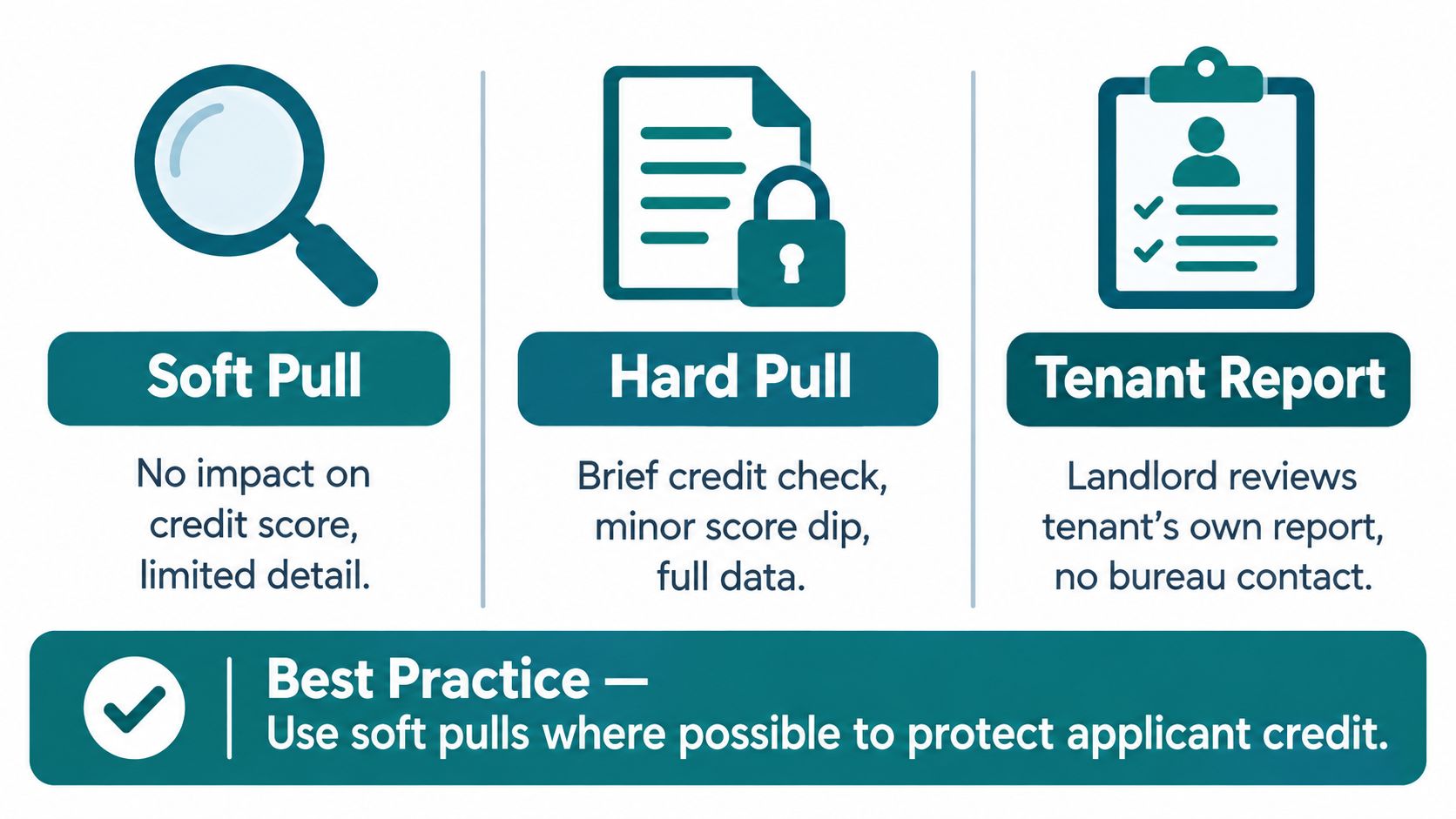
I don't like default hard inquiries for every applicant. They're heavier than most landlords need at the first pass, and they can create a friction point for otherwise good tenants. A soft pull leaves no footprint on the applicant's file, while a hard pull is visible to future lenders and can temporarily affect the file.
Use soft first, hard later
The cleaner workflow is simple. Use a soft pull at the showing or first application stage to narrow the pool, then move to a hard inquiry only after the applicant has moved into finalist status and re-consented in writing. That keeps the top of your funnel lighter and the candidate experience better.
Better alternatives when the file is thin
Tenant-supplied bureau reports are often the best middle ground. Applicants can provide their own Equifax or TransUnion report, which avoids a fresh inquiry. Newcomers may need something like Nova Credit if they don't have meaningful Canadian history, and students or gig workers may be better served by landlord references than by trying to force a bureau file to say more than it can.
My rule: don't spend a hard inquiry unless you're actually ready to make a decision.
The other reason to prefer a softer approach is that it protects the applicant while you're still sorting the file. If the file is messy and you're only pre-screening, a hard pull is unnecessary exposure. A Canadian screening platform with a soft-pull credit summary lets you review financial behaviour without creating the same friction as a full bureau hit, which is exactly where a tool like Alero Background & Identity can fit naturally.
PIPEDA Aligned Retention, Access, and Disposal of Credit Reports
Privacy isn't a paperwork exercise. Once you collect a credit report, you're holding personal information that has to be controlled, used for the stated purpose, and disposed of properly under PIPEDA principles Office of the Privacy Commissioner on business personal information. In landlord screening, that means meaningful consent first, limited use, and no casual file dumping after the decision is made.
Build a simple retention workflow
Hold the report only as long as you need it to make the decision, then delete it unless you've got a specific reason to keep it. For a small portfolio, that usually means a short retention window, and you should never keep it longer than you can justify if a complaint surfaces. If someone requests access, you need to be able to produce it and correct factual errors where appropriate.
Physical security still matters. Paper copies belong in locked storage, and digital copies should sit in encrypted folders with limited access. If you're still emailing reports around your office, stop. That is how privacy mistakes happen.
Dispose of it like it matters
When the report is no longer needed, destroy it cleanly. Cross-cut shredding is the right move for paper, and secure deletion is the right move for digital files. You should also keep a simple log of when the file was accessed and when it was destroyed.
| PIPEDA-Aligned Retention and Disposal Checklist | |
|---|---|
| Action | What to do |
| Collect | Get meaningful consent before any screening |
| Store | Use locked cabinets or encrypted folders |
| Limit access | Let only authorized staff handle the file |
| Use | Restrict use to the tenancy purpose named on the form |
| Retain | Keep only as long as necessary for the decision |
| Destroy | Use cross-cut shredding or secure digital deletion |
| Log | Record access and disposal dates |
The legal point is straightforward, and landlords tend to overcomplicate it. Keep less, store better, destroy sooner. If you want a privacy workflow that's already built around Canadian screening expectations, Alero Background & Identity publishes PIPEDA-aligned handling practices that fit this kind of file control Alero's PIPEDA background checks guidance.
Key Takeaways for Running a Fair Tenants Credit Check
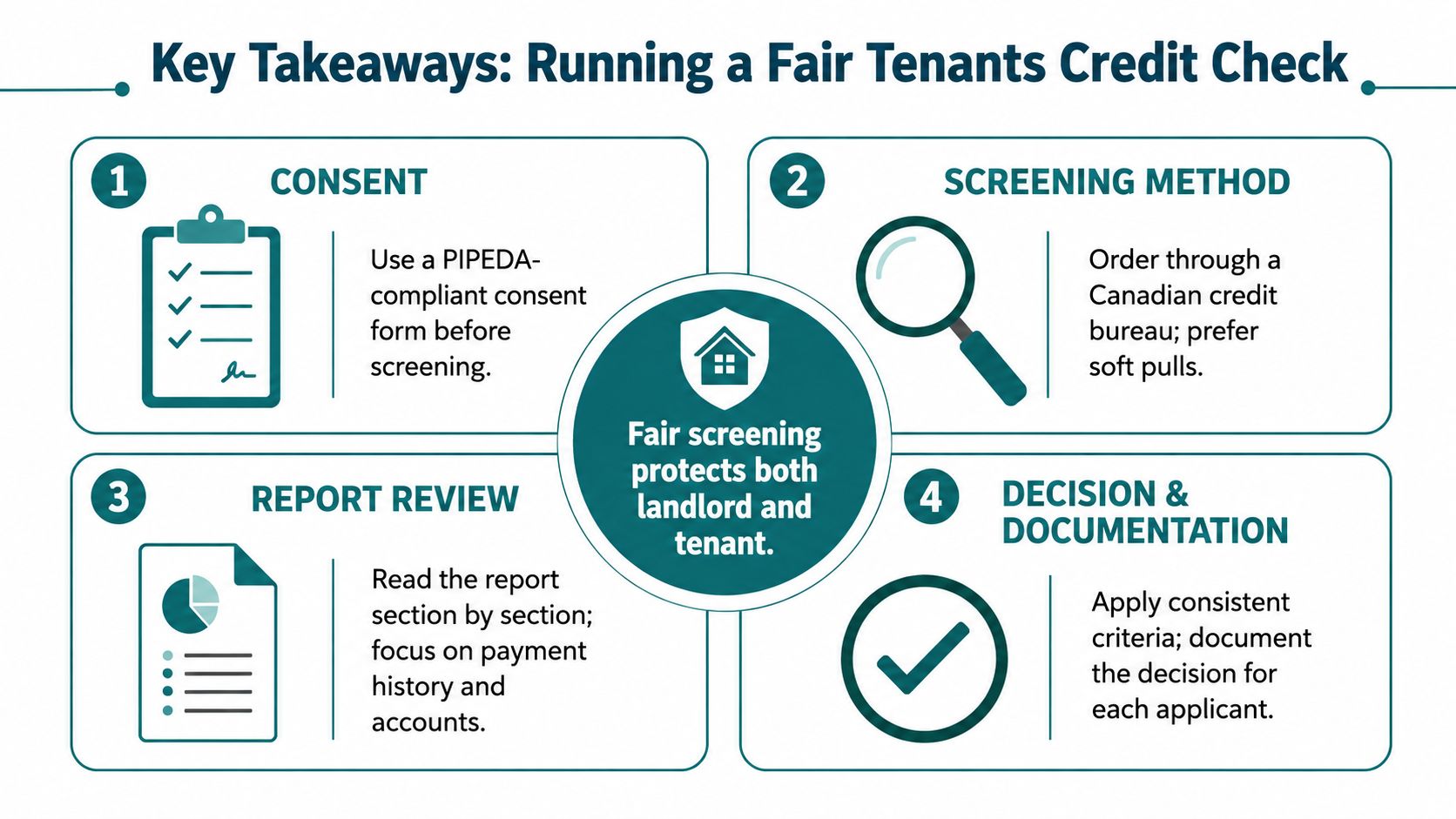
Fair screening is boring on purpose. You get the consent first, you order through a Canadian bureau, you prefer a soft pull where possible, and you read the report section by section instead of chasing a single score. Then you weigh the result against income and rental history, document the decision, and delete the file when it's no longer needed.
What landlords keep missing
Ontario does not give you a statutory minimum credit score for tenancy, so stop pretending there's a fixed number hiding in the law. The Human Rights Code also means you have to assess applicants individually, which is exactly why a thin file or a blemish can't be treated as an automatic no. And yes, the hard inquiry itself can become part of the friction if you use it carelessly.
Print this and use it
- Capture consent properly: Use a PIPEDA-compliant screening form before any bureau contact.
- Start with the lightest tool that works: Use a soft pull first if you can.
- Check the whole file: Weigh income, landlord references, and payment history together.
- Decide consistently: Apply the same criteria to every applicant.
- Store carefully: Restrict access and keep the report only as long as needed.
- Destroy cleanly: Shred paper and securely delete digital copies.
Screening works when it's disciplined, not when it's aggressive. If you want a cleaner process for credit, identity, and reference verification in one Canadian workflow, visit Alero Background & Identity and see how a PIPEDA-aligned process can tighten your screening without making it harder for good applicants to complete.