A Montreal-area logistics firm is ready to hire a new delivery driver. The offer letter is drafted, the fleet insurer wants the file before the policy bind date, and the candidate is already living in another province. The HR coordinator needs a Quebec driving abstract, but the candidate can't easily visit a Société de l'assurance automobile du Québec service outlet.
That situation exposes the employer-side challenge. Downloading a document is only one step. HR also needs to know what the abstract proves, how the candidate can authorise access, how to interpret licence and offence information, and where the record stops answering the employer's risk question.
Table of Contents
- Setting the Scene for HR Teams Ordering a Quebec Driving Abstract
- What a Quebec Driving Abstract Actually Contains
- How to Request a Quebec Driving Abstract Online or In Person
- Reading Licence Status, Demerit Points, and Offence History
- Employer Use Cases and Legal Limits for the Abstract
- Why a Clear Abstract Is Not the Whole Picture
- Practical Checklist for Adding the Abstract to Your Screening Workflow
Setting the Scene for HR Teams Ordering a Quebec Driving Abstract
A Quebec driving abstract is an official record issued through the Société de l'assurance automobile du Québec, commonly called the SAAQ. It gives an employer a defined view of the driver's licensing position and recent driving compliance history. It isn't a complete background investigation, and it isn't a national Canadian driver record.
That distinction matters when a hiring decision depends on a start date. A candidate may be able to view their own record through SAAQclic, while an employer needs authorisation before receiving information for hiring purposes. The SAAQ's current FAQ states that users can access only their own driving record in SAAQclic, third-party access requires authorisation, and only printed and signed documents are considered official. The SAAQclic access portal also lists driving-record functions within the digital workflow.
Practical rule: Treat the abstract as a controlled government record, not as a casual attachment a candidate can forward without checking its official status.
The operational pressure usually comes from several directions at once:
- Candidate experience: A request that feels unclear or repetitive can slow completion and damage trust.
- Onboarding coordination: A delayed record can hold up vehicle assignment, training, or the offer condition.
- Insurance requirements: Fleet insurers may require driver documentation before coverage or renewal decisions.
- Record handling: The employer must protect personal information, limit internal access, and avoid keeping the file indefinitely.
The useful workflow is straightforward: confirm that driving is part of the role, identify the correct Quebec record, obtain valid consent, order or collect the official document, review the fields consistently, and pair the result with the other checks the position requires. The rest of the process depends on understanding what SAAQ records and what it leaves outside the abstract.
What a Quebec Driving Abstract Actually Contains
A Quebec driving abstract, often called a relevé d'information, is the SAAQ-issued summary of a person's provincial driving record. The SAAQ description of a driving record request identifies the core information: licence status, active demerit points, and offences committed.
For an employer, the document is a current, time-bounded record, not a lifetime account of every driving-related event. SAAQ states that demerit points remain on the record for 2 years after the conviction date, or for 2 years after the entry date when the matter concerns licence-payment purposes. That rule makes the abstract useful for reviewing recent compliance, while limiting what it can prove about older conduct.
The issued document may include the driver's name, date of birth, licence number, licence class, issue information, current status, restrictions, and conditions. It may also list demerit points, offence entries, dates, monetary penalties where recorded, suspensions, revocations, and other administrative actions. Review the actual document supplied for the role. HR should not assume that every abstract has the same layout or displays every field in the same way.
What the abstract does and does not establish
The abstract can show whether the person appears licensed for the proposed driving duties and whether recent SAAQ-recorded events warrant follow-up. It cannot answer every question raised during a hiring review.
It is not a CPIC criminal record check. A criminal record check addresses criminal record information through the appropriate police or authorised screening process. The driving abstract addresses SAAQ licensing and driving history. The two checks serve different purposes and should not be treated as substitutes.
The same distinction applies across provinces. A Quebec abstract is not interchangeable with an Ontario, Alberta, British Columbia, or other provincial driver abstract.
| Record | Issuing body | Covers | Does not cover |
|---|---|---|---|
| Quebec driving abstract | SAAQ | Quebec licence status, active demerit points, and SAAQ-recorded offences | A general criminal history, unrelated identity concerns, or every event from another jurisdiction |
| Basic criminal record check | Police service or authorised screening body | General criminal record information under the applicable process | Driving suitability, licence class, or SAAQ demerit status |
| Vulnerable sector check | Local police agency or authorised body | Criminal record information, sexual-offence record suspensions, and potentially additional eligible local police information | General-purpose screening for every job |
| Driver abstract from another province | The relevant provincial licensing authority | That province's licensing and driving record | A complete Quebec record or national criminal screening |
Parking tickets, out-of-province infractions, and criminal convictions should not be presumed to appear because they matter to an employer. The abstract proves official Quebec driving information within the record's scope. It does not prove that no other safety, licensing, or conduct issue exists, so the hiring decision should use the other checks required for the position.
How to Request a Quebec Driving Abstract Online or In Person
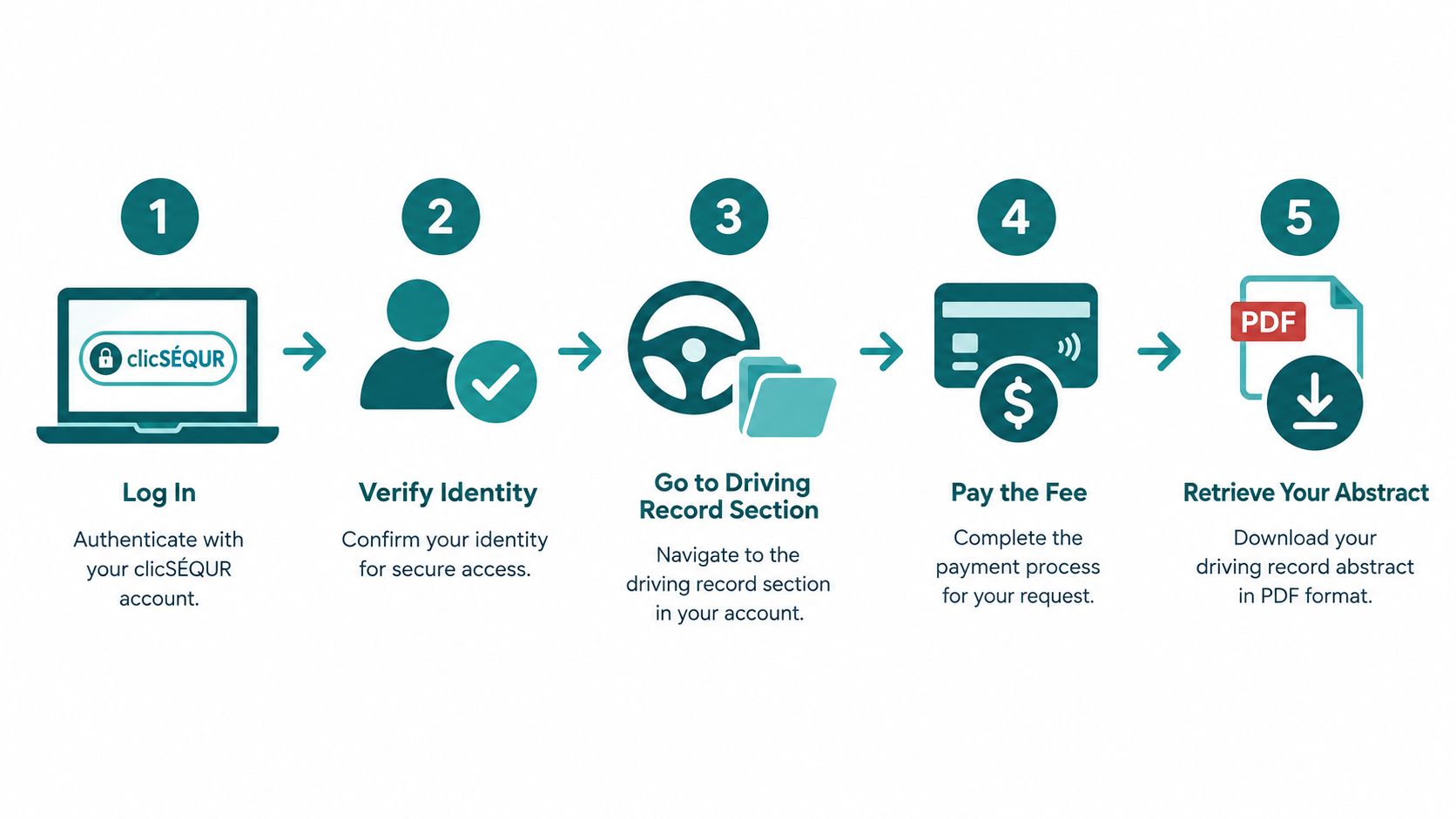
The cleanest starting point is the licence holder. SAAQ's digital process directs individuals to their own record through SAAQclic. The candidate authenticates through the available Quebec government login process, such as clicSÉQUR where applicable, completes identity verification, goes to the driving-record function, follows the request instructions, pays any applicable fee, and retrieves the document in the format provided.
The candidate should then check whether the employer needs an official printed and signed document. SAAQ's FAQ says that only printed and signed documents are considered official, even though driving-record functions are available through SAAQclic. That creates a practical distinction between a convenient digital view and a document suitable for an employer's formal file.
A workable employer request path
- Confirm the record type. Make sure the role requires a Quebec driving abstract, rather than a criminal record check or a record from another province.
- Explain the purpose. Tell the candidate why the record is needed, who will review it, and whether it may be shared with an insurer or another authorised decision-maker.
- Obtain written authorisation. The SAAQ says third-party access requires authorisation. An employer shouldn't assume that a candidate's verbal agreement or an unsolicited screenshot is sufficient.
- Choose the access route. The licence holder may use SAAQclic or visit an SAAQ service outlet. A properly authorised third party or service provider may help manage the request, subject to the applicable SAAQ process.
- Validate the document. Check the candidate's identity, document date, official status, and whether the record is complete before placing it in the hiring file.
An in-person request may suit a candidate who can reach an SAAQ outlet and wants staff assistance. HR should tell the candidate to bring acceptable identification and a payment method accepted by the outlet, then confirm the current requirements directly with SAAQ before the appointment. Candidates outside Quebec may face more friction, especially if they no longer have easy access to provincial services or need to clarify which jurisdiction holds the relevant licence record.
The document may be issued in French, and a candidate's Quebec residence shouldn't be confused with the jurisdiction of the licence record. For an employer, the important questions are whether the person held or holds a Quebec licence, whether the record is official, and whether the hiring team can interpret the document accurately.
Build the request into the hiring timeline rather than ordering it after every other condition has been cleared. If the candidate must mail a consent or signed request, the cycle can extend beyond the employer's preferred onboarding window. A provider that manages driver's abstract screening can help organise consent, identity matching, document collection, and status tracking, but it doesn't remove the need for a lawful authorisation path.
Reading Licence Status, Demerit Points, and Offence History
A hiring manager calls after a candidate's driving record arrives. It shows an offence, but the more immediate question is whether the person is authorised to drive the vehicle assigned on the first day. Read the abstract in three layers: licence status, demerit points, and offence history.
Licence status comes first
Licence classes identify the driving authority recorded by SAAQ. HR may see classes such as 5, 6A, 6B, 6C, 6D, and 8, along with restrictions or conditions. Match the class to the actual duties. A person qualified to drive an ordinary passenger vehicle may not be authorised for a heavier vehicle, motorcycle, bus, or other specialised assignment.
Status terms also have different operational effects. Valid means the record shows current validity, while suspended, revoked, and expired statuses require action before assigning driving work. A suspension or revocation can prevent immediate vehicle access. An expired licence needs clarification. A valid status still does not confirm required training, endorsements, insurance approval, or compliance with the employer's policy.
Demerit points need dates and context
SAAQ retains demerit points for 2 years after conviction, or for 2 years after the relevant entry for licence-payment purposes. The active balance therefore reflects the applicable retention window, rather than every point the driver may have received over time. That distinction matters when a hiring manager compares a current abstract with an applicant's broader driving history.
Assess each offence by date, status, type, and connection to the role. Highway Safety Code infractions can point to driving behaviour or compliance concerns. Criminal Code driving offences, including impaired driving, dangerous driving, or street racing, call for a more serious review. Counting points alone will not provide enough context.
| Abstract field | Typical values | Interpretation for employers |
|---|---|---|
| Licence status | Valid, suspended, revoked, expired | Establish whether the person appears authorised to drive now |
| Licence class | 5, 6A, 6B, 6C, 6D, 8 | Compare the class and restrictions with the vehicle and duties |
| Demerit points | Active balance or recorded entries | Review recent compliance within the SAAQ retention window |
| Offence history | Dates, descriptions, points, penalties | Look for severity, recency, repetition, and relevance |
| Administrative action | Suspension, revocation, non-renewal | Identify barriers to assigning driving duties or vehicles |
A clear abstract is useful evidence that the document contains no reported active points or listed offences within its scope. It does not establish safe driving, a complete national record, or suitability for every position. Record the job-related reason for concern, then assess severity, recency, repetition, and role relevance before making a decision. A minor, older entry should not automatically produce a rejection without that context.
Employer Use Cases and Legal Limits for the Abstract
A Quebec driving abstract has its clearest value when driving creates a real job requirement or business risk. The decision standard should be practical: what driving activity will the person perform, what licence authority is needed, and what evidence does the employer need before giving access to a vehicle?
| Employer use case | Why the record matters | What it should not replace |
|---|---|---|
| Commercial driving under the National Safety Code | Licence status and recent driving compliance support operational risk review | Role-specific training, licence verification, and other safety controls |
| Last-mile delivery and logistics | Frequent road exposure makes current driving information relevant | Reference checks and fleet supervision |
| Transit and paratransit | Passenger safety and licence suitability require focused review | Any additional screening required by the role |
| Fleet insurance underwriting or renewal | The insurer may require driver documentation for risk assessment | The employer's consent and privacy obligations |
| Field service or sales | Driving may be incidental but still necessary for work | Broad screening unrelated to the actual duty |
Consent and purpose limit the process
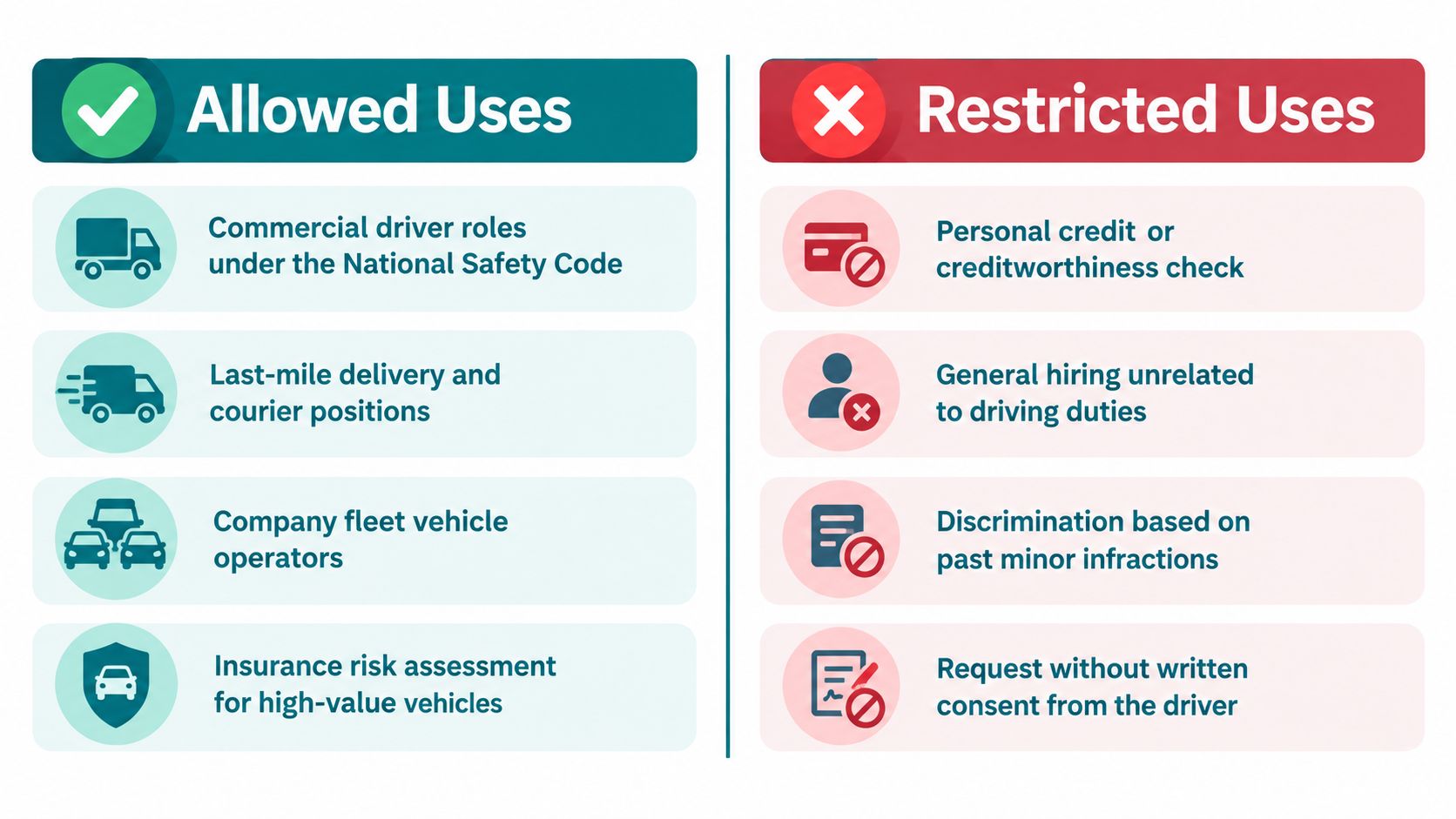
Private-sector employers must handle the abstract as personal information under the applicable Canadian privacy framework, including PIPEDA where it applies and Quebec's privacy legislation, including the Act respecting the protection of personal information in the private sector. Public bodies and some regulated organisations may have additional rules. The employer should collect only what the role requires, explain the purpose, obtain meaningful consent or rely on a clearly documented lawful basis where applicable, and restrict access to people who need the information.
A hiring team may use the abstract to verify driving eligibility, make a job-related decision, place conditions on vehicle access, or share necessary information with an insurer when the candidate has been properly informed and the disclosure is authorised. It shouldn't use the document as a personal credit check, a general character report, or a substitute for criminal screening.
Privacy boundary: A document collected for driving eligibility shouldn't quietly become a permanent employee profile or a general-purpose risk file.
Employers also need a retention rule. Keep the record only as long as there's a legitimate business, legal, insurance, or audit reason, then securely dispose of it according to the organisation's retention schedule. Re-requesting an abstract may be appropriate when the role or insurer requires an updated record, but repeated collection without a clear purpose increases privacy exposure.
Automated screening shouldn't make an unexplained final decision. A human reviewer should assess the record against the job's genuine requirements, consider relevant context, and provide a consistent escalation path for questions or corrections. The Canadian screening compliance resources can help HR teams organise consent and handling controls, but employers remain responsible for their own decisions and policies.
Why a Clear Abstract Is Not the Whole Picture
A clear Quebec driving abstract closes one question only: what does the SAAQ record show within its scope? It doesn't establish that the person has no out-of-province history, no unresolved matter, or no other conduct relevant to the position.
The abstract reflects SAAQ-recorded licence status, convictions, suspensions, and demerit information. It may not reveal driving history held by another jurisdiction before the person obtained or transferred a Quebec licence. It also doesn't answer whether a pending charge has been adjudicated, whether another jurisdiction imposes a relevant restriction, or whether non-driving conduct creates a role-specific concern.
Build a layered screen
A defensible process matches each check to a separate question:
- Basic criminal record check: Use it when the employer needs general criminal record information and the role supports that collection.
- Judicial Matters Check: Treat it as a distinct product that can address judicial information available through the applicable police screening process. Don't describe it as interchangeable with a basic criminal record check or a vulnerable sector check.
- Vulnerable sector check: Reserve it for work involving authority or trust over children or vulnerable persons. The RCMP policy on police dissemination of criminal record information states that the employer must request the check in writing and explain the role's relationship to vulnerable persons. It can only be conducted by the police agency or authorised body in the applicant's local jurisdiction.
- Licence verification: Confirm the class, restrictions, and any role-specific qualification directly against the job requirement. Examples may include air-brake, taxi, or school-bus qualifications.
- Reference checks: Ask prior employers about the candidate's actual driving exposure, vehicle type, incident history, and adherence to safety procedures.
- Insurance or motor vehicle record review: For commercial fleets, use the insurer's required process rather than assuming the SAAQ document answers every underwriting question.
The RCMP's explanation of criminal record checks distinguishes a standard criminal record check from a vulnerable sector check. The latter adds a search for sexual-offence record suspensions and may involve eligible local police information, so it shouldn't be ordered for a routine driving role unless the vulnerable-sector legal threshold is met.
Practical Checklist for Adding the Abstract to Your Screening Workflow
The best workflow makes the request proportionate, predictable, and easy for the candidate to complete. Put the decision points in the ATS or HRIS before the recruiter sends the consent request.
Use this operational sequence
- Confirm the driving requirement: Verify that the person will drive for work, operate a company vehicle, transport goods or passengers, or otherwise perform a duty that justifies the record.
- Select the correct jurisdiction: Determine whether Quebec is the relevant licensing province. A Quebec resident may not necessarily have a Quebec driving record the employer needs.
- Obtain written consent: Explain the purpose, intended recipients, review process, and retention approach. Keep the authorisation with the screening record.
- Match identity details: Check the full legal name, date of birth, and licence number before submission. Errors can cause rejection, delay, or a record being matched to the wrong person.
- Choose the access route: Use SAAQclic when the candidate can complete the process digitally, or plan for an SAAQ outlet or paper-based route when that's more appropriate. Build time for an official printed and signed document if the employer or insurer requires it.
- Set expectations clearly: Don't promise an instant result. Confirm the current processing route and tell the candidate when HR will follow up.
- Pair the checks intelligently: Add the relevant criminal record check level, a Judicial Matters Check where the role and policy call for it, a vulnerable sector check only where the legal test is satisfied, and licence-class confirmation for specialised work.
- Restrict access: Store the PDF in a permission-controlled HR or compliance location, not in an open recruiting inbox. Record who reviewed it and why.
- Apply a retention date: Tie deletion to the organisation's documented Quebec privacy and record-keeping requirements rather than keeping the file indefinitely.
- Complete quality control: Have the reviewer record their initials, verification date, decision rationale, and comparison with the candidate's self-disclosed driving history.
The mandatory workflow visual below can be used as a simple reference for recruiters and hiring managers.
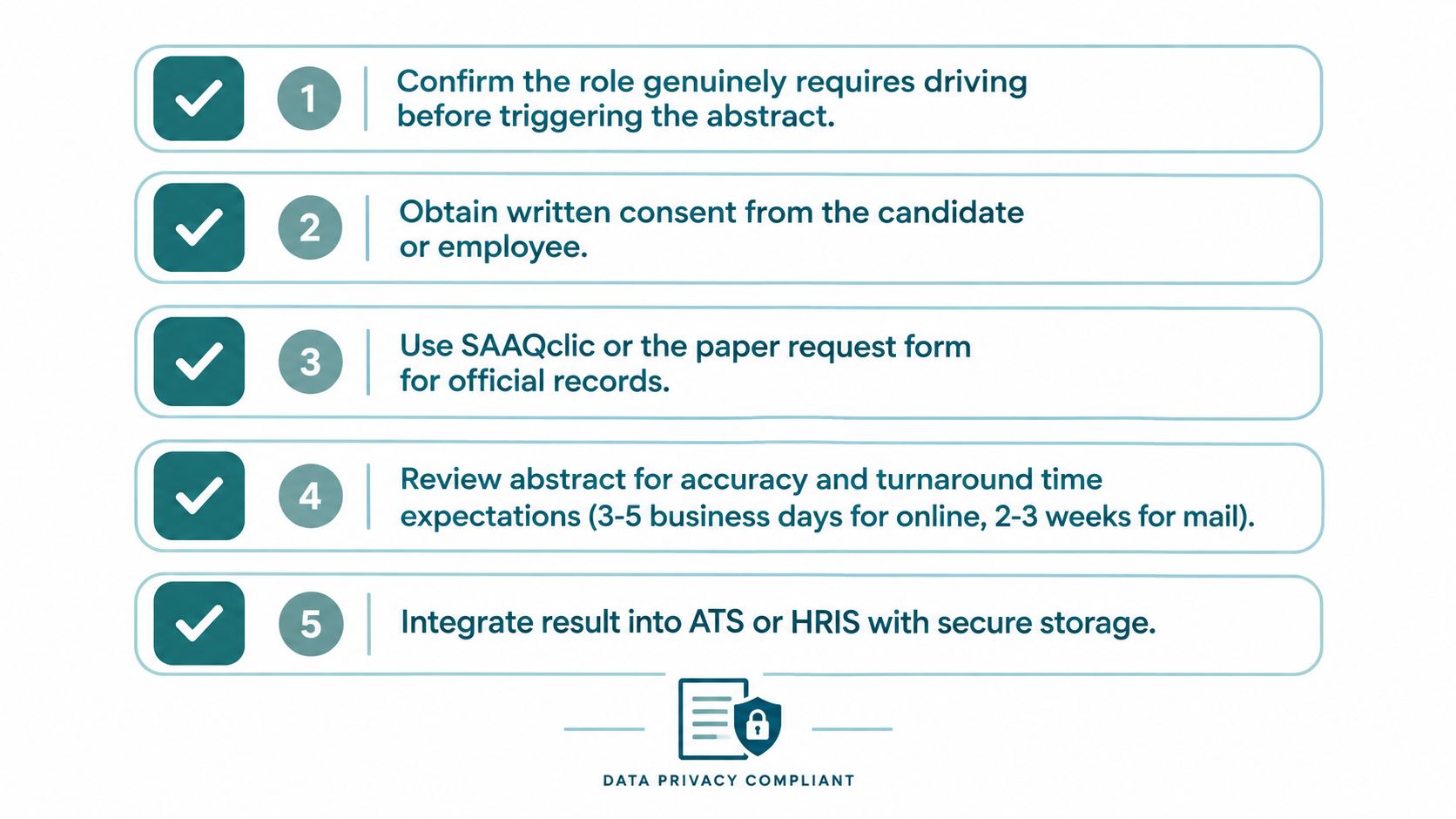
For teams processing repeated driver hires, an integration can reduce duplicate data entry and make consent and status tracking easier. The Alero integrations page describes how screening workflows can connect with common HR systems, but the employer should still keep the role requirement, review criteria, and retention decision under human control.
A final review should answer three questions: Is the abstract official and attributable to the right candidate? Does the licence status and class support the actual job? Has the reviewer avoided treating a clear record as proof of complete safety or a minor entry as automatic disqualification?
Alero Background & Identity supports Canadian employers with identity verification, criminal record screening, vulnerable sector checks where applicable, licence verification, and provincial driver's abstract workflows. Visit Alero Background & Identity to organise consent, candidate intake, secure screening records, and HRIS or ATS-connected review for Quebec driving roles.