A candidate arrives for a security guard interview with a clean-looking licence card and a confident explanation of their experience. Your recruiter checks the card, sees that the name appears correct, and moves the applicant into onboarding. Days later, someone notices that the licence expires before the guard's first scheduled shift.
That situation is avoidable. An Ontario security licence status check should be treated as a live compliance control, not as a one-time review of a document supplied by the candidate. The registry result, expiry date, identity match, and criminal screening record all need to fit the actual hiring timeline.
Table of Contents
- The Hidden Risks in Security Guard Hiring
- Navigating the Provincial Licence Registry
- Interpreting Expiry Timelines and Renewal Windows
- Aligning Provincial Checks with Federal Criminal Screening
- Avoiding Privacy and Compliance Pitfalls
- Building a Frictionless Verification Workflow
The Hidden Risks in Security Guard Hiring
A guard can show an apparently valid licence during recruitment and still lose eligibility before the first shift. Orientation, site training, uniform fitting, client approval, and scheduling may all occur after the initial check. The operational question is therefore not only whether the licence is active today, but whether it will remain valid when the assignment begins.
That gap can force an employer to remove a person from the schedule, delay a client deployment, repeat onboarding work, or explain why a worker presented as qualified cannot perform the assignment. A paper copy also cannot reliably show whether the registry record changed after the document was issued.
Ontario's licensing system operates at significant scale. The province's 2024–2025 annual report says the Private Security and Investigative Services Branch oversaw 161,484 licensed individuals and 1,122 licensed agencies, with 115,384 applications received and 101,618 licences issued during that reporting period, as reported on the Ontario private security and investigative services page. For employers, that volume reinforces the need to make status checks and renewal follow-up routine parts of hiring administration.
Why candidate documents aren't enough
A candidate-provided copy may be incomplete, outdated, or difficult to authenticate. It may omit the legal name used in the registry, contain an unclear licence number, or provide little practical warning about an approaching expiry date.
Use the document as an input, then verify the record independently. Record the search date, the information used, the displayed result, and the expiry date. Compare that date with the planned orientation, deployment, and first shift. If valid licensing is a condition of employment, state the requirement clearly in the offer and onboarding documents.
Practical rule: An active result answers “is this licence active now?” It does not automatically answer “will this person remain eligible when we schedule the work?”
The operational cost of a stale check
The risk increases when several teams handle one hire. Recruiting may check the licence, HR may complete criminal screening, operations may schedule the guard, and a site supervisor may assume the file is complete. Without a named owner and an expiry alert, each person may reasonably believe another team has confirmed the current status.
Set the registry check before final approval, then revisit it when the hiring timeline extends toward the expiry date. Treat a licence that is active but nearing expiry as a managed exception, not an automatic pass. Confirm the renewal plan, set a follow-up date, and hold deployment if the licence will not cover the assignment. This protects staffing continuity while giving the applicant time to complete renewal.
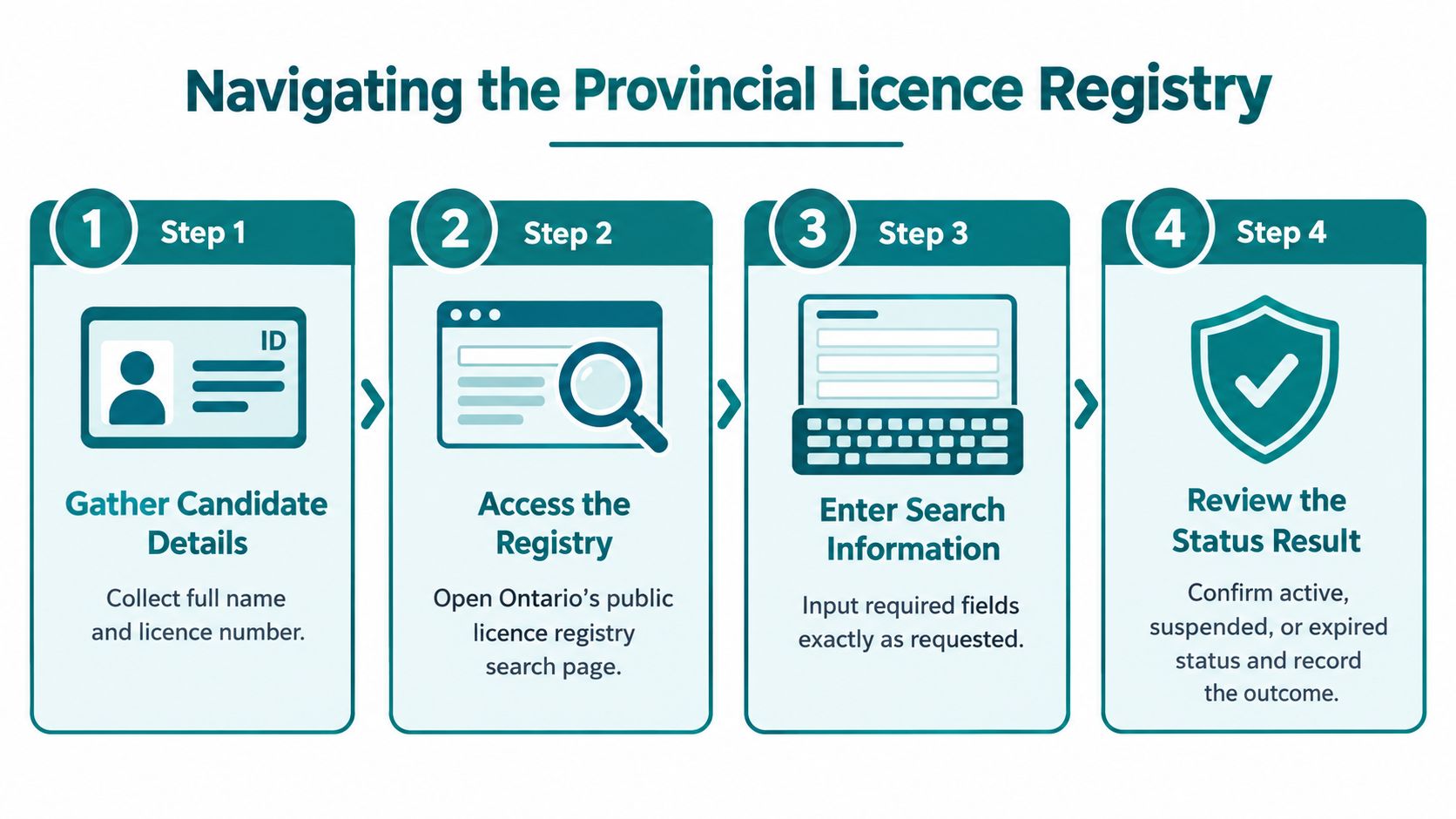
Navigating the Provincial Licence Registry
A candidate can appear ready for orientation while the hiring file still lacks a verified licence record. Start with Ontario's public licence registry, the official source for checking an individual security guard or private investigator licence. The registry also supports searches for agency licences and registered employers. A scanned card can be cropped or altered and often omits the expiry date field, so it cannot support a compliance decision on its own.
Search the right record
For an individual guard, request the 6–8 digit licence number shown on the licence, along with the candidate's full legal name. Check both against the application and identity documents. A transcription error, an incomplete name, or a mismatch between the applicant and the registry record can produce an inconclusive result or attach the wrong record to the file.
Search an agency by its licence number or legal business name. Search a registered employer by its registration number or legal business name. Keep those records separate from the individual licence. An agency's valid status does not establish that each guard it proposes is currently licensed. The Ontario public licence registry guidance sets out the available search paths and explains the registry's role in confirming status.
A reliable search sequence
Gather candidate details. Obtain the individual's full legal name and licence number. Compare them with the application and identity records before searching.
Open the official registry. Use Ontario's public search page, not an unofficial directory or an image forwarded by another person.
Choose the correct record type. Use the individual search for a guard or investigator. Select the agency or registered-employer search when checking an organisation.
Review and preserve the result. Confirm the displayed status and expiry information. Record who completed the search, the search date, the details entered, and the result obtained.
A registry result is independent evidence of status, but it does not prove that the person completing the application is the licence holder. Employers can add identity verification services to the intake process, then keep the provincial licence check and federal criminal screening as separate controls within the same hiring file.
What to do when the result is unclear
An unsuccessful search requires investigation before a hiring decision. Check transcription errors, spacing, legal-name differences, and the selected licence category. Ask the candidate to clarify the information and run the search again.
If the result shows an expired or otherwise unusable status, pause deployment and document the decision. If it shows active, record the expiry date and compare it with orientation, site training, client approval, and the planned first shift. An active result confirms eligibility at the time of the search. It does not guarantee coverage through onboarding or deployment, so set a follow-up check when the schedule approaches expiry.
Interpreting Expiry Timelines and Renewal Windows
A licence can show as active during an onboarding check and still expire before the employee reaches the first regulated shift. That timing gap creates a practical risk for employers. Ontario states that individual security guard and private investigator licences are valid for two years, while agency licences are valid for three years. Individual renewals may be submitted up to 90 days before expiry, as set out in the Private Security and Investigative Services Branch annual reporting.
Treat the registry result as a point-in-time confirmation, not a promise that the licence will cover the entire hiring process. Compare the remaining validity with orientation, site training, client approval, uniform or access setup, and the planned first shift. A candidate starting immediately may have enough time remaining. A delayed start or lengthy client approval process may require a renewal plan before deployment is scheduled.
Assess the usable licence period
Record three dates against the licence result:
- Search date: When HR or operations confirmed the current status.
- Expected start date: When the candidate is likely to begin regulated work.
- Planned review date: When the team will check the status again.
The expiry date deserves its own control. A short remaining period does not automatically disqualify a candidate, but it does require follow-up. Ask whether a renewal has been submitted, request supporting evidence through a secure process, and set a review date before assigning regulated duties. Keep the renewal question separate from the federal criminal screening process. Each check answers a different hiring question, and neither should be treated as proof that the other remains current.
Ontario's licensing activity has shifted across recent reporting cycles. The province reported 132,419 licensed individuals and 952 licensed agencies in 2022–2023, followed by 158,052 licensed individuals and 1,156 licensed agencies in 2023–2024. For 2024–2025, it reported 161,484 licensed individuals and 1,122 licensed agencies, including a 2% year-over-year rise in licensed individuals, according to the 2023–2024 and related branch reporting. The figures do not explain why activity changes, but they support a repeat-check policy rather than a single review at offer stage.
Handle renewals as a workflow event
The provincial licensing portal allows users to renew a pre-existing licence and check an application's status. Employers can classify each file into three operational categories:
- The licence is active and has enough remaining validity for the planned work.
- The licence is active, but its expiry is close enough to require a scheduled re-check.
- The licence is no longer usable, or the renewal position has not been confirmed.
Use conditional offer language for the second and third categories. State that the candidate must maintain the required licence and that status will be verified before regulated duties begin. Do not promise a shift based only on an application receipt.
In 2024–2025, test volume fell 19.7% year over year to 60,520, while applications rose about 9%. Because the reasons for those timing shifts are unclear, the safe operational response is to re-check status whenever renewal timing could affect a start date, training schedule, or deployment decision.
Aligning Provincial Checks with Federal Criminal Screening
A provincial licence confirms a person's standing within Ontario's private security licensing system. It doesn't replace the criminal screening required for the role or erase the employer's responsibility to choose a check that matches the duties.
Ontario requires security guard and private investigator applicants to submit a Criminal Record and Judicial Matters Check with the licence application. The province also states that agency licences must be renewed every three years, as described in its guidance for individual security guard and private investigator licences. That provincial requirement serves the licensing process. An employer's own screening programme may have a separate purpose, such as assessing role-related risk before hiring or meeting a client's contractual requirements.
Know what each check does
A basic Criminal Record Check, or CRC, is generally used to identify relevant criminal-record information through an authorised screening process. A Criminal Record and Judicial Matters Check, or CRJMC, goes beyond a basic record check by addressing available judicial matters information. A Vulnerable Sector Check, or VSC, is a restricted check for roles involving trust or authority over children or vulnerable persons.
The RCMP distinguishes between name-based and fingerprint-based searches. A name-based search checks active criminal files in the National Repository of Criminal Records and is often used as a preliminary search. A fingerprint-based search checks the full national repository and produces a certified result after identity is verified by fingerprints. If a name-based search can't confirm identity, fingerprints may be requested, according to RCMP criminal record information policy guidance.
Employers can't request a VSC because they prefer the most extensive option. The role must meet the legal threshold, and the request must follow the authorised police or screening process. For a standard security post that doesn't involve the required relationship with vulnerable persons, a VSC may be inappropriate and can create human rights concerns.
Matching the check to the security role
| Check Type | Best Used For | Legal Boundary |
|---|---|---|
| Criminal Record Check | General pre-employment screening where the role requires a basic criminal record search | Obtain informed consent and assess only information relevant to the job |
| Criminal Record and Judicial Matters Check | Ontario licensing requirements and roles where judicial matters information is relevant | Use the check for its stated purpose, with a documented, role-related rationale |
| Vulnerable Sector Check | Positions involving trust or authority over children or vulnerable persons | Request only where the role qualifies and use the authorised process |
An employer should also separate the screening decision from an automatic exclusion rule. A record doesn't always answer whether someone can perform the job safely and lawfully. Apply consistent criteria, allow the candidate to address inaccurate or incomplete information, and document how the decision relates to the actual duties. Teams that need to operationalise the criminal screening stage can review Canadian criminal record check services as one part of a broader, consent-based process.
Avoiding Privacy and Compliance Pitfalls
Licence numbers, identity documents, and criminal screening results are sensitive personal information. Sending them through ordinary email or keeping them in an unrestricted shared folder may feel convenient, but convenience doesn't establish a defensible privacy process.
Canadian employers need a clear purpose for collection, meaningful consent, limited access, and a retention approach that reflects the information's sensitivity. Depending on the organisation and its activities, obligations may arise under PIPEDA or applicable provincial privacy legislation. Employers should also consider whether a vendor stores or processes information outside Canada, especially where internal procurement rules or client contracts require Canadian data handling.
Consent must be auditable
Don't rely on a generic sentence buried in an application form. Consent should explain what information will be collected, why the employer needs it, who may receive it, and how the information will be used. The record should show the version of the disclosure presented to the applicant and the date consent was obtained.
A compliant workflow also gives the candidate a reasonable way to correct identity details or challenge an apparent match. This matters when names are similar, records require fingerprint confirmation, or the registry information doesn't align with the application.
A defensible file contains the reason for the check, the applicant's consent, the result, the decision, and the retention or deletion action.
Limit access and retention
Store only what your team needs. In many cases, HR doesn't need an unrestricted copy of every document once the verification decision has been recorded. Use role-based access, protect exported reports, and establish a deletion schedule that considers employment requirements, legal holds, client obligations, and applicable privacy rules.
Human rights considerations apply alongside privacy. Don't ask for a VSC when the role doesn't qualify, don't use irrelevant personal information in the hiring decision, and don't create a blanket rule that treats every criminal record as disqualifying without examining relevance, recency, and the duties involved.
A formal Canadian screening compliance programme can help teams standardise consent, access, retention, and review procedures. The provider still needs appropriate due diligence, but a controlled process is safer than informal document exchanges between recruiters, applicants, and site managers.
Building a Frictionless Verification Workflow
The most reliable workflow connects the licence check to the rest of hiring instead of making HR repeat the same questions in separate systems. Start with the application, collect the legal name and licence number, complete identity proofing, run the role-appropriate criminal check, and route any exceptions to a named reviewer.

A mobile-first intake reduces the need for applicants to email licence cards and forms back and forth. It also gives candidates a clearer view of what they need to provide, which helps prevent delays caused by missing information. Identity verification adds an important control because the registry record must belong to the person being hired, not merely to someone with a similar name.
Connect checks to hiring decisions
A practical workflow can assign a status to each requirement:
- Identity confirmed: The individual's identity details support the screening request and registry search.
- Licence active: The Ontario record supports eligibility on the date checked.
- Expiry monitored: The team has recorded the expiry date and scheduled a future review where needed.
- Criminal screening complete: The selected check matches the role and consent is documented.
- Review required: A mismatch, unclear result, or role-specific concern has been routed for human assessment.
HRIS and ATS integrations can remove duplicate data entry by passing candidate details into the screening request and returning a clear status to the hiring file. That doesn't mean every decision should be automated. A system should flag exceptions, while a trained reviewer decides what the result means for the job.
The workflow should continue after the first shift. Set a re-verification reminder before the licence expiry date, define who owns the review, and require confirmation before assigning future regulated work. For agency and client environments, keep the individual's licence status separate from the agency's corporate status so a change in one record doesn't get overlooked.
A Canadian screening partner such as Alero Background & Identity can combine identity proofing, credential verification, and criminal checks through a consent-led intake, with HRIS and ATS integration options and Canadian data residency. The useful test isn't whether a platform removes every manual step. It's whether your team can see the current status, identify an exception quickly, and show how the decision was made.
The following video provides another view of how a digital verification process can fit into an employer workflow.
Before adopting any tool, map the process from application to first shift and then through recurring compliance reviews. Confirm who owns the registry search, who handles a renewal exception, how candidates provide consent, where records are stored, and when old documents are deleted. A clear operating model will do more for compliance than adding another disconnected screening order form.
Alero Background & Identity offers Canadian criminal record checks, identity verification, and credential-focused screening workflows that can support an Ontario security licence status check from candidate intake through renewal monitoring. Visit Alero Background & Identity to connect licence verification with a privacy-conscious hiring process.