A candidate is moving fast through your hiring funnel. The role is a field sales job, a delivery route, or a service position that puts someone behind the wheel on company time. HR has the resume, the references look fine, but the question is simple, can this person drive safely and consistently in Ontario, and do you have the right record to make that call?
That's where the Ontario drivers abstract becomes more than a checkbox. For employers, it's a practical screening tool that helps you balance speed, compliance, insurance expectations, and road-safety risk. It also sits alongside criminal record checks, identity verification, and, for some roles, commercial driving records, so choosing the wrong document can waste time and create avoidable gaps in your process.

For HR teams, small business owners, recruiters, and hiring managers, the challenge is not just ordering a record. It's knowing which Ontario driving record fits the job, how to read the result without overreacting, and when a standard abstract is enough versus when you need a different record for commercial or compliance-heavy screening. A good starting point is understanding how driving checks fit into broader logistics and fleet hiring, which is why many teams fold them into a larger screening workflow, as described in Alero's logistics screening guidance for Canadian employers.
Table of Contents
- Introduction Why Ontario Driving Records Matter in Hiring
- What an Ontario Drivers Abstract Is and What It Is Not
- Choosing the Right Ontario Driving Record for Your Hiring Need
- How Employers Can Request an Ontario Drivers Abstract
- How to Read and Interpret Key Fields on the Abstract
- Compliance and Screening Context for Canadian Employers
- Putting It All Together for Faster Safer Hiring Decisions
Introduction Why Ontario Driving Records Matter in Hiring
A candidate reaches the final shortlist for a delivery role. The position includes daily driving, customer visits, and regular use of a company vehicle. References and experience may look strong, yet the hiring decision still depends on a practical question: does the applicant's recent Ontario driving history fit the work?
The Ontario drivers abstract helps answer that question. It turns driving history into a hiring input, allowing HR teams to compare a candidate's recent conduct with the role's safety, licence, and insurance requirements. The record is especially useful for drivers, delivery staff, and field workers whose work takes place on the road.
Ontario's standard employer-facing option is typically the 3-year driver record. The province lists an uncertified copy at $12 and a certified copy at $18 (SafeHire Ontario drivers abstract guide). That makes the abstract a practical official snapshot for routine screening, while higher-risk or commercial roles may require a different record.
The right record depends on the hiring use case. For a role with occasional driving, a standard abstract may provide enough recent information. A position with frequent vehicle use calls for closer attention to demerit points, active suspensions, and convictions. Commercial transportation or compliance-heavy work may call for a CVOR-style record rather than relying only on the standard three-year view.
Ontario's driving record page identifies the abstract's main fields, including driver details, demerit point total, active fine suspensions, and relevant convictions, suspensions, and reinstatements within the past 3 years. Reviewing those fields consistently helps employers apply the same screening approach to each candidate.
Practical rule: Match the record type to the driving responsibility, then assess the visible history against the job's threshold.
A driving check does not predict every future incident. It gives employers a documented basis for a safer, more consistent decision within a broader workflow, such as logistics screening guidance for Canadian employers.
What an Ontario Drivers Abstract Is and What It Is Not
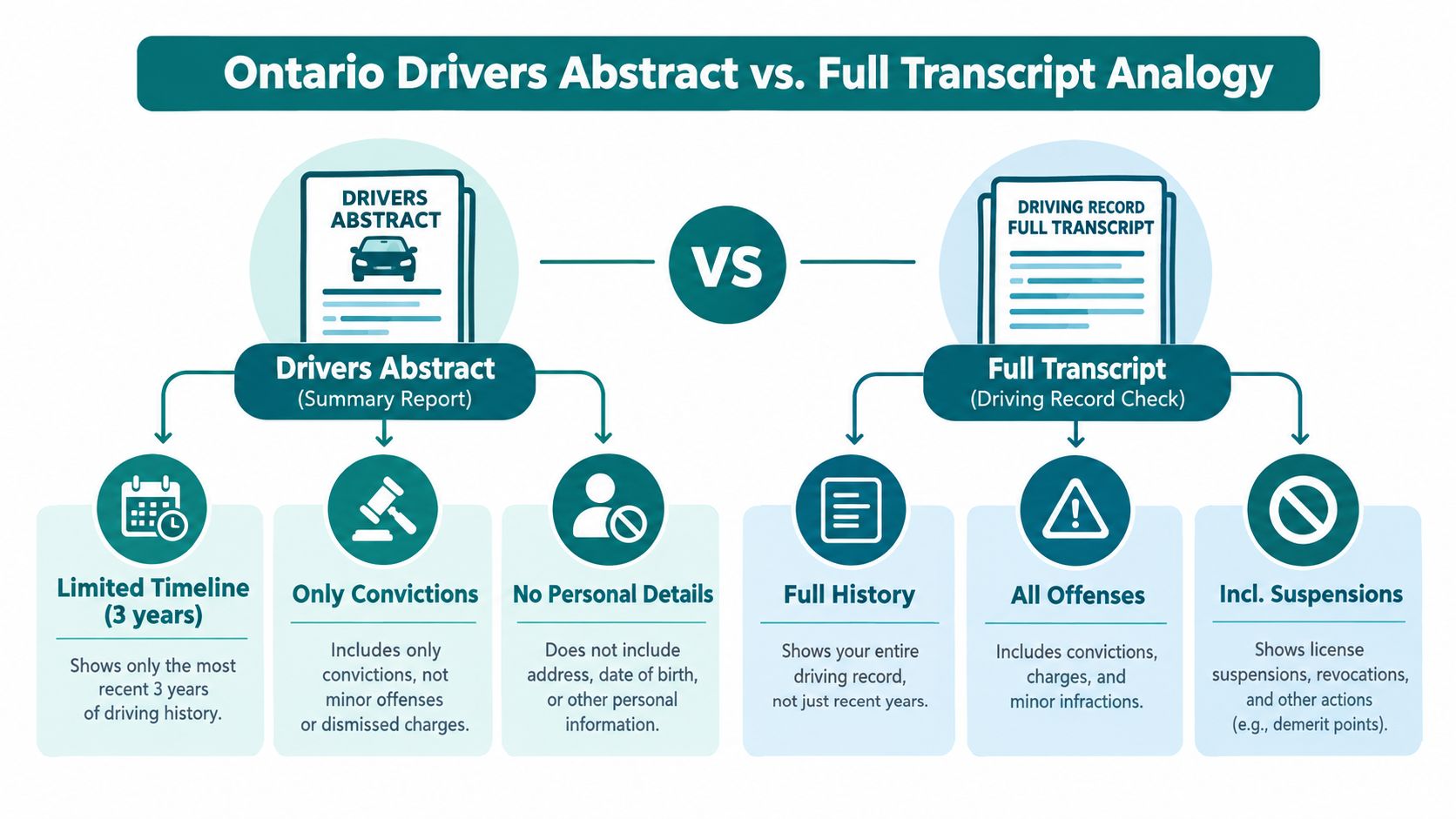
An applicant for a delivery role may present a clean record, while HR still needs to ask what that record covers. An Ontario drivers abstract works like a recent report card, not a complete transcript. It shows documented driving information within a defined period, so it supports a hiring decision without answering every question about a person's driving history.
The abstract is a time-bounded official snapshot
Ontario's standard abstract includes licence details, the demerit point total, active fine suspensions, and relevant convictions, suspensions, and reinstatements from the past 3 years (Ontario driving record page). Employers can use those fields to assess recent licence status and driving conduct against the requirements of the role.
The time limit matters. An issue that falls outside the visible period may not appear, while a current demerit point total can still indicate present exposure. A clean abstract therefore means no relevant items are shown in that record window. It does not prove that no older driving issue ever existed.
The document also serves a different purpose from a criminal record check. It is a motor vehicle record focused on driving conduct, licence status, and certain driving-related offences. A separate criminal screening may still be appropriate, depending on the position and the employer's screening process.
It is not a lifetime record
For HR, the practical interpretation is recent verified driving behaviour, not a complete life history. The record helps standardise what the employer can review, but it cannot replace a decision about the role's actual driving exposure.
Use the documents as distinct tools:
- Abstract: recent official driving history for routine screening.
- Licence verification: confirmation that the licence is valid and belongs to the candidate.
- Commercial or CVOR-related record: a better fit when the position involves commercial motor vehicles or additional fleet oversight.
A demerit threshold should be tied to the job's responsibilities, not applied without context. Occasional driving may call for a basic recent check, while frequent, regulated, or commercial driving may require a broader record review. When the standard 3-year abstract does not answer the employer's risk question, select a different record type before making the hiring decision.
A clean abstract supports a decision, but it does not make the decision by itself.
Choosing the Right Ontario Driving Record for Your Hiring Need
A candidate may regularly drive to client sites, deliver goods, or operate a commercial vehicle. Those roles create different screening questions. Ordering a generic abstract for each applicant can leave HR with too little information, or with a document that does not match the job.
Choose the record by the driving exposure first, then place the order.
Match the record to the hiring use case
| Record Type | Best For | Scope and Cost |
|---|---|---|
| 3-year uncertified driver record | Routine employment screening for non-commercial driving roles | Official Ontario snapshot of the past 3 years, with the province's published price at $12 for an uncertified copy |
| 3-year certified driver record | Formal verification, legal needs, or employers that require an officially certified copy | Same 3-year scope, with the province's published price at $18 for a certified copy |
| Complete driver history or licence history | Full-history review, verification, or cases where older licence activity matters | Ontario service pages describe complete history options and the same published price points for abstract and complete licence history products |
| CVOR-related driver abstract | Fleet, logistics, and commercial motor vehicle screening | Can cover up to 5 years of commercial-motor-vehicle-related events, which is a different scope from the standard consumer abstract (MyDrivingAbstract FAQs) |
The standard 3-year record usually fits occasional, non-commercial driving, such as a sales employee using a company car. It gives HR a consistent recent record for a role with limited driving exposure.
A certified copy fits a file that requires formal document verification. A complete driver or licence history is more appropriate when older activity, licence details, or a longer review period affects the decision. The available record should answer the employer's actual question, rather than follow an ordering habit.
Commercial work calls for a different lens. A courier, transit worker, truck driver, or fleet operator may create exposure that a standard consumer abstract does not fully address. A CVOR-style record can be a better fit when the role involves commercial motor vehicles, regulated transport, or responsibility for fleet operations.
Apply the same decision rule consistently
- Occasional non-commercial driving: start with the standard Ontario abstract.
- Formal verification or legal file: consider the certified version.
- Older history or licence detail: choose a complete or licence history product.
- Commercial or fleet screening: request a CVOR-style record.
Demerit information should also be read against the job. A threshold that may be acceptable for occasional driving can be unsuitable for a position involving frequent road time or commercial equipment. Set the review standard before assessing candidates, document why it fits the role, and apply it consistently.
Alero Background & Identity offers Ontario driver's abstracts within its Canadian screening services, alongside identity and verification tools. That can help employers connect the record request to the position instead of using one generic form for every hire.
How Employers Can Request an Ontario Drivers Abstract
A fleet supervisor needs to confirm licence status quickly. An HR team hiring for occasional driving may need only a standard record. The request should match that job decision from the start, because the right abstract is a screening tool, not another document to collect.
Start with consent and a clear purpose
Ontario driver's abstracts help employers and insurers assess driving risk when driving forms part of the role (The Big CA overview). Before ordering, explain the purpose to the candidate, identify who will review the record, and set a retention period. Consent should relate to this specific screening purpose rather than sit inside a broad onboarding form.
The request should also reflect the record type selected earlier. A standard abstract may answer a routine driver verification question. A role involving commercial vehicles, regulated transport, or fleet responsibility may require a different record and a closer review of older activity.
Choose the ordering channel
Ontario provides several ways to obtain a driving record. Online ordering generally suits a quick uncertified copy. In-person or mailed requests may be more appropriate when the candidate needs a certified document or another record type.
- Online ordering: suitable for a quick uncertified abstract.
- In person: useful when same-day service or certification is needed.
- Mail: practical when a formal copy is required and in-person access is difficult.
The channel affects speed and formality, not the hiring standard. Decide what the role requires before the candidate begins the request.
Keep the workflow candidate-friendly
Ask only for information that supports the hiring decision. If the position requires a standard abstract, do not request a more intrusive record without a job-related reason. An ATS or HRIS can collect consent once, show the request status, and reduce repeated email instructions.
Ontario's published service pricing provides a direct-request benchmark. The standard record costs $12 for an uncertified version and $18 for a certified version. Employers can confirm the current requirements and order through the province rather than paying for an unnecessary resale service.
For teams that prefer a managed process, Alero's Ontario driver's abstracts service can place the record request alongside other Canadian screening steps. The same review standard should still apply, whether the candidate orders directly or the employer uses a screening provider.
How to Read and Interpret Key Fields on the Abstract
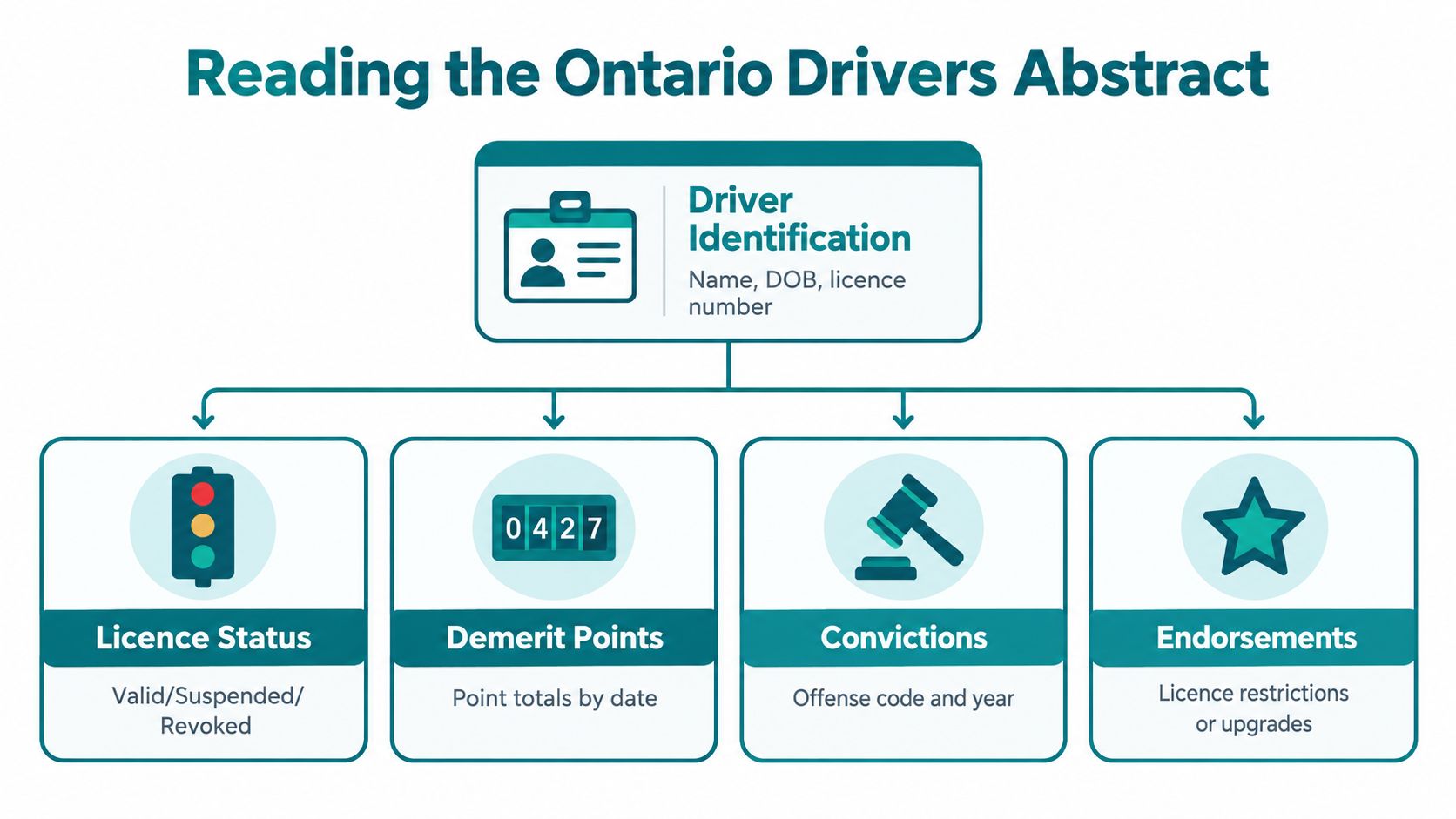
A hiring manager reviewing a delivery driver's record may see a valid licence and assume the screening is complete. The abstract needs a closer reading. Treat it as a hiring decision tool, similar to a timeline: identity confirms whose record you have, licence status shows whether the person can drive now, and the history helps assess recent, serious, or repeated conduct.
Read the fields in a consistent order
Ontario's driving record page describes identification details, demerit point totals, active fine suspensions, and convictions, suspensions, and reinstatements from the past 3 years (Ontario driving record page). Review those fields in sequence:
- Driver identification: Match the record to the candidate's identifying information.
- Licence status: Confirm that the licence is valid and not suspended.
- Demerit point total: Check the candidate's current exposure under Ontario's point system.
- Convictions and suspensions: Examine the offence type, dates, and any reinstatement information.
This order prevents a serious issue from being overlooked because the total point count appears low. It also gives HR a repeatable process across candidates and roles.
Use thresholds as decision markers
Ontario's demerit-point system provides practical reference points. Points remain on the record for 2 years from the offence date. A full G-licence holder receives a warning letter at 6 to 8 points, the Ministry may require an interview at 9 to 14 points, and a suspension can occur at 15 or more points (Ontario demerit points page).
These thresholds are screening markers, not automatic hiring rules. An employer can compare the record with the job's driving requirements, insurance rules, and internal policy. A candidate close to a threshold may need a more careful review than someone with no current points, especially in a safety-sensitive role.
The offence itself also matters. Ontario lists 3 points for holding or using a hand-held device while driving, 4 points for exceeding the speed limit by 30 to 49 km/h, 6 points for careless driving, and 7 points for failing to remain at the scene of an accident. Those entries provide context that a total alone cannot show.
Practical rule: Review recency, severity, and pattern together. One older issue calls for a different response than several recent offences.
Compare points with convictions
Demerit points and convictions use different retention periods. Square One's Ontario guidance explains that points stay for 2 years from the offence date, while convictions remain on the driver abstract for 3 years from the conviction date (Square One Ontario demerit points guidance). A conviction can therefore remain visible after its points have dropped off.
A low point total does not by itself establish low driving risk. For commercial or safety-sensitive work, review the conviction history, suspension information, and licence status together. If the role requires broader commercial-vehicle information, a standard 3-year abstract may not answer every screening question, so HR should confirm whether a CVOR-style record is the appropriate record type.
Compliance and Screening Context for Canadian Employers
An Ontario driving record should sit inside a broader Canadian screening framework, not replace it. HR teams often need more than one check because driving risk, identity risk, and criminal risk are different issues. If you blur them together, you can end up with a process that looks thorough but doesn't answer the right question.
Match the check to the legal purpose
A basic criminal record check, a Criminal Record and Judicial Matters Check, and a Vulnerable Sector Check are not interchangeable. For vulnerable sector checks, the RCMP says only the police agency or authorized body in the applicant's local jurisdiction can conduct the check, and the applicant must request it from the police service where they live. The RCMP also says online VSCs are only available to applicants living in that police agency's jurisdiction (RCMP criminal record dissemination policy).
Ontario adds its own jurisdictional rule. Toronto Police Service says only Toronto residents, identified by a postal code beginning with “M”, can obtain a Vulnerable Sector Check there, and youth applications from ages 14 to 17 are only processed when the role is with federal, provincial, or municipal government and the agency is Toronto Police-approved (Toronto Police Service checks page). Those limits matter because employers sometimes assume a VSC can be requested anywhere, by anyone, for any role. It can't.
Keep privacy and fairness front and centre
PIPEDA, provincial privacy laws, and human rights obligations shape how you collect, store, and use screening information. The safest practice is to collect only what the role needs, store it securely, limit access, and document how the result affected the hiring decision. That's especially important when a driving record intersects with insurance requirements or an accommodation issue.
Alero's compliance-focused workflow, described on its compliance page, is one option employers use to keep consent, data handling, and report review aligned with Canadian screening expectations. The main operational value is not marketing polish, it's having a structured process that keeps the candidate experience clear and the audit trail easier to defend.
Putting It All Together for Faster Safer Hiring Decisions
The best Ontario screening process is simple, but not simplistic. Start by choosing the right record for the job, then collect consent cleanly, then read the result as a risk signal rather than a yes-or-no stamp. If the role involves commercial driving or fleet work, don't assume the standard abstract is enough.
A practical hiring checklist looks like this:
- Match the record to the role: standard abstract, certified copy, complete history, or commercial record.
- Capture consent early: tie the request to the actual driving requirement.
- Review the right fields: identity, status, points, suspensions, and convictions.
- Check both points and convictions: one can fall off before the other.
- Document the decision: keep the reasoning consistent across candidates.
If you standardise those steps, you reduce rework and make it easier to compare candidates fairly. You also make the process less frustrating for applicants, because they're asked for the right document once instead of being bounced between forms and follow-ups.
For roles with higher road exposure, or where you need a broader screening package, a trusted Canadian screening partner can keep the workflow tight and compliant while still moving quickly.
Alero Background & Identity supports Ontario driver's abstract requests as part of a broader Canadian screening and identity verification workflow, with consent-based ordering, clear report handling, and data stored within Canada. If you want to simplify driving-record checks for hiring, visit Alero Background & Identity and review the screening options that fit your roles and turnaround needs.