You've got a conditional offer waiting, a manager asking when the new hire starts, and a screening file stuck because the wrong check was ordered or the candidate's name doesn't match their ID. That's the core hr background check problem in Canadian hiring: it's rarely about whether you can screen, it's about whether you can screen the right person, for the right role, with the right consent, without slowing the offer down.
In Canada, a good screening program does more than pull a record. It protects privacy, respects human rights, keeps candidate experience intact, and gives hiring teams a repeatable way to move fast without guessing. For employers that run high-volume hiring, regulated roles, or volunteer intake, the difference between a loose process and a structured one shows up in compliance risk, manual rework, and the amount of back-and-forth your team has to manage.
Ontario's scale tells the story. The province processed over 1 million police record checks annually, and more than 70% were vulnerable sector checks, which shows how screening sits inside hiring and volunteer operations in Canada's care, education, and public-trust roles (Ontario government release). If turnaround time slips or the wrong check is used, the whole hiring chain feels it.

A structured Canadian program solves three problems at once, it reduces unnecessary screening, it keeps consent and privacy defensible, and it gives candidates a clearer path through the process. That's the lens I use on every hiring workflow now, define the check by role, collect only what you need, and make the candidate journey simple enough that people finish it. Alero Background & Identity fits naturally into that model as a Canadian screening and identity verification option, but the core discipline is process, not platform.
Table of Contents
- Why Canadian HR Teams Need a Structured Background Check Program
- Understanding Canadian Background Check Types and When to Use Each
- How to Operationalise Your HR Background Check Workflow
- Consent Privacy and Compliance Essentials for Canada
- Choosing a Vendor and Integrating Screening With Your ATS
- Avoid Costly Mistakes and Keep Candidates Moving
Why Canadian HR Teams Need a Structured Background Check Program
The mess starts when teams treat screening like a generic admin step. One manager wants a “full check,” another wants “everything,” and a third wants the fastest possible result without thinking through role fit. The outcome is usually the same, extra candidate friction, avoidable delays, and inconsistent decisions that are hard to defend later.
The operational cost of inconsistency
Canadian employers don't have the luxury of a one-size-fits-all approach. Under Canadian privacy rules, screening has to be necessary and reasonable for the job, and consent matters because candidates can refuse it (Canadian privacy and criminal-record rules). That means the workflow has to start with role design, not with a vendor form.
Practical rule: if the check type isn't tied to the duties, trust level, or regulatory context of the role, it probably doesn't belong in the package.
A structured program also protects hiring speed. Ontario has linked police record-check workload to service-delivery reform, which is a reminder that turnaround time is a live operational issue, not a theoretical one (Ontario government release). HR teams feel that pressure most when checks are ordered too early, too broadly, or with incomplete candidate data.
What a modern program actually covers
A working program usually includes identity verification, criminal record screening, judicial matters checks, vulnerable sector checks, and role-specific verification such as education, employment, credit, or driving history. It also needs bilingual candidate communication, secure handling, and a clean handoff into the ATS or HRIS so recruiters don't end up copying data between systems by hand.
The privacy piece matters just as much as the speed piece. Canadian guidance expects secure handling, purpose limitation, access controls, and retention discipline, and Ontario employers often rely on human-rights and privacy principles rather than a single dedicated private-sector screening statute (employment background checks primer). If your process is scattered across email, spreadsheets, and shared drives, that's where risk creeps in.
The most reliable screening programs are boring in the best way. They're predictable, role-based, and easy for candidates to complete on a phone. That's the standard worth aiming for before anyone talks about automation.
Understanding Canadian Background Check Types and When to Use Each
A hiring manager asks for “a criminal check,” and the core question remains unanswered. For Canadian HR, the check has to fit the role, the level of trust, and the legal authority to request it. That matters most in schools, care settings, and finance, where the wrong screen can slow hiring or create avoidable compliance risk.
CRC, CRJMC, and VSC are not the same tool
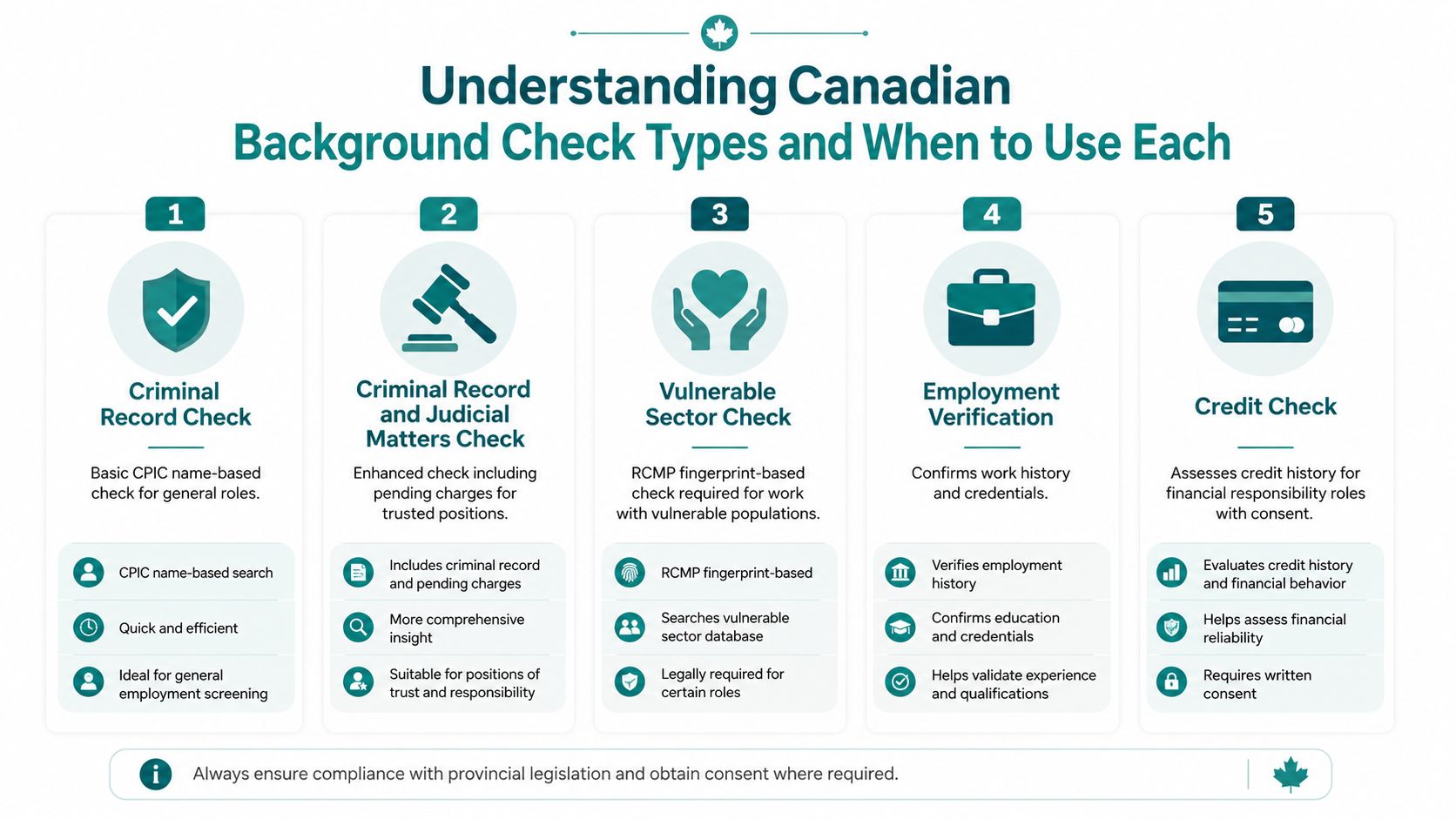
A basic Criminal Record Check is the lightest option. It is a standard name-based criminal screening for general roles, and it works when you need a straightforward result without the added vulnerability context. A Criminal Record and Judicial Matters Check adds more than the basic record and fits trusted but non-vulnerable roles, such as board members, administrative staff, contractors, or people in schools and care facilities who are not in positions of authority over vulnerable persons (York Regional Police CRJMC guidance).
A Vulnerable Sector Check is different again. The RCMP says it includes a criminal record check plus a search for record suspensions for sexual offences, and only the police agency or authorised body in the applicant's local jurisdiction can conduct it (RCMP criminal record checks). The RCMP policy guidance says vulnerable sector verifications were created in 2000 to protect children and vulnerable persons, and police may search local records and intelligence databases as part of that process (RCMP policy guidance).
For a full breakdown of Canadian criminal record check types, see this guide to criminal record checks in Canada.
| Canadian Criminal Check Types by Role Fit | What It Includes | Who Can Request | Best For |
|---|---|---|---|
| Criminal Record Check | Basic CPIC name-based criminal search | Employers, with consent and role relevance | General staff and low-trust roles |
| Criminal Record and Judicial Matters Check | Criminal search plus outstanding entries and charges | Employers, with consent and role relevance | Trusted roles that do not require VSC |
| Vulnerable Sector Check | Criminal record plus sexual-offence pardon or suspension search, and related police-database review | Only the police agency or authorised body in the applicant's jurisdiction | Work with children and vulnerable persons |
| Employment Verification | Work history and credential confirmation | Employers with consent | Experience-sensitive roles |
| Credit Check | Financial history summary, used with consent | Employers where financial responsibility is relevant | Finance or cash-handling roles |
Match the check to the job, not the habit
A credit summary can be defensible for finance roles where the employee handles money or sensitive financial authority. A driver abstract is often more useful than a broader personal screen for fleet positions. For jobs involving care or access to vulnerable people, the VSC may be appropriate, but only where the role justifies it and the local police process supports it.
The cleanest test is simple, ask whether the result will change a hiring decision for this specific role. If the answer is fuzzy, the check is probably too broad.
The rest of the screening menu sits outside criminal checks. Identity proofing, education verification, employment verification, reference checks, and public social-media review all show up in Canadian hiring, but each one needs proportionality. Québec privacy guidance has sharpened that point by focusing on necessity for the role, not consent alone, and by preferring reference checks over credit checks when the goal is to assess character (Québec privacy regulator guidance). That is the practical filter. Ask whether the check fits the job, then decide whether it belongs in the ATS flow at all.
How to Operationalise Your HR Background Check Workflow
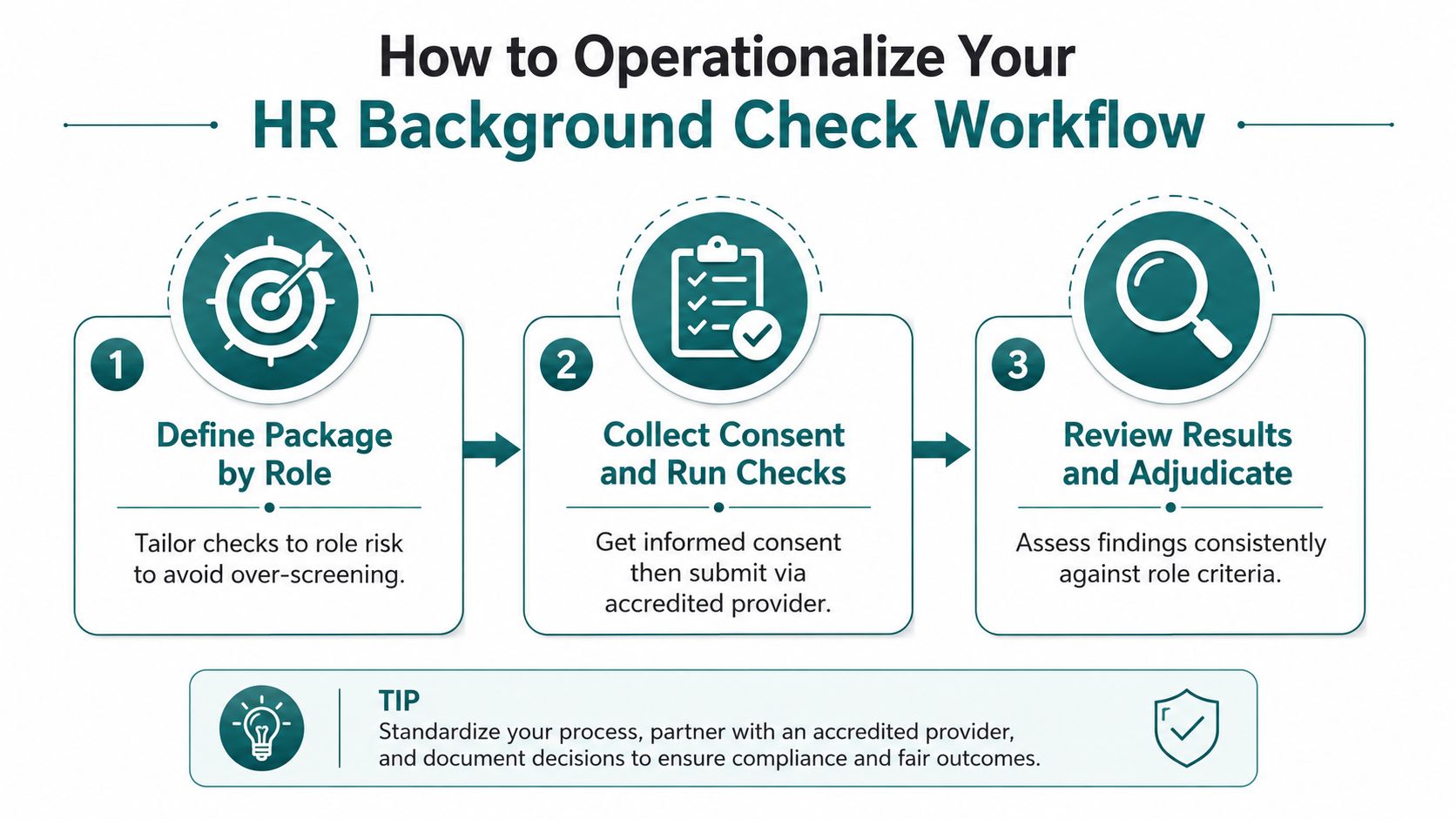
The teams that move fastest don't improvise. They use a repeatable flow that starts before the requisition goes live and ends with a clean decision file inside the ATS. In practice, that usually means three actions, define the package, trigger the digital invitation, then review and monitor the result.
1. Define the package by role
Start with the job, not the candidate. A basic criminal check might fit general staff, a credit summary may fit finance roles, and a driver abstract makes sense for fleet positions. That is the point where most over-screening gets prevented, because the package reflects the position instead of a manager's preference.
The most common data mistake is right here. Collect the candidate's exact legal name as it appears on their primary government-issued ID, including middle names or previous legal names, plus the current residential address before you submit anything. Typos, nicknames, and missing middle names are a major cause of identity mismatches and manual review delays.
2. Trigger the digital invitation
Once the package is set, enter the candidate's full name and email into the portal to send a secure, mobile-friendly consent and intake link. A brief heads-up text or email before the invite lands helps a lot, because candidates know the message is legitimate and can have their ID ready.
Operational win: prep the candidate first, then send the link. That small sequence change reduces drop-off because the candidate isn't trying to guess what the email is asking for.
Alero Background & Identity supports this kind of workflow with Canadian screening and identity verification, plus ATS and HRIS integrations, bilingual workflows, and Canadian data residency. That combination matters because it reduces manual entry, keeps the consent trail in one place, and avoids the common mess of moving candidate data between systems.
3. Review and monitor status
Once the check is in motion, track progress in real time and handle identity flag alerts before they stall the file. When the final report comes back, access it securely and adjudicate it against the role criteria you set up at the start, not against a vague organisational comfort level.
The fastest teams keep this part narrow. Only hiring decision-makers should see the result, and only the people who need it should be able to touch the record. That discipline prevents the classic problem of sensitive information drifting into inboxes, spreadsheets, or casual chat threads.
Consent Privacy and Compliance Essentials for Canada
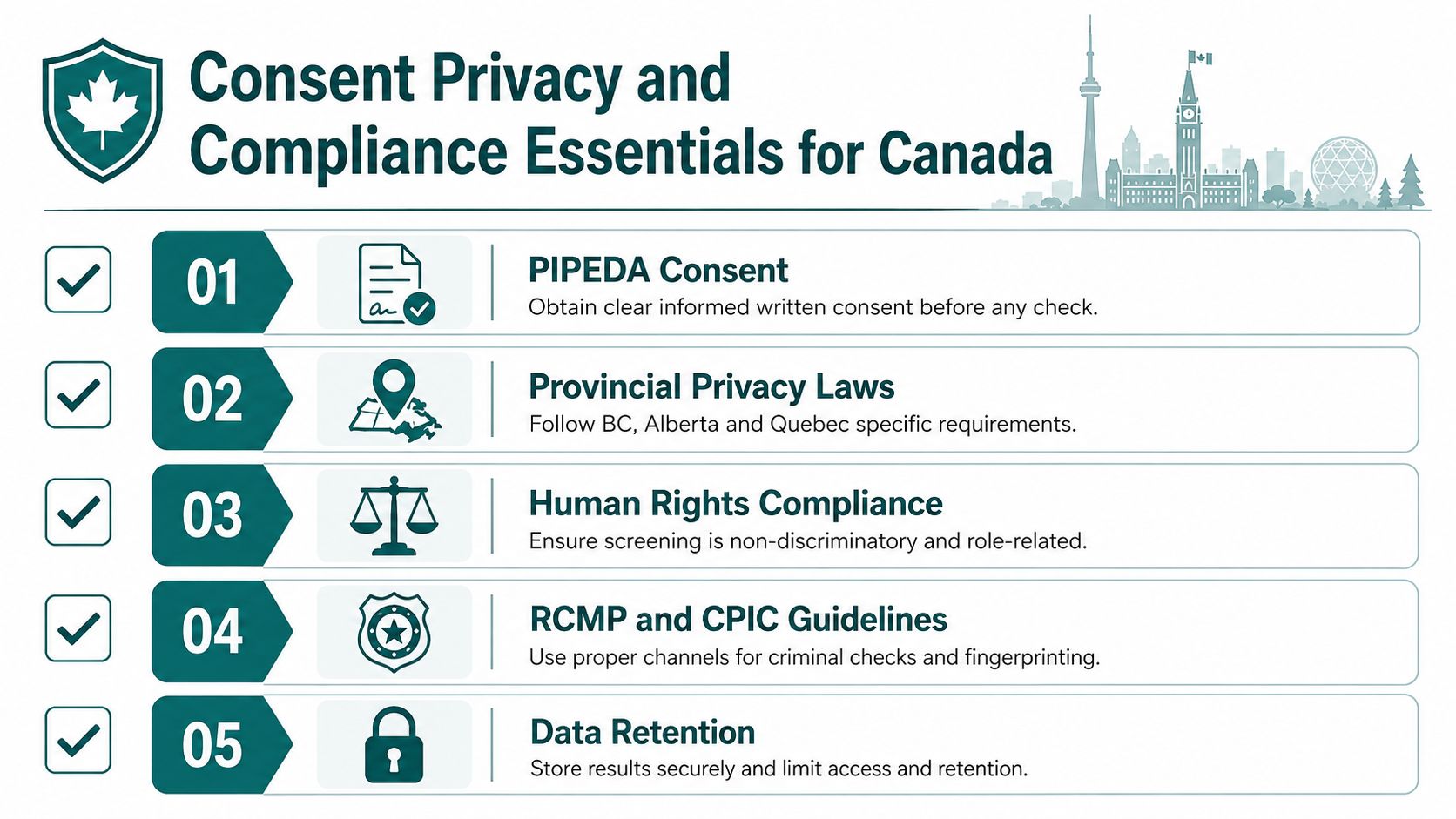
A candidate accepts the screen, then asks what it covers and who will see it. That is the right moment to slow down and make the process plain. Canadian screening depends on consent, necessity, and clear purpose, and privacy rules expect the collection to be informed, knowledgeable, and voluntary (Office of the Privacy Commissioner of Canada guidance on employee personal information). If the candidate cannot see what is being collected, why it is needed, and how it will be used, the workflow is already weak.
Consent is necessary, but it is not enough
Consent does not make every check acceptable. Employers still need a job-related reason to collect the information, and the screen has to fit the role. The Office of the Privacy Commissioner of Canada's fair information principles are a good baseline for that, because they push HR teams to limit collection, explain use, and keep the process transparent (PIPEDA fair information principles).
Ontario does not give private-sector employers one simple background-check statute to follow, so policy design matters even more. Blanket screening, vague consent language, and using police-record information beyond the stated purpose all create avoidable risk. Human-rights obligations also stay in play, so the check has to match the job and the decision criteria have to be defensible.
Handle the data like sensitive hiring evidence
Treat screening results as sensitive hiring evidence. Limit access to the people who make the hiring call, store the record securely, and keep it only as long as your retention rules require. For Canadian screening operations, our Canadian screening compliance standards are built around that approach.
Practical rule: if the result affected the hiring decision, keep the decision record long enough that the applicant can reasonably ask for access.
The edge cases matter too. Ontario-focused guidance warns against asking candidates to supply their own record unless they self-disclose, and it flags that some non-conviction or youth-related information should not be passed along (CFIB criminal background check guidance). Québec adds a stricter check on necessity. If you cannot show that the information is required for the role, collection may be offside even when the candidate agrees to it (Québec privacy regulator guidance).
Keep the workflow staged. Tell candidates exactly which check you want, collect written consent, and trigger the screen only after the person is clearly identified or the offer is conditional. That keeps the file cleaner, lowers discrimination risk, and gives recruiters a consent trail they can stand behind if questions come later.
Choosing a Vendor and Integrating Screening With Your ATS
A screening vendor should reduce work, not add another queue for recruiters to babysit. The useful questions are practical ones, can the vendor capture consent cleanly, does it keep applicant data in Canada, can a recruiter see status without emailing support, and does it fit the systems you already use.
What to look for in a provider
The strongest vendors make the candidate experience obvious. Statuses should be plain language, intake should work well on a phone, and support should be reachable when a file gets stuck. Canadian employers also need CAD pricing they can understand up front, plus a system that doesn't bury them in setup fees or minimums.
That's where Alero's integrations page is relevant. A Canadian team can use a provider like Alero Background & Identity when it needs PIPEDA-aligned consent workflows, Canadian data residency, and a frictionless candidate flow that lives inside the hiring process instead of outside it.
Fit the screening into the ATS, don't bolt it on
The best integration pattern is simple, once a candidate reaches the right stage in the ATS, the check is triggered automatically, the consent trail is captured, and status updates flow back into the file. That cuts duplicate data entry and gives recruiters a single place to monitor progress instead of juggling portals.
A good rollout usually starts with one role family, not the entire organisation. Pilot the workflow on jobs where screening is already common, then expand once the process is stable and hiring managers understand the timing. That lets you test exception handling, candidate messaging, and adjudication rules before the process becomes company-wide.
Turnaround speed still matters, but not at the expense of accuracy. For clear results, Canadian providers often aim for a fast result window, and the better ones pair that with human support for review cases and identity flags. The point isn't to chase speed blindly, it's to make speed reliable enough that recruiters can trust the process.
Avoid Costly Mistakes and Keep Candidates Moving
The most expensive screening mistakes are usually self-inflicted. Over-screening or choosing the wrong check type slows hiring, frustrates candidates, and creates legal exposure under privacy and human-rights rules. It also wastes the team's time because someone has to explain why a file was sent for the wrong level of review.
The two delays I see most often
The first is the wrong package. Teams order a vulnerable sector check for a role that doesn't legally warrant it, or they pull a credit report where a simple employment verification would have done the job. The second is identity mismatch, usually caused by a nickname, a missing middle name, or an incomplete address.
The fix is procedural, not heroic. Use a role-based checklist before the invite goes out, collect the exact legal name and current address first, and send a short heads-up message so the candidate knows the email contains a secure ID verification link and should have government ID ready. That simple prep often keeps the process moving without extra follow-up.
Keep the program tight after launch
Once the workflow is live, review the files that land in manual review and ask why they got stuck. Most of the time, it's a data entry problem or an over-broad request, not a candidate issue. That's also where periodic re-verification matters for regulated roles, because screening isn't always a one-time event.
A clean program is one that gets easier to run after the first month, not harder.
Standardise the package library, measure where candidates drop off, and keep the adjudication rules narrow. If the role doesn't justify the check, don't order it. If the result won't change the decision, don't collect it. That discipline is what keeps hiring moving without turning screening into a compliance headache.
If you want a Canadian hr background check process that's role-based, consent-first, and easy for candidates to complete on mobile, Alero Background & Identity can help you structure the workflow and keep it inside your ATS. Visit Alero Background & Identity to see how Canadian screening, identity verification, and integrations can fit your hiring process without adding manual work.
Enhanced by Outrank tool