An HR coordinator opens a PDF, sees a driver's licence number, and has to decide whether to onboard the candidate, hold the file, or send it to compliance. That decision feels simple until the licence check turns out to be the wrong kind of check. In Canada, card or application status, licence validity and class, and the official driver abstract are different records, and each one answers a different hiring question.
For Canadian HR teams, that distinction matters. A self-service portal can confirm that a card is being processed, but it won't usually give you the driving history you need for a safety-sensitive role. A photocopy can show what the candidate handed over, but it won't tell you whether the licence has been suspended, whether the class matches the job, or whether you need a formal record request before you can make a defensible decision.
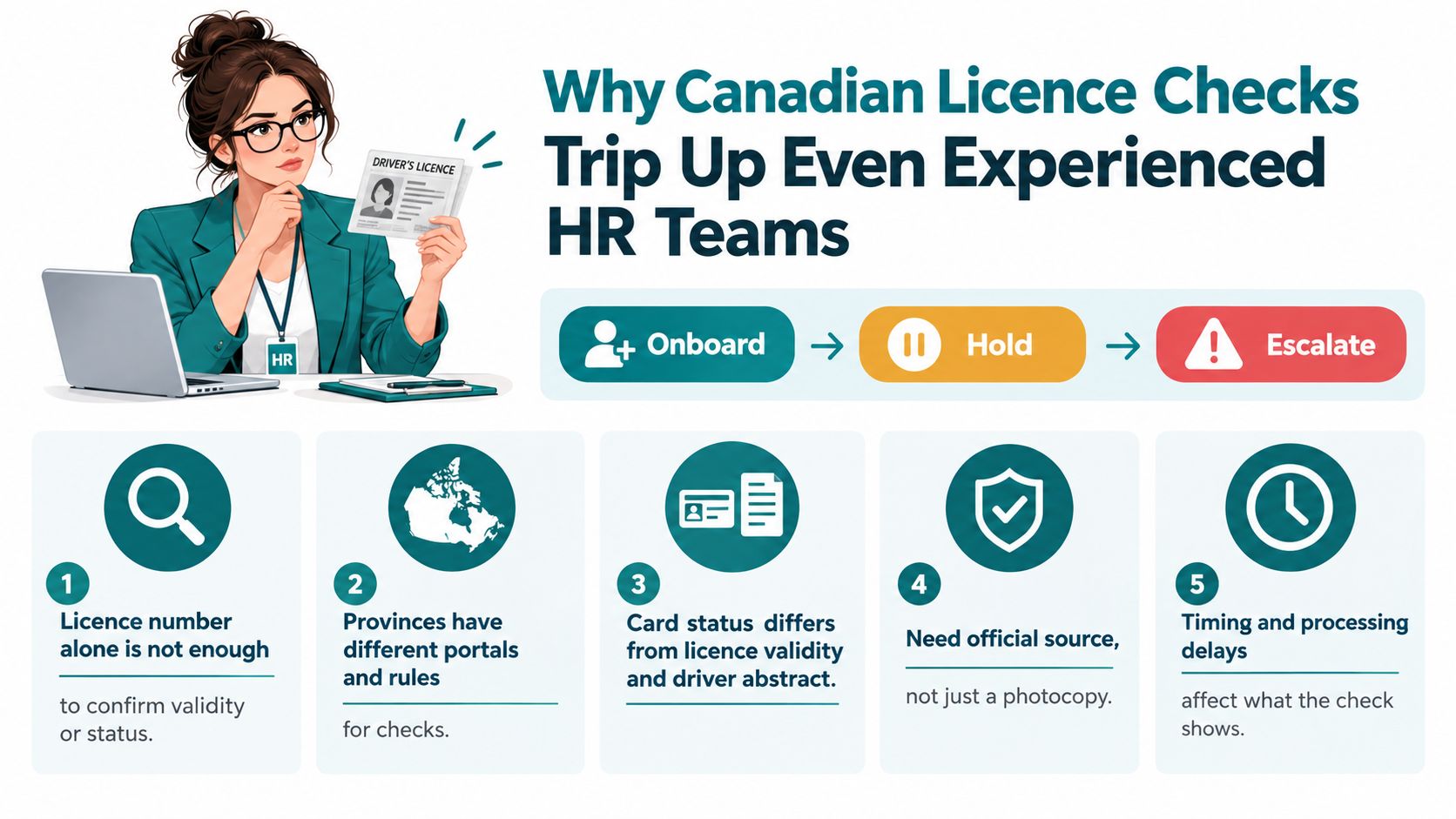
Table of Contents
- Why Canadian Licence Checks Trip Up Even Experienced HR Teams
- The Three Distinct Checks Behind the Phrase Licence Status
- Self-Service Paths by Province and What They Actually Show
- How Employers Request an Official Licence Check or Driver Abstract
- Privacy, Consent, and Human Rights Rules That Shape the Process
- What to Do When a Check Surfaces an Issue
- Key Takeaways for Drivers and Hiring Teams
Why Canadian Licence Checks Trip Up Even Experienced HR Teams
The most common failure point is treating a licence number as if it solves the whole problem. It doesn't. One number can sit inside three separate processes, and the wrong one gets candidates, recruiters, and hiring managers talking past each other.
The first mistake is assuming the card tells the whole story
A card status check only answers whether the document has been issued, renewed, replaced, or is still moving through the mail stream. That's useful, but it's narrow. In California, the DMV's public-facing workflow makes the split obvious, because it separates status tools from driver-record access and says nearly all services can be completed online, with specific tools for status checks and records requests. The same practical distinction shows up in Canadian hiring: the portal result is not the same thing as the underlying record.
A second mistake is treating an out-of-province licence as automatically acceptable because it looks current. A valid-looking card doesn't tell you whether the holder can legally drive the class of vehicle your role requires in that jurisdiction. It also doesn't tell you whether a suspension, reinstatement, or class restriction should change your hiring decision.
Practical rule: if the job depends on driving, ask what question you're trying to answer before you ask for any document.
The second mistake is using the wrong record for the wrong decision
The third common error is confusing a licence check with a criminal background check or a driving abstract. Those aren't substitutes. In Canada, the RCMP treats a vulnerable sector check as a specialised screening tool for people working or volunteering in positions of trust over children or vulnerable persons, and it's different from a basic criminal record check and from a driving history record. That separation matters because a clean licence status doesn't clear someone for a role that needs criminal screening, and a criminal record check doesn't tell you if the person can legally drive the class you need.
The last mistake is operational, not legal. Teams rely on screenshots, assume the candidate's copy is current, and then discover the record changed before onboarding. That's why the rest of this guide separates the three checks and shows which one answers which question.
The Three Distinct Checks Behind the Phrase Licence Status
Card status, licence validity, and the driver abstract are not the same thing
When people say “check driver licence status”, they usually mean one of three things. The problem is that each one serves a different purpose in hiring and compliance, so using the wrong one creates avoidable risk.
| Check | What it confirms | Where to get it | Who needs it |
|---|---|---|---|
| Card or application status | Whether a card, renewal, replacement, or application is pending, issued, or delayed | Provincial or territorial self-service portal, or issuing registry | Drivers who need a quick status update, HR teams triaging a file |
| Licence validity and class | Whether the licence is active, what class or endorsements apply, and whether restrictions affect driving duties | Issuing province or territory's official licensing system | Employers hiring for driving roles, fleet teams, and drivers checking their own eligibility |
| Driver abstract | The formal driving history used for screening, including offences, suspensions, and reinstatements where the province reports them | Official record request channel in the issuing jurisdiction | Employers, insurers, and regulated operators that need an auditable record |
The first check is the lightest one. It answers, “Is the card moving?” The second check answers, “Can this person drive the role we're hiring for?” The third answers, “What does the official record show for screening or insurance purposes?”
Why HR teams get burned when they collapse the three into one
A candidate can have a card in transit and still be eligible to drive, or they can have a visible licence card that's not enough for the position you're hiring for. A self-service status check won't give you the historical detail you need for a fleet file, and a driver abstract won't replace the card status question if the issue is whether the replacement card arrived.
That split is the reason strong screening workflows keep the questions separate. If you need a quick yes or no on a card, use the status path. If you need a formal record for a driving role, request the abstract through the correct channel. If you need both, don't assume one document covers the other.
Self-Service Paths by Province and What They Actually Show
Provincial portals are useful when the question is narrow and immediate. They're much less useful when a hiring manager wants a complete driving history, because most self-service systems are built to confirm status, not to release the full abstract. A good workflow starts by collecting the licence number, the full legal name, and date of birth, then sending the user to the correct provincial path for that credential.
Ontario's ServiceOntario and similar portals elsewhere are built for quick confirmation, not open-ended screening. Alberta's digital services, BC's provincial systems, and the other provinces and territories each handle access differently, and the candidate's province of licensing determines where the lookup has to happen. If you're doing this at scale, a self-serve workflow like Alero's self-serve portal can help standardise intake and reduce back-and-forth without pretending that one portal covers every jurisdiction.
What the portals generally show
Most portals will confirm the status of the card or the basic licence information that the issuing authority is willing to display. Some will show class information or whether a learner status is active. Very few will release the underlying abstract online, and Quebec, Nunavut, and the territories often require an in-person or mailed process for anything beyond basic confirmation.
If the result you need is “is this licence active and what class is it,” self-service may be enough. If the result you need is “what does the official record say,” it usually isn't.
What to expect by jurisdiction
| Province / Territory | Self-service portal | Information required | What it shows |
|---|---|---|---|
| Ontario | ServiceOntario | Licence number, identifying details | Basic status and driver-record access path |
| Alberta | Provincial online services | Licence number, legal name, date of birth | Status-oriented confirmation and account-based access |
| BC | Provincial licensing services | Licence and identity details | Status or class-related information depending on the service |
| Saskatchewan | Provincial online or registry process | Licence number and personal details | Basic confirmation, limited online detail |
| Manitoba | Provincial service channel | Licence and identity details | Status-related information, not the full abstract |
| Quebec | SAAQ service path | Licence and identity details | Basic confirmation, with more formal request paths for records |
| Atlantic provinces | Provincial registry or service portal | Licence number, name, date of birth | Status confirmation, limited disclosure online |
| Yukon | Issuing office or service channel | Licence and identity details | Basic confirmation, often with manual follow-up |
| Northwest Territories | Issuing office or mailed request | Licence and identity details | Limited self-service availability |
| Nunavut | Issuing office or mailed request | Licence and identity details | Limited self-service availability |
The practical rule is simple. Self-service answers whether the licence looks current. It does not answer what is on the official record.
How Employers Request an Official Licence Check or Driver Abstract
An employer should never build a hiring decision around a candidate screenshot if the role needs an auditable driving record. The better workflow is to use the official request channel for the province that issued the licence, then store the result in the screening file with the consent record attached. For employers that use a consolidated screening platform, Alero's driver's abstracts service is one example of how that request can be centralised without losing the source record.
Who can request what
The rules vary by province. In Ontario, the licence holder orders their own record, so the employer has to get written consent and have the driver submit the request. In Alberta, Saskatchewan, Manitoba, and many Atlantic provinces, the employer can usually apply directly with the candidate's authorisation and the required fee. Quebec's process generally runs through the driver, who then shares the abstract. BC uses its own licensing and record channels, and employers need to follow the province's current record-access path rather than relying on a copied card.
For regulated fleets, National Safety Code obligations can add another layer. If you run vehicles under a safety-sensitive regime, a basic licence confirmation may not be enough. You need the record the regulator and your insurer will recognise.
How long it takes and why that matters
Turnaround varies by province and by the method used. Some results are immediate or same-day, while others can take several business days. That matters because a hiring decision can't outrun the record. If the role starts this week and the abstract won't arrive until next week, you need a holding decision, not a guess.
A practical screening file usually includes three things, not one. The signed consent, the official request receipt, and the returned abstract or confirmation. That sequence protects the employer when a candidate later says the wrong record was used or the role requirements weren't disclosed clearly enough.
Privacy, Consent, and Human Rights Rules That Shape the Process
Licence checks sit inside privacy law, not outside it. Under PIPEDA, employers in commercial activity need meaningful consent and must use personal information for the purpose they disclosed. Provincial privacy laws add their own rules. PIPA in Alberta and BC, and Quebec's Law 25, shape how personal information is stored, transferred, and protected after collection.
That means the process has to be narrow. If the job doesn't require driving, don't collect a driving record. If the role only needs proof that a card is active, don't ask for a full abstract. Collecting more than the role needs creates unnecessary privacy exposure and slows candidates down for no gain.
Human rights rules matter just as much
Every province and territory has human rights protections that limit employment screening. A driver's licence check should only be required when driving is a genuine occupational requirement. If the role is administrative, retail, or remote, a blanket licence request can look like overreach and invite a discrimination complaint.
That's also why a licence check must stay separate from a criminal record check or a credit check. Each one answers a different risk question, and each one needs its own lawful purpose. Employers should write that purpose down before the record is requested, keep only what's needed, and retain it for the period required by policy or law.
Alero's compliance guidance is relevant here because the legal problem is usually not the record itself. It's the way the employer collected, explained, stored, and used it.
Best practice: disclose the screening purpose in writing before the request goes out, and store the result separately from the general personnel file.
What to Do When a Check Surfaces an Issue
A dirty or unclear result doesn't automatically mean the candidate is unusable. It means someone has to slow down and sort out whether the issue is administrative, temporary, or disqualifying.
For drivers
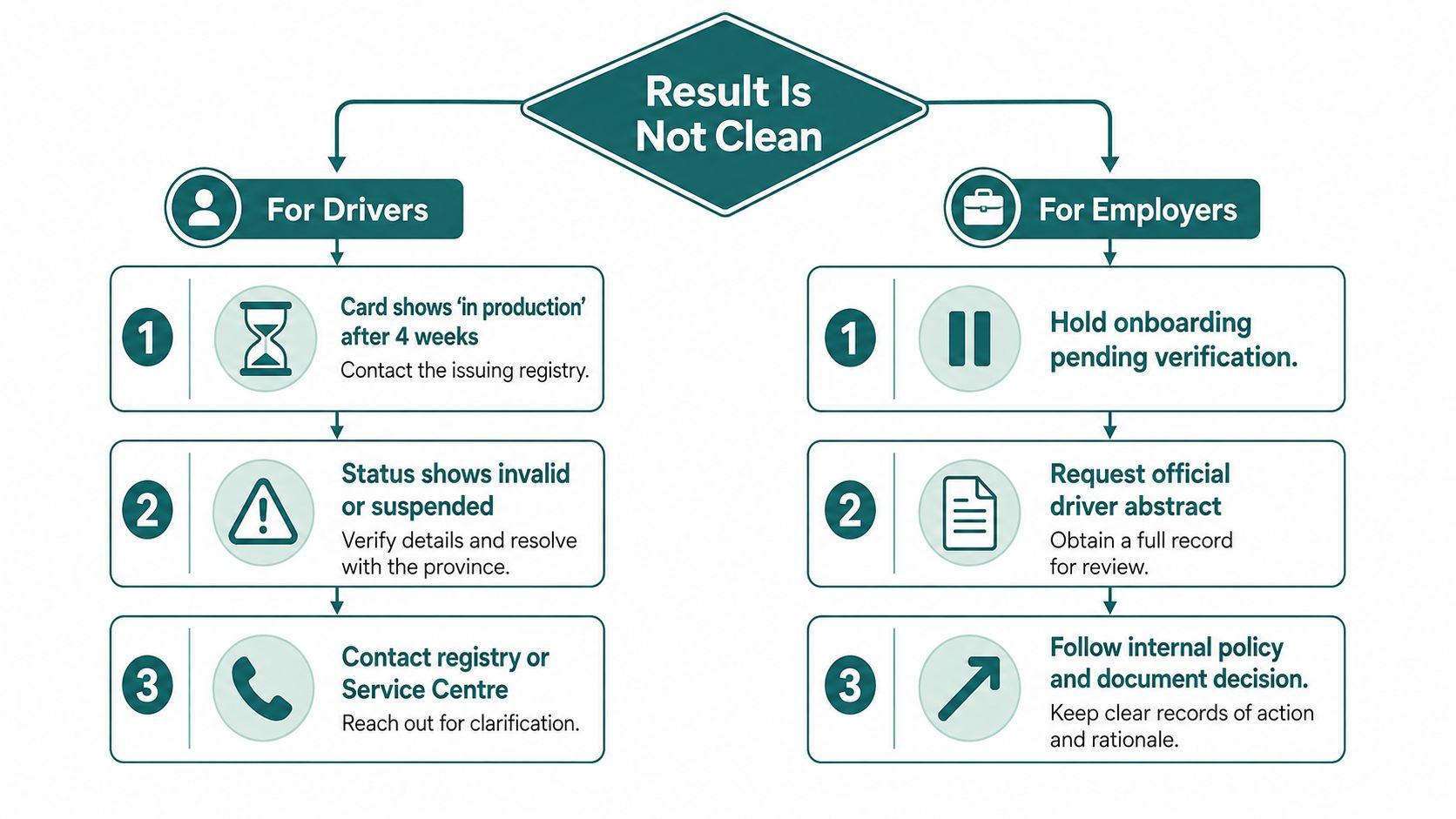
If a card still shows as in production long after you expected it, contact the issuing registry and confirm the mailing status. If the class shown is wrong, or the licence no longer matches the role you want, book the next appropriate recheck or upgrade path with the provincial service centre. If a suspension appears, deal with reinstatement steps and any outstanding fines before asking for a fresh abstract.
If the record shows a demerit pattern or another issue that blocks the role, ask about the waiting period and whether the province allows the issue to age out before reapplying. Don't assume the answer is permanent until the issuing authority says so.
For employers
Do not reject a candidate solely because a status result looks unsettled if you haven't asked for context. Confirm when the issue was resolved, whether the role is safety-sensitive, and whether your internal policy allows you to rely on the specific record you received. If the file needs a defensible record, request the official abstract rather than making a call from a screenshot.
Keep the checklist tight:
- Verify the source portal. Confirm the result came from the issuing province or territory.
- Capture the screen with a timestamp. Preserve what you saw at the time of review.
- Store the result separately. Keep it out of the personnel file unless policy requires otherwise.
Key Takeaways for Drivers and Hiring Teams
The safest way to handle how to check driver licence status is to match the record to the decision you're trying to make. A card status check is for timing. A licence validity check is for driving eligibility. An official driver abstract is for screening, insurance, and auditability.
Use the right provincial portal, not the nearest one. Have the licence number, full legal name, and date of birth ready before you start. Get written consent before any third party requests an abstract, and don't confuse a licence check with a criminal record check. If the result shows a suspension, class mismatch, or expiry issue, work through the province's reinstatement or upgrade process before the role starts.
If your team needs a cleaner way to separate card status checks from official driver abstracts, Alero Background & Identity can help you run Canadian screening with the right consent, the right record type, and a smoother candidate experience. Visit Alero Background & Identity to review driver's licence verification and background screening options that fit Canadian hiring workflows.