
Most name-based criminal record checks in Canada clear in 3 to 10 business days, while vulnerable sector, fingerprint-based, or high-volume municipal checks can stretch from several weeks to 120 business days. That gap is the whole story, and it's why so many Canadian employers get burned by the phrase “fast background check.”
If you're asking how long does a background check take, stop looking for one number. In Canada, the right answer depends on three things: the check type, the police service handling it, and whether the file stays on the automated path or gets pushed into manual review. A clean electronic submission can move quickly. A vulnerable sector check, a fingerprint request, or a file with a possible record match can slow your hiring process to a crawl.
The mistake I see most often is simple. Teams confuse the vendor's turnaround with the police service's turnaround. Those are not the same thing. A screening platform can collect consent, verify identity, and submit a file quickly. It cannot make a municipal police backlog disappear.
Table of Contents
- How Long a Background Check Actually Takes in Canada
- The Three Levels of Canadian Criminal Record Checks
- Typical Timelines for Each Check Type
- Why Instant Background Checks Are Mostly a Myth
- Hidden Bottlenecks That Add Days or Weeks
- What Employers and Candidates Can Do to Speed Things Up
- Compliance Considerations That Affect Turnaround
- Building a Screening Workflow That Plans for the Slowest Link
How Long a Background Check Actually Takes in Canada
Three business days versus 120 business days. That spread, published by the RCMP for different criminal record check scenarios, is why any one-size-fits-all turnaround promise is useless for Canadian hiring teams (RCMP processing times and fees).
Set expectations from the slowest credible path, not the fastest advertised path. In Canada, a straightforward electronic submission with no record match may clear quickly. A file that triggers manual processing, needs clarification, or routes through a busy police service can sit for weeks.
That distinction matters because HR is usually tracking two separate timelines:
- Vendor timeline: consent collection, identity verification, and submission
- Records-holder timeline: police service or RCMP processing and result release
Treat those as one number and you will miss start dates.
What the range means in practice
The useful question is not, “What is the fastest result anyone has seen?” The useful question is, “What is the likely turnaround for this check type, in this jurisdiction, if nothing goes perfectly?”
For many employers, the answer lands somewhere between a few business days and a few weeks. For harder files, it can run much longer. That is why I tell hiring teams to stop quoting best-case timing to managers. Best-case timing is how you create avoidable escalations.
Rule to use: if a police service controls the final clearance, your hiring plan should follow that police service's pace, not your screening vendor's intake speed.
Municipal backlogs decide the hiring timeline
This is the part generic articles skip. Canadian turnaround times are heavily shaped by local police workflows, intake method, and backlog. Online submissions tend to move faster. Mail still slows things down. Manual review is where timelines expand fast.
Ottawa Police, for example, posts online processing ranges in business days and makes clear that service timelines depend on application type and handling method, not marketing claims from screening platforms (Ottawa Police background check questions).
For HR, the takeaway is simple:
- Clean electronic files are the fastest path
- Municipal police-issued checks often take a week or more
- Mail-based delivery still adds avoidable delay
- Manual review or record matching is where a routine hire can turn into a multi-week wait
If you want honest timelines, start with the check type and the jurisdiction handling it. Everything else is secondary.
The Three Levels of Canadian Criminal Record Checks
If you don't know which check you're ordering, you can't estimate timing properly. Canadian employers usually talk about “a background check” as if it's one thing. It isn't.
The practical stack for criminal screening is three levels deep. Each level adds scope, and added scope usually means added time.
Level 1 and Level 2 checks
A Level 1 Criminal Record Check (CRC) is the basic option. It's the starting point for many standard hiring workflows where the role doesn't involve vulnerable people and doesn't require broader judicial information.
A Level 2 Criminal Record and Judicial Matters Check (CRJMC) goes further. It's used when the role justifies a broader review, such as positions with a higher trust threshold or internal policy requirements. Because it reaches further than a basic CRC, it tends to create more review points and more chances for delay.
If your team needs a cleaner breakdown of available screening options, Alero's overview of Canadian criminal record check services is a useful operational reference.
Level 3 vulnerable sector checks
A Vulnerable Sector Check (VSC) is not a general-purpose screening tool. The RCMP is clear that it applies to people who volunteer or work in positions of trust or authority over children or vulnerable persons, and it must be requested through the police agency in the applicant's local jurisdiction. Accredited fingerprinting companies do not provide this check (RCMP vulnerable sector checks).
That point matters because some employers still treat VSCs like an upgraded CRC. They aren't. They're a role-specific legal process.
| Check Level | Scope | Databases Queried | Typical Use |
|---|---|---|---|
| Level 1 | Basic criminal record information | Criminal record repositories used for standard name-based criminal record screening | General employment screening |
| Level 2 | Criminal record plus judicial matters information | Broader police and judicial matter queries than Level 1 | Roles needing more than a basic CRC |
| Level 3 | Vulnerable sector screening for eligible roles | Includes the local police process required for vulnerable sector requests | Roles involving trust or authority over children or vulnerable persons |
Order the narrowest check that fits the role. Over-ordering slows hiring and creates compliance risk.
Typical Timelines for Each Check Type
A "3-day background check" is the exception, not the planning standard in Canada. The timeline depends on which agency touches the file, whether the result stays name-based, and whether a local police service has a backlog.
For HR teams, the practical rule is simple. Budget to the slowest likely step, not the vendor's fastest screenshot.
Name-based checks
A straightforward name-based criminal record check can clear quickly when the file stays electronic and no extra review is triggered. But Canadian employers get burned when they treat the fastest path as the normal path.
Ontario is the clearest example. A Canadian HR Reporter roundup, summarized by SafeHiring, showed wide variation by police service and check type, with some services turning files around far faster than others and some sitting in multi-week backlogs (SafeHiring.ca summary of Ontario timing variation). That is the point HR teams need to act on. "Ontario timing" does not exist. Toronto, the OPP, and smaller municipal services can all move on different clocks.
If the check runs through a local police workflow, use the local police service's reality for your hiring plan.
Fingerprint-based and high-friction files
Fingerprint files follow a different timetable. They usually take longer, and they become unpredictable the moment the file needs manual review or a record has to be matched and confirmed.
Canadian legal and screening explainers commonly describe ordinary fingerprint processing in business days, with much longer waits when a file hits a record match or result delivery adds mailing time (Credibled explanation of Canadian criminal background checks). That is why fingerprinting should never sit at the end of your hiring process if the role has any realistic chance of requiring it.
The same logic applies to higher-friction police checks. CRJMCs and vulnerable sector checks often move slower than a basic name-based CRC because the scope is broader and the local police service usually controls the queue.
| Check Type | Fast Path | Typical Planning Range | Long-Delay Scenario | Main Bottleneck |
|---|---|---|---|---|
| Name-based CRC | A few business days on a clean electronic file | Several business days, sometimes longer if local police handling is involved | Weeks where municipal backlog, manual review, or mail delivery applies | Local police processing, file routing, delivery method |
| CRJMC | Slower than the fastest CRC path | Often measured in business days, but varies by police service | Longer where broader review or queueing is involved | Added scope, police workflow, manual handling |
| Vulnerable Sector Check | Rarely the fastest option | Often longer than a standard CRC | Weeks when local police volumes are high or extra screening steps apply | Local jurisdiction, role-specific police process |
| Fingerprint-based check | Often several business days in a straightforward case | Variable, and usually slower than name-based screening | Much longer where there is a record match or mailed output | RCMP processing, match review, mail delivery |
Set candidate expectations from this table, not from best-case marketing copy. That one change prevents a lot of avoidable offer-date misses.
Why Instant Background Checks Are Mostly a Myth
The “instant background check” pitch usually describes the fastest possible path, not the process most Canadian HR teams are managing.
A true Canadian criminal record workflow has several breakpoints. A clean name-based file may move quickly. But once a file triggers manual review, local police handling, fingerprint requirements, or mail delivery, the idea of instant clearance falls apart.
Where the fast path ends
The biggest misconception is that a name-based check and a police-issued result are the same thing. They're not. The RCMP distinguishes a name-based criminal record check, which applicants may request through a local police agency or a third-party company, from a vulnerable sector check, which must be requested by the police agency where the applicant lives (RCMP policy on dissemination of criminal record information).
That distinction changes both workflow and timeline. Some checks can be initiated outside the police service. Some cannot.
| Process Step | Real Canadian CRC | Marketed "Instant" Check |
|---|---|---|
| Intake | Consent and identity details are collected | Candidate enters basic details online |
| Submission | Request is routed to the appropriate system or police workflow | Search is presented as immediate |
| Review | Clean files may clear quickly, but exceptions can trigger manual handling | Manual review is often invisible in the sales pitch |
| Release | Results may still depend on police processing and delivery | “Instant” implies same-session completion |
If a role needs a vulnerable sector check, stop expecting same-day closure. That's not how the Canadian process works.
Hidden Bottlenecks That Add Days or Weeks
A background check rarely blows up because of one dramatic issue. In Canadian hiring, delays usually come from routine handoffs that nobody priced into the timeline.
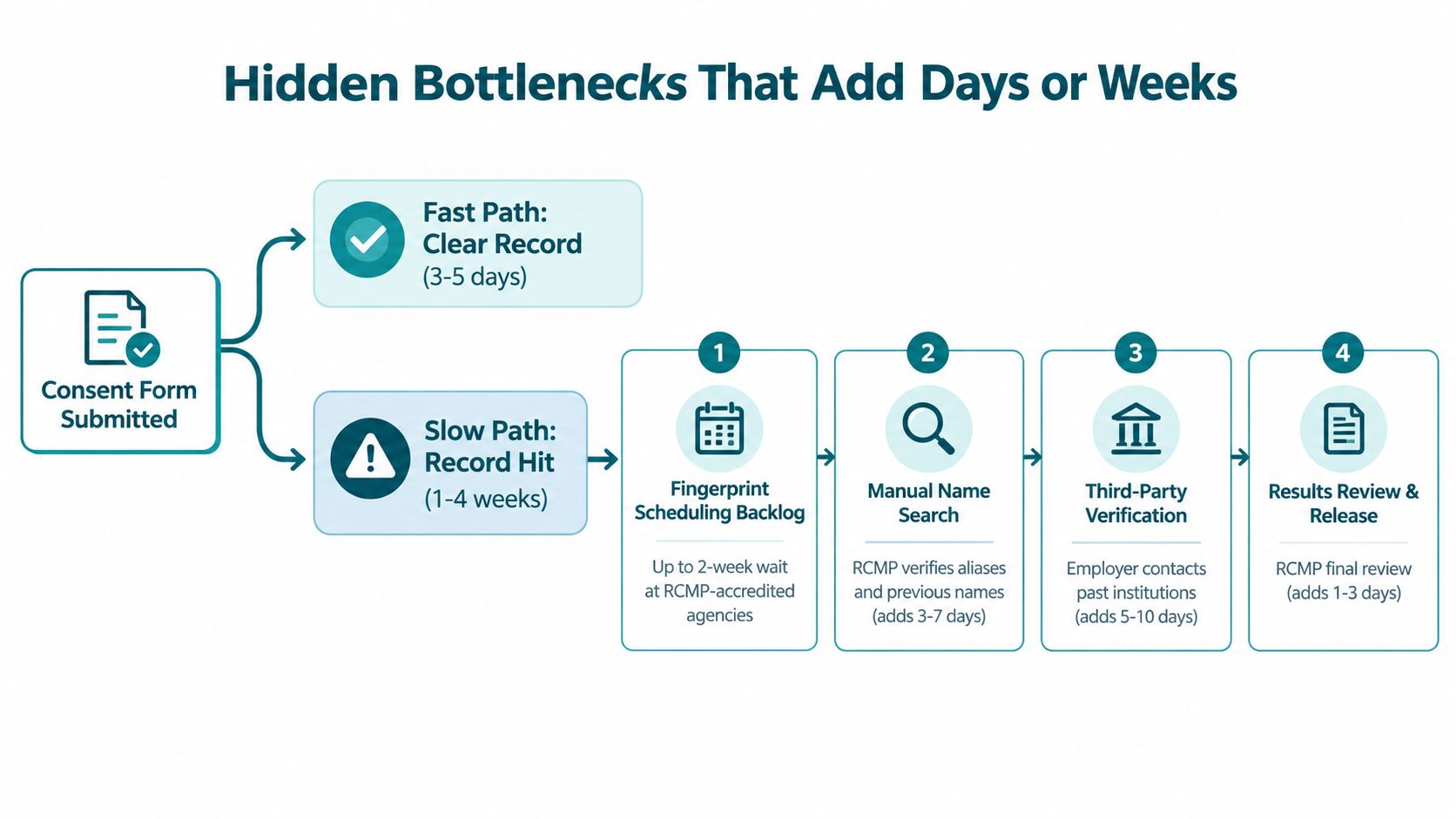
The bottlenecks that matter most
Fingerprints are the biggest schedule breaker. The moment a file needs fingerprinting, your timeline now depends on appointment availability, identity verification, submission processing, and result release. HR teams that promise a quick close after a fingerprint request are guessing, not planning.
Mail is another slow point that still catches employers off guard. Some police services continue to use mailed delivery or allow mail-in applications, and that adds dead time you cannot speed up with reminder emails. Toronto Police notes that mailed applications can take longer to reach the applicant, which is exactly why paper-based workflows keep stretching hires after the actual review is done.
The other delays look small, but they pile up fast:
- Wrong check type selected: Requesting a vulnerable sector check for a role that only needs a standard criminal record check creates avoidable rework.
- Incomplete intake: Missing prior names, address details, signatures, or date of birth information pushes the file back for correction.
- Wrong police service: A candidate starts with the wrong jurisdiction for a police-issued process and has to resubmit through the service tied to their residence.
- Possible record match: A name-based result triggers manual review, and the file leaves the fast queue.
- Identity mismatch: The name on the form does not line up cleanly with the ID presented, so the provider or police service pauses the request.
What actually causes the long tail
The longest delays usually come from process design, not from the candidate.
That matters because many employers keep treating slow checks like a chasing problem. It is a setup problem. If your workflow waits until the end of hiring to collect consent, confirm legal names, choose the right check level, and verify jurisdiction, you have already built lag into the file before the police service sees it.
Clean intake and correct routing save more time than status follow-ups ever will.
My recommendation is simple. Audit every step before submission. Confirm the role requires the level of screening requested. Validate identity details early. Keep paper out of the process where possible. In Canada, the teams that shorten turnaround are not the ones asking for miracles. They are the ones removing preventable friction before a check enters a municipal or police queue.
What Employers and Candidates Can Do to Speed Things Up
The best way to speed up screening is boring. Submit cleaner files. Speed doesn't come from chasing updates. It comes from preventing avoidable exceptions.
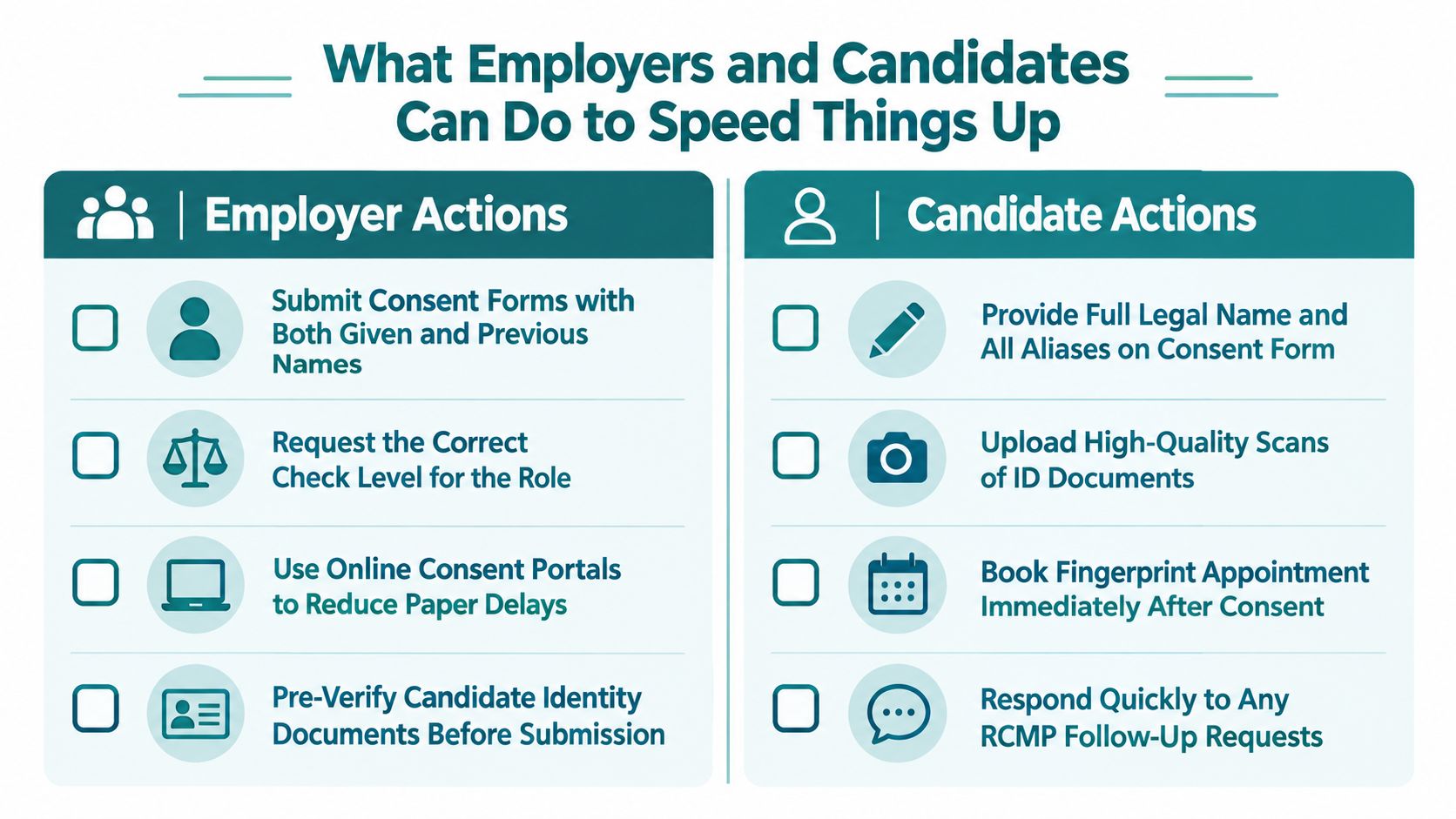
What employers should fix first
Use this as an operating checklist:
- Match the check to the role: Don't request a vulnerable sector check unless the role qualifies for one under the Canadian framework.
- Collect full identity details: Include legal name, prior names where applicable, and current jurisdiction details.
- Use digital intake where available: Electronic submission cuts out avoidable paper lag.
- Start before the planned start date: Background checks should sit earlier in the hiring workflow, not at the very end.
- Pre-verify identity documents: Catch mismatch issues before submission.
For teams hiring remotely, the cleanest workflows combine consent collection with early identity validation. A practical example is using a process like Alero's approach to remote hiring identity verification, where identity proofing happens before the background screening request hits the queue.
What candidates can do
Candidates also control more of the turnaround than they think:
- Provide every relevant name: legal name, prior names, and aliases where applicable
- Prepare government ID early: don't wait until after consent is sent
- Book fingerprint appointments quickly: if fingerprints may be required, delay only makes the queue worse
- Respond to follow-up fast: when a police service or screening provider asks for clarification, same-day response matters
- Confirm local jurisdiction: especially for checks that must run through the police service where the applicant lives
The fastest background check is the one that doesn't need to be corrected and resubmitted.
Compliance Considerations That Affect Turnaround
Compliance isn't separate from speed. In Canadian hiring, compliance is often the reason one file clears smoothly and another gets stuck in loops.
Consent and purpose have to be right
Under the Office of the Privacy Commissioner of Canada, consent under PIPEDA must be meaningful, and for individuals unable to provide meaningful consent, the organisation should obtain consent from a parent or guardian. The OPC generally considers this to include anyone under 13, except in exceptional circumstances (OPC guidance on PIPEDA consent).
For HR teams, that means youth hiring, student programmes, and community-facing roles need an age-aware consent workflow. If your intake form ignores that issue, you can end up redoing the file.
VSC requests need specific employer handling
The RCMP's guidance is blunt here too. Only the employer can request a vulnerable sector check when one is required, and the request must be made in writing with a specific explanation of how the duties place the applicant in a position of authority or trust with vulnerable persons (RCMP guidance on criminal record checks).
That's not paperwork theatre. It's a real process step. If your team treats VSCs like generic candidate-initiated checks, you create delay at the front end.
Strong compliance operations usually include:
- Role-based check selection: only request what the position justifies
- Clear consent language: make scope and purpose obvious
- Retention rules: keep documents only as long as your policy and legal obligations support
- Documented workflows: especially for regulated or child-facing roles
If your team is tightening policy and process, a Canadian-specific framework such as Alero's screening compliance guidance can help align intake, consent, and record-check handling.
Building a Screening Workflow That Plans for the Slowest Link
Most hiring teams still build around the fastest number they've heard. That's a planning error.
If one step in the process can take weeks, that step sets your real hiring timeline. In Canada, the choke point is often the police service handling the record check, especially for vulnerable sector or manually reviewed files.
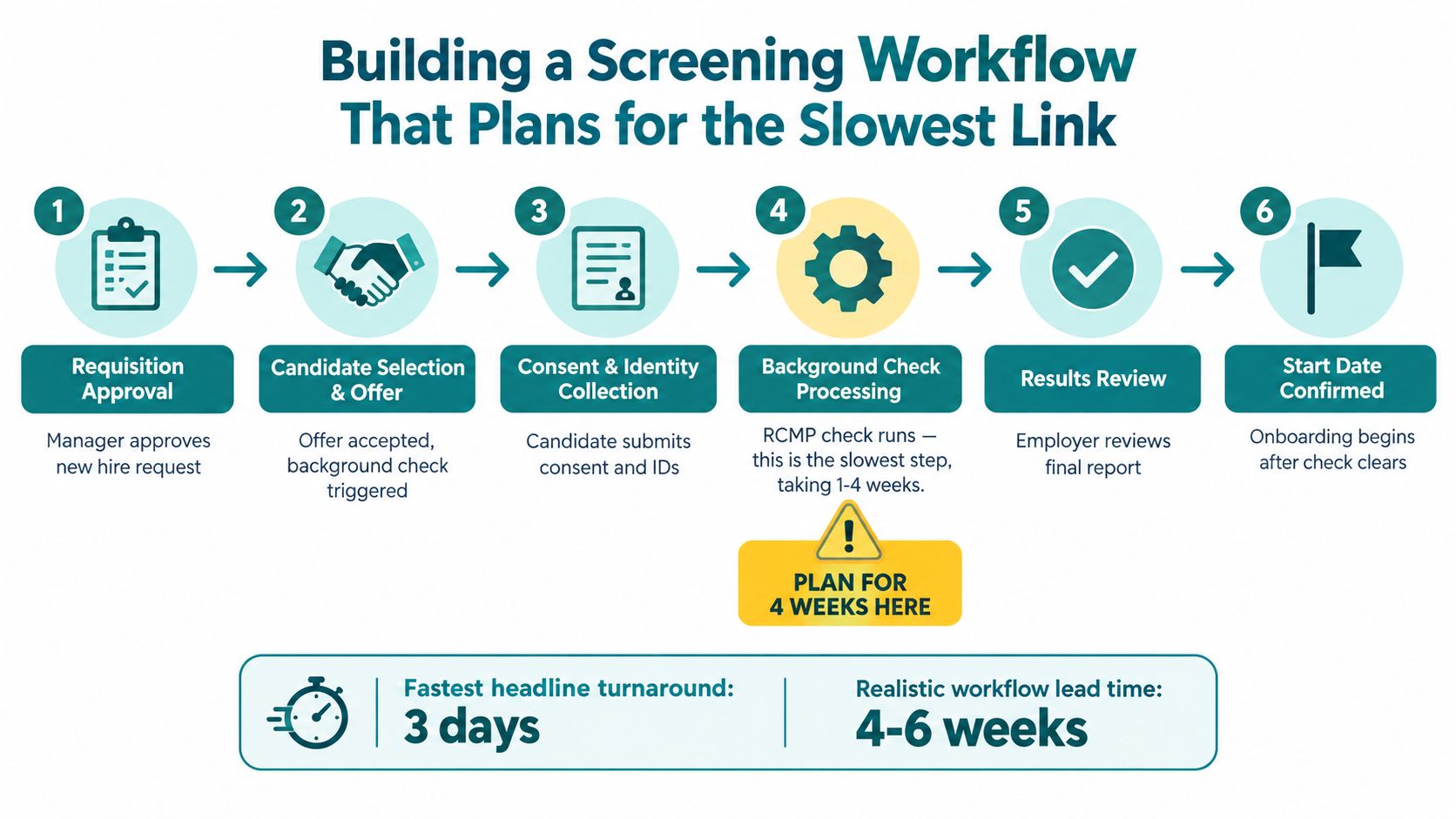
Build the workflow around dependency, not hope
A workable screening process usually looks like this:
- Trigger screening at offer stage: not after all other onboarding steps are done
- Collect consent and identity immediately: don't leave candidate forms sitting
- Run parallel checks where possible: identity, references, and other verifications can move while the criminal record piece is processing
- Set start dates with a buffer: especially where local police or vulnerable sector checks are involved
- Track timelines by jurisdiction: one police service's norm tells you nothing about another's
The practical operating model
The strongest HR teams treat screening as a cycle-time problem, not a one-off purchase.
That means:
- keeping a simple tracker of where delays usually happen
- separating vendor processing time from police processing time
- training recruiters not to promise unrealistic clearance windows
- escalating only when there is an actual exception, not just normal queue time
Plan for the slowest mandatory step first. Everything else should fit around it.
If you do that, candidate communication gets easier, onboarding gets cleaner, and hiring managers stop asking why a “quick background check” is still pending two weeks later.
Alero Background & Identity helps Canadian employers run criminal record checks, identity verification, and related screening workflows in a way that fits Canadian privacy and hiring requirements. If you want a cleaner process, more accurate intake, and fewer avoidable delays between offer and start date, visit Alero Background & Identity.