An HR lead in St. John's has a Class 1 driver starting Monday and needs to confirm the person's driving record before assigning a route. The candidate is ready, the manager is asking for a start date, and a missing authorization form is now the only thing standing between a completed check and an avoidable delay.
That situation is common across Canadian fleets, logistics companies, contractors, and employers with insured driving roles. The mistake is treating a driver abstract NL request as a simple document order. In Newfoundland and Labrador, it's a consent-controlled government-record access process. Your workflow should reflect that from the first candidate email to the final retention decision.
Table of Contents
- What a Driver Abstract in NL Actually Is
- Information You Need Before Requesting the Abstract
- Requesting the Abstract Online, In Person, by Mail or Fax
- Fees, Payment Rules and Turnaround Times
- Employer Consent and Privacy Rules You Cannot Skip
- Where the NL Abstract Fits in a Broader Screening Workflow
- Practical Takeaways and Compliance Checklist for HR Teams
What a Driver Abstract in NL Actually Is
A driver abstract is the official copy of an individual's driving record maintained by Newfoundland and Labrador's provincial Motor Registration Division. The record can be requested through MyGovNL, in person, by mail, or by fax, subject to the province's identification and authorization requirements. The province's official driver-abstract guidance is the right starting point for employers, because generic motor-vehicle-report guides often describe rules from another province.
The document is relevant when a person will drive for work, operate a company vehicle, transport goods, work under an insurer's fleet requirements, or perform another role where driving history affects the hiring decision. It helps HR confirm the record held by the issuing authority. It doesn't replace a practical licence check, a reference call, an employment verification, or a role-specific risk review.
Know what the document is not
A driver abstract is not a driving-experience letter. It doesn't describe a candidate's skill, route familiarity, customer service, safety attitude, or ability to operate your equipment. It's also not a CVOR equivalent, and it isn't a criminal record check.
Keep the screening categories separate:
- A Criminal Record Check, or CRC, addresses criminal-record information through the applicable police or screening channel. It's not a substitute for a driving record.
- A Judicial Matters Check can cover additional court-related information where the applicable authority and process permit it. Employers should use the check that matches the role and the issuing authority's requirements.
- A Vulnerable Sector Check, or VSC, is restricted to eligible positions involving vulnerable persons. An employer can't order one merely because it prefers a more extensive check. The candidate and role must meet the applicable eligibility requirements, and the police service determines whether the request qualifies.
NL's process can feel less uniform than the online portals employers may know from neighbouring provinces. That's precisely why your team should use the provincial channel, confirm the candidate's details, and capture written permission before anyone submits a third-party request.
Information You Need Before Requesting the Abstract
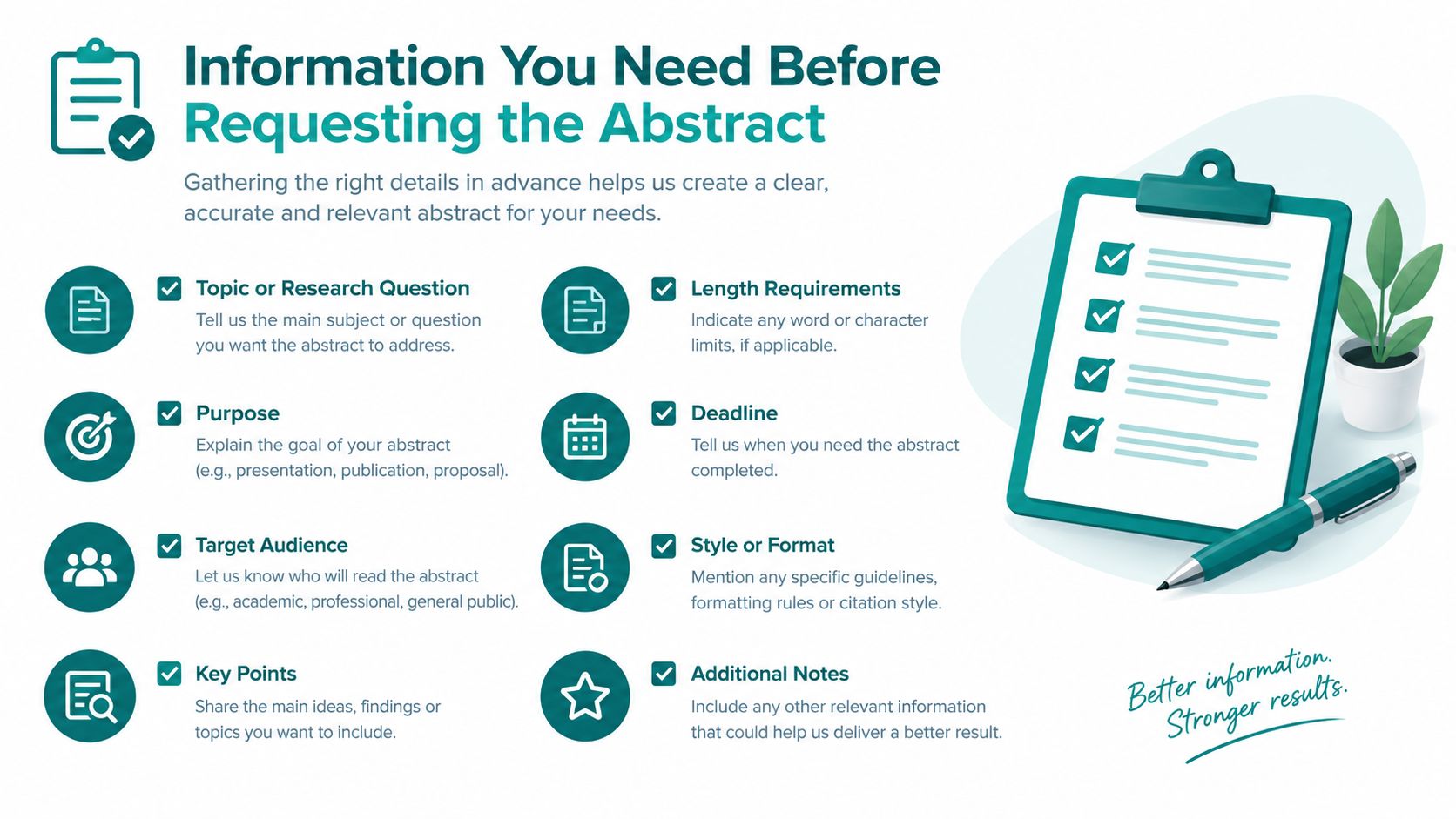
A fleet operator in Corner Brook is preparing a Class 3 driver for onboarding. The recruiter has the candidate's resume and offer letter, but that isn't enough to request an abstract. Before starting, the recruiter should assemble the candidate's surname and given name or names, licence number, and the delivery details required by the province.
The provincial process generally requires the driver's name plus either the driver's licence number or the driver's date of birth, along with an address or fax number for delivery. A request for someone else's record also requires that person's written permission. The provincial third-party abstract guidance sets out this requirement for employers and other authorized requesters.
Build the request around verified identity
Use the candidate's full legal name as it appears on the licence. If the employer has a copy of the physical licence, compare the licence number and name before submitting. Date of birth is particularly useful when names are common or when a recruiter is working from an incomplete application.
The employer should also have a signed authorization that identifies:
- The individual giving permission, with their name and signature.
- The organization making the request, including a contact person.
- The employment purpose, such as assessing eligibility for a commercial driving role.
- The record being requested, described as the NL driver abstract or driving record.
- The date of authorization, so the file shows when permission was granted.
Practical rule: Don't let a recruiter “sort out consent later.” If the authorization isn't in the file before the third-party request, the process can stop before it starts.
Payment must also be arranged in advance, because the province requires payment before releasing the abstract. Incomplete identifying information creates follow-up work, while a missing written authorization can prevent an employer request from proceeding at all.
Requesting the Abstract Online, In Person, by Mail or Fax
The right channel depends on the hiring deadline and who is making the request. An individual can request their own record through MyGovNL, while an employer requesting a candidate's record must first satisfy the third-party authorization requirement.
For an online request, the candidate or authorized requester signs in to MyGovNL, selects the Driver and Vehicle service, chooses “Purchase your driving record (abstract)”, completes the required details, pays electronically, and views or saves the resulting PDF when payment succeeds. The government's digital-service reporting confirms that online driving-record transactions are already an established part of the provincial service environment. From the platform's November 2019 launch through March 31, 2024, the report recorded 42,851 online driving-record transactions, alongside 369,497 total MyGovNL account registrations. These figures appear in the MyGovNL service information.
In-person requests are normally completed the same day. The province identifies Motor Registration offices in locations including St. John's, Bay Roberts, Clarenville, Gander, Grand Falls-Windsor, Corner Brook, Labrador City, and Happy Valley-Goose Bay. Mail and fax requests generally require approximately three business days after receipt, so they're poor choices when a route assignment is imminent.
Choose the channel against the start date
| Channel | Turnaround | Payment Method | Best For |
|---|---|---|---|
| MyGovNL online | Online result after successful payment | Electronic payment | Candidates or employers with a complete digital file |
| In person | Normally same day | Payment in advance | Urgent onboarding and deadline-driven fleet assignments |
| Approximately three business days after receipt | Payment in advance | Non-urgent requests with time for delivery | |
| Fax | Approximately three business days after receipt | Payment in advance | Employers that already use a documented fax process |
For a Monday start, ask the candidate to complete the online process early enough for HR to review the PDF before assigning driving duties. If the role can't wait, use an in-person Motor Registration office where available. Employers that handle recurring requests can also use a screening workflow such as driver abstract processing for Canadian employers, provided the authorization trail remains clear.
Fees, Payment Rules and Turnaround Times
The provincial fee for a driver abstract is $15, and payment must be made in advance. That figure is the government charge, not necessarily the employer's total cost. Your real per-hire cost can also include staff time, candidate follow-up, document review, third-party processing, and delivery expenses where a paper-based request is used.
The sensible budget rule is simple: start with the $15 government fee, then add the internal cost of obtaining consent, checking identity details, reconciling payment, reviewing the result, and securely filing or deleting the document. Don't hide those operational costs from hiring managers. A cheap request can still become expensive when a recruiter has to chase an unsigned form or correct a mismatched licence number.
Speed and documentation involve a trade-off
Online retrieval produces a digital PDF that can be saved to the candidate's restricted file. That makes review and audit easier, but only if the employer stores the authorization and records the purpose of the request alongside it. In-person service may resolve an urgent request quickly, but the team still needs to document who attended, what was requested, and how the record was received.
The province's official process states that in-person requests are normally completed the same day, while mail or fax requests generally take approximately three business days after receipt. Don't promise a candidate a start date based only on the fee. Build the hiring timeline around the channel, payment completion, candidate responsiveness, and the time your team needs to assess any issue.
| Channel | Fee | Payment Methods | Turnaround | Best For |
|---|---|---|---|---|
| MyGovNL online | $15 | Electronic payment | Online delivery after successful payment | Standard digital screening |
| In person | $15 | Payment in advance | Normally same day | Urgent hiring decisions |
| $15 | Payment in advance | Approximately three business days after receipt | Planned requests | |
| Fax | $15 | Payment in advance | Approximately three business days after receipt | Established administrative workflows |
Current charges and service details can change. Confirm the applicable amount before submitting a batch of requests, and use the employer's screening pricing information to separate government fees from any provider or workflow costs.
Employer Consent and Privacy Rules You Cannot Skip
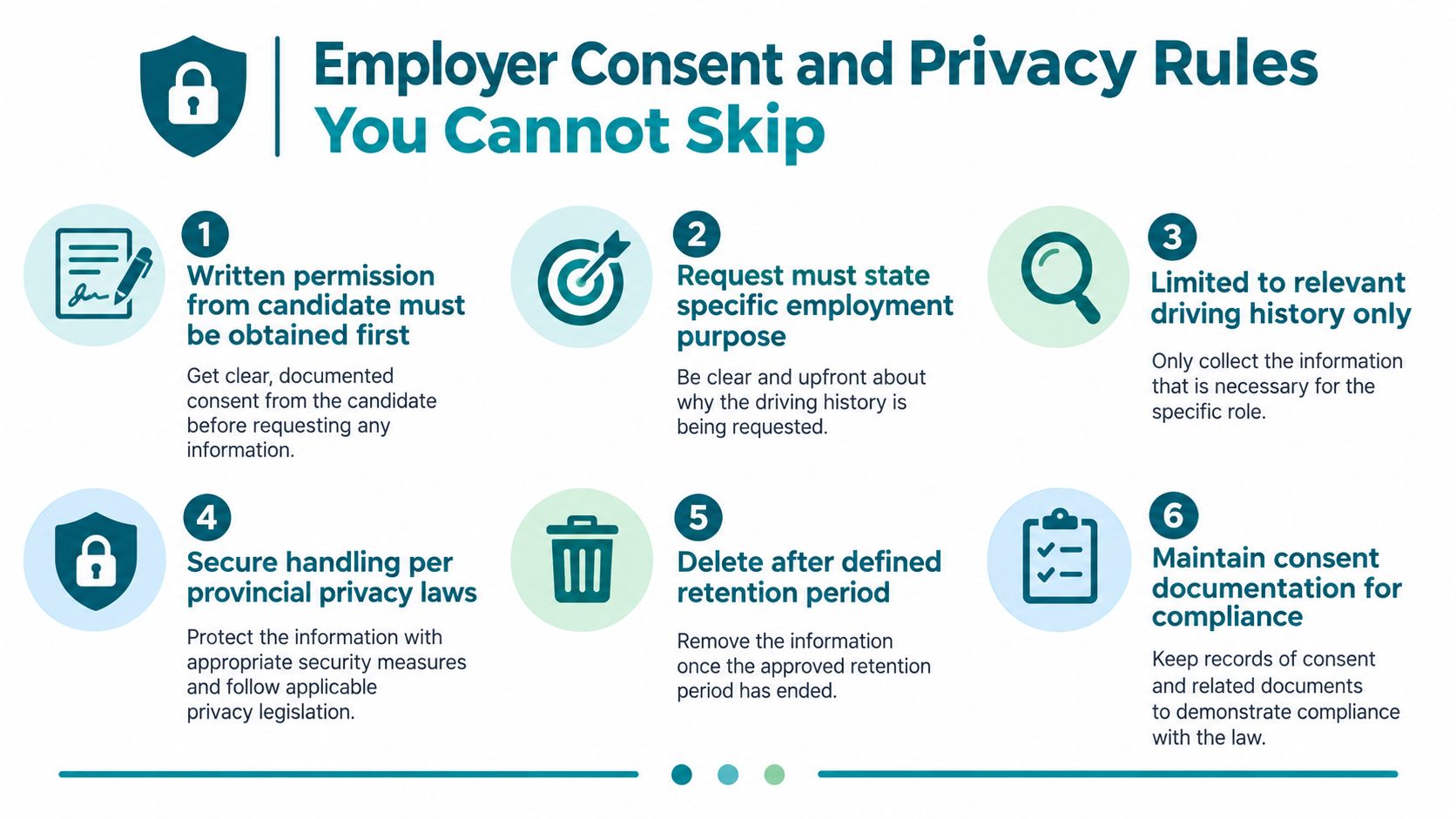
A fleet hiring manager has a start date, a vehicle assignment, and a candidate ready to work. The driver abstract request still stops until the candidate provides written permission. For an employer requesting a Newfoundland and Labrador driver abstract, consent is a condition of access, not a courtesy email added after the document arrives.
State the employment purpose in the authorization. “General background screening” gives HR too much room to reuse the record. “Assessing eligibility to operate company vehicles in a commercial driving role” identifies the decision, sets the proper scope, and helps the candidate understand why the information is being collected.
Apply purpose limitation and minimization
Canadian privacy guidance expects organizations to identify the purpose for collecting employee information, obtain knowledge and consent subject to limited exceptions, collect only what the purpose requires, and control later use, disclosure, and retention. The Office of the Privacy Commissioner of Canada's employer guidance also explains that individuals should understand how their information is used and have a way to challenge its accuracy or completeness.
A practical HR process should follow these rules:
- Collect for the role: Request an abstract when driving forms part of the job or affects the hiring decision.
- Limit access: Share the record with people involved in the documented hiring or fleet-safety assessment.
- Retain deliberately: Set a retention period based on legal, operational, and insurance needs, then dispose of the record securely.
- Handle discrepancies fairly: Give the candidate a meaningful opportunity to question an apparent error before making an adverse decision.
- Separate recurring checks: Hiring authorization does not automatically cover future monitoring. Use a separate notice and consent process where ongoing checks have a lawful, disclosed purpose.
Your privacy obligations depend on the employer's structure and jurisdiction. The federal Commissioner explains that PIPEDA applies to private-sector organizations conducting commercial activities across Canada and continues to apply to federally regulated organizations. Alberta, British Columbia, and Quebec have substantially similar private-sector legislation. PIPEDA has limited employment-sector application outside federally regulated organizations, so an NL employer should identify the privacy and human-rights rules governing its operations. The Commissioner's overview of privacy rights and business obligations provides a useful starting point.
Alero Background & Identity's compliance guidance explains how employers can build PIPEDA-aligned consent workflows. Keep the signed authorization, stated purpose, access history, decision notes, and disposal record together.
Poor consent practice can prompt refusal by the issuing authority, a privacy complaint, or a serious loss of candidate trust.
Where the NL Abstract Fits in a Broader Screening Workflow
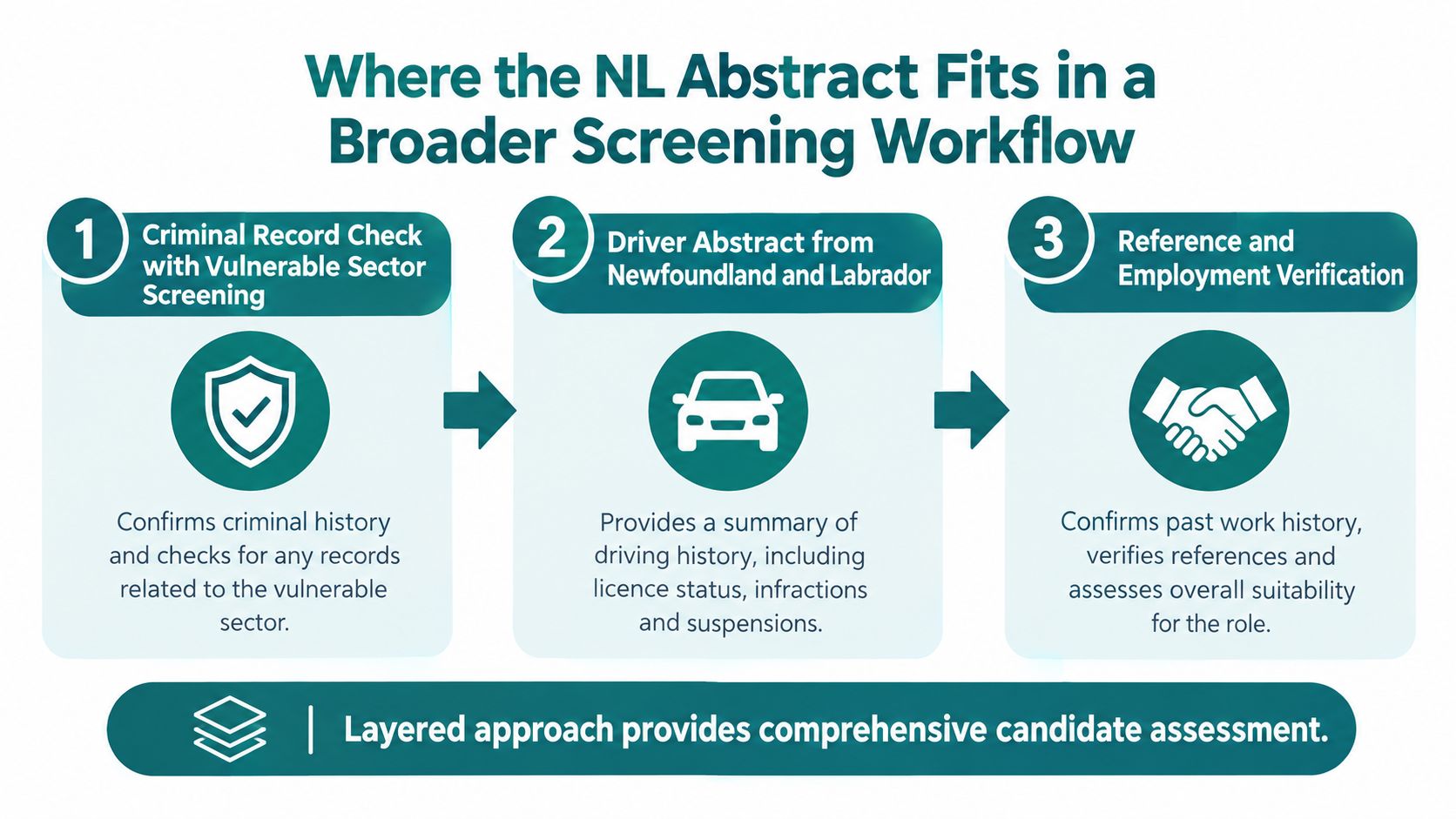
A driver abstract is one record in a layered screening program. It answers a driving-history question. It doesn't establish that a candidate has the right experience, meets every insurance condition, is suitable for work with vulnerable people, or accurately described prior employment.
A practical Canadian workflow may combine the abstract with a role-appropriate criminal check, employment references, licence-class verification, and credential checks. For a fleet or safety-sensitive position, the hiring manager should compare the candidate's licence information with the role's actual vehicle and insurance requirements. A separate process may be needed for ongoing fleet monitoring where the employer has a lawful, disclosed purpose and the necessary consent and notice controls.
Keep screening categories distinct
A CRC is designed to identify criminal-record information through the applicable police or screening process. A Judicial Matters Check may provide additional court-related information where the authority permits it. A VSC is different again. It's reserved for eligible roles involving vulnerable persons, and the police service or responsible authority determines whether the position qualifies.
The employer shouldn't use a VSC as a general upgrade for every hire. Nor should it use a driver abstract as a substitute for a CRC. Each check should answer a defined question connected to the job.
A screening provider can reduce fragmentation by collecting the candidate's authorization once, obtaining the relevant records through the proper channels, and returning clearly separated results in one package. Alero Background & Identity offers Canadian criminal checks, identity verification, driver's licence verification, provincial driver abstracts, reference checks, and HRIS or ATS integrations, with applicant data stored on Canadian servers. The value is operational consistency, not permission to bypass the province's consent requirements.
Practical Takeaways and Compliance Checklist for HR Teams
Your team doesn't need a complicated policy. It needs a repeatable one that stops incomplete requests before they reach Motor Registration.
Do this, not that
- Verify the licence details: Compare the licence number and legal name with the candidate's physical licence information. Don't rely on a nickname from a resume.
- Obtain written permission first: Keep the signed authorization in the screening file before requesting the record. Don't order first and ask for consent later.
- State the purpose precisely: Tie the request to the driving duties, fleet assignment, insurer requirement, or regulated role. Don't use an open-ended statement that permits unrelated use.
- Pick the channel by deadline: Use online service for a standard digital workflow and in-person service when timing is urgent. Don't choose mail or fax when the hiring manager needs a result immediately.
- Reconcile the fee: Record the $15 provincial charge against the candidate or requisition file. Don't assume a provider invoice contains only the government fee.
- Review fairly: If the result changes the hiring decision, give the candidate a chance to identify a possible error or provide relevant context. Don't treat an unfamiliar entry as proof of current risk without review.
- Delete when justified: Follow a defined retention schedule tied to legal and operational needs. Don't keep full driving records indefinitely.
Ten checks for every NL request
- Role confirmed: Does the position involve driving or another documented reason to obtain the record?
- Purpose written: Does the consent form state the specific employment purpose?
- Candidate identified: Does the name match the candidate's legal identity information?
- Licence checked: Has the licence number been compared with the available licence information?
- Authorization signed: Is written permission dated and stored before submission?
- Delivery confirmed: Is the address, fax destination, or digital delivery route correct?
- Channel selected: Does the chosen method fit the hiring deadline?
- Fee reconciled: Has the provincial charge been recorded separately from any service cost?
- Access restricted: Can only authorised HR, fleet, safety, or legal personnel view the result?
- Escalation defined: Does the team know who reviews a discrepancy before an offer is withdrawn or a driving assignment is refused?
For a candidate starting soon, send the authorization form immediately, confirm the licence details, and choose the fastest practical provincial channel. If your team handles recurring fleet hiring, document the workflow once and use it consistently rather than improvising consent and retention for every requisition.
If your organisation needs Canadian criminal checks, identity verification, licence verification, and Newfoundland and Labrador driver-abstract workflows in one candidate-friendly process, review Alero Background & Identity. Use it to standardise consent, track screening status, and keep the abstract request connected to the role-specific decision.