
In most standard Canadian employer checks, withdrawn charges don't appear; Ontario's major screening change took effect on 1 November 2018. They can still surface on enhanced or vulnerable sector checks under strict disclosure rules, especially in Ontario.
A hiring manager may see a candidate's screening result marked Review, hear that an old charge was withdrawn, and wonder whether the report is wrong. The answer usually depends on three things: the screening product ordered, the province's disclosure rules, and whether the role qualifies for a more intrusive check.
That distinction matters. A withdrawn charge isn't a conviction, but information about the event may still exist in police systems. Employers therefore need to separate record retention from lawful disclosure. They also need to avoid ordering a broader check just because it might reveal more information. The right check is the one that matches the role, the legal authority for the screening, and the organisation's documented risk requirements.
Table of Contents
- When a Withdrawn Charge Shows Up on a Canadian Background Check
- How Withdrawn Charges Are Classified in Canadian Criminal Records
- Which Canadian Background Checks Can Show Withdrawn Charges
- Ontario Rules for Disclosing Withdrawn Charges on Police Record Checks
- How Employers Should Handle Review Outcomes Involving Withdrawn Charges
- Building a Compliant Canadian Screening Workflow That Reduces Risk
When a Withdrawn Charge Shows Up on a Canadian Background Check
A recruiter is preparing an offer for a healthcare support position. The candidate has completed the consent form, verified their identity, and disclosed that a charge from the past was withdrawn. The recruiter orders a check suitable for the role. The result comes back marked Review, which creates an immediate question: did the withdrawn charge appear, or does the status relate to something else?
The first step is to identify the check that produced the result. A Criminal Record Check, a Criminal Record and Judicial Matters Check, and a Vulnerable Sector Check do not have identical purposes or disclosure rules. Treating them as interchangeable is one of the fastest ways to create confusion for both the employer and the candidate.

The result depends on the screening tier
For an ordinary criminal record check in Ontario, a withdrawn charge is generally treated as non-conviction information and isn't disclosed. A broader police information process can involve additional police-held information, but disclosure remains controlled by the applicable legal framework. A vulnerable sector process has a narrower purpose and can involve exceptional disclosure where the statutory test is met.
The employer's task isn't to decide whether a withdrawn charge feels serious. The task is to establish:
- What was ordered: Confirm whether the result came from a CRC, CRJMC, or VSC.
- Why it was ordered: Check that the product corresponds to the duties and risk profile of the position.
- Who requested it: The organisation, not the candidate, is responsible for selecting the check and applying the relevant rules.
- What the status means: A “Review” status should trigger a controlled review process, not an automatic rejection.
- Which province applies: The candidate's location and the police service handling the check can affect the disclosure framework.
A candidate who says, “There's a withdrawn charge on my record,” may be referring to information they know exists in a police or court history. That doesn't mean the same information should appear on every employment screening report. Conversely, an employer shouldn't assume that “withdrawn” always means invisible in every context.
Practical rule: Don't interpret the case outcome before confirming the check type. The product ordered determines the legal and operational context in which the information can be assessed.
Hiring workflows often fail at this point. Some employers order the broadest available check for every position, while others use a basic check for roles that may lawfully require enhanced screening. The first approach creates unnecessary privacy and candidate-experience concerns. The second can leave the employer without the information the role legitimately requires.
How Withdrawn Charges Are Classified in Canadian Criminal Records
A hiring manager may see a candidate disclose a withdrawn charge and assume it will appear on every screening result. That assumption is unsafe. A withdrawn charge is an allegation that ended without a conviction, so it falls within non-conviction information, alongside charges that were dismissed, stayed, or ended in an acquittal. The classification matters because a conviction-focused search and a broader police information search answer different questions. The distinction is explained in this guide to criminal record checks in Canada.
The RCMP's guidance on managing criminal records states that a record suspension is not needed for charges that were dismissed, stayed, or withdrawn. These outcomes are not convictions. An employer should not tell a candidate to seek a record suspension just because a withdrawn charge might still exist in a police database.
Retention isn't the same as disclosure
A police service may retain incident information even after the prosecution ends without a conviction. That explains how a candidate can know about an old charge while receiving no reference to it on a routine criminal record check. Database retention and employer disclosure are separate questions.
| Question | What it means |
|---|---|
| Does the information exist? | A police service may retain historical information connected with an incident. |
| Is it a conviction? | A withdrawn charge is not a conviction. |
| Can a standard check disclose it? | In Ontario, withdrawn charges generally aren't disclosed on standard checks. |
| Can an enhanced check assess it? | Only where the applicable rules permit that form of review and disclosure. |
A clear standard check therefore has a limited meaning. It indicates that the reportable information covered by that product did not include a disclosable conviction or another permitted item. It does not establish that the person has never had contact with police or that no historical information exists.
Why the language on a report matters
The report should describe the result accurately without presenting a withdrawn charge as a conviction. Status labels such as Clear and Review help an HR team route the file, but neither label is a hiring recommendation.
A Review result calls for a controlled assessment of the position, the applicable policy, and the information reported. The candidate should have a fair opportunity to address a relevant issue before a decision is made. Informal online searching, speculation about the allegation, and requests for unnecessary personal details create avoidable privacy and fairness risks.
The working rule is straightforward: a withdrawn charge can exist without being reportable on a routine check. Employers that apply this distinction are less likely to reject a candidate based on incomplete information or demand documents the candidate is not required to provide. Classification should guide the review, while the ordered product and applicable provincial rules determine what the employer can assess.
Which Canadian Background Checks Can Show Withdrawn Charges
Canadian employers commonly distinguish among three screening products. Their names can vary slightly between police services and providers, but the operational question remains the same: is the check designed primarily to identify convictions, or does it permit a more limited review of police information beyond convictions?
A Criminal Record Check, or CRC, is generally the basic, conviction-focused product. In Ontario, non-conviction information isn't disclosed on a standard check. A Criminal Record and Judicial Matters Check, or CRJMC, adds certain judicial information and is broader than a basic CRC, but it isn't a general licence to disclose every historical police contact. A Vulnerable Sector Check, or VSC, is reserved for eligible roles involving authority or trust with vulnerable persons.
The RCMP's police dissemination policy explains that a VSC isn't a completely separate category of police record check. It combines a criminal record check with a search for record suspensions for sexual offences. Only the local police agency or an authorised body where the applicant lives can conduct it.
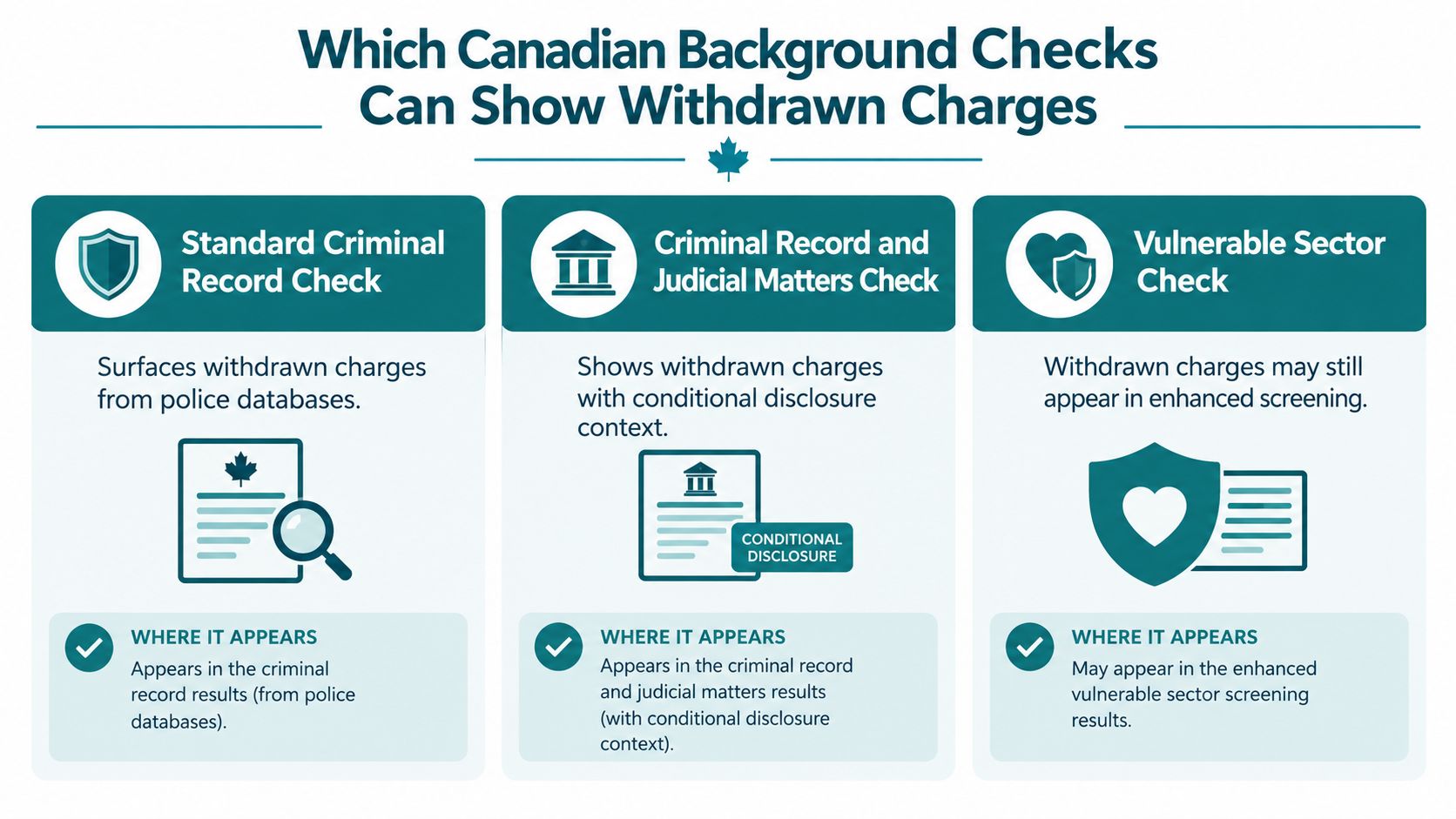
Compare the products before ordering
| Check Type | Includes Convictions | Includes Non-Conviction Information | Typical Use Case |
|---|---|---|---|
| Criminal Record Check | Yes, subject to the applicable screening process | Generally no on a standard Ontario check | Routine hiring where a conviction-focused check is appropriate |
| Criminal Record and Judicial Matters Check | Yes | Broader judicial information may be included, subject to disclosure rules | Roles requiring more information than a basic check |
| Vulnerable Sector Check | Yes, with the additional VSC search | Withdrawn charges may be disclosed only under strict legal criteria | Eligible positions involving authority or trust with vulnerable persons |
The table should guide intake, not replace legal review. An employer can't make a VSC appropriate merely by preferring more information. The position must qualify, and the local police service or authorised body must be able to conduct the check.
What works and what creates risk
What works is a role-based matrix. For each position, record the duties, the reason screening is required, the check level permitted or required, who approves the request, and how a Review result will be handled.
What doesn't work is ordering a VSC for every employee, asking candidates to obtain their own check without clear instructions, or treating a CRJMC as if it were a VSC. Those practices blur the boundary between legitimate risk assessment and unnecessary collection of sensitive information.
For regulated and healthcare roles, teams should also align the check with the organisation's sector obligations. A practical reference for that context is this guide to healthcare background screening in Canada, but the employer still needs to confirm the role's specific requirements with the relevant regulator or authority.
The candidate experience matters too. Explain the purpose of the check, obtain consent through the approved workflow, and tell the applicant what a Review status means. Don't promise that a withdrawn charge can never appear. State instead that the outcome depends on the product, jurisdiction, and legal disclosure criteria.
The embedded resource below can help teams visualise how check categories differ in practice.
Ontario Rules for Disclosing Withdrawn Charges on Police Record Checks
Ontario provides the clearest statutory framework for employer-facing police record checks. Under the Police Record Checks Reform Act, 2015, non-conviction information includes charges that were dismissed, withdrawn, or stayed, as well as matters that ended in an acquittal. The classification matters because Ontario doesn't treat that information as ordinary conviction history.
The Ontario government's police record check guidance says non-conviction information isn't disclosed on a standard Criminal Record Check or Criminal Record and Judicial Matters Check, except in narrowly defined exceptional circumstances connected with a vulnerable sector check. Toronto Police Service guidance aligns with that framework and lists withdrawn and dismissed charges among non-conviction dispositions.
The Ontario hierarchy
Ontario employers should think of the three products as a hierarchy of purpose and disclosure:
- Basic Criminal Record Check: Focuses on criminal convictions and doesn't ordinarily disclose non-conviction information.
- Criminal Record and Judicial Matters Check: Includes certain additional judicial information, but it isn't a general pathway for reporting withdrawn charges.
- Vulnerable Sector Check: May permit exceptional disclosure of non-conviction information where the legal test is satisfied and the role is eligible.
This hierarchy prevents a common mistake. A CRJMC is broader than a CRC, but broader doesn't mean unlimited. The fact that a police service has access to historical information doesn't automatically mean an employer may receive it.
When exceptional disclosure can occur
Section 10 of the Act sets the legal test for exceptional disclosure of non-conviction information in a vulnerable-sector context. The exception is narrow. It isn't an alternative route for employers that just want a more detailed check, and it doesn't apply to every role involving contact with the public.
The Ontario Police Record Checks Reform Act establishes the statutory structure governing these checks. The employer must first establish that the position is eligible for a VSC. The authorised police service then applies the legal criteria to determine whether non-conviction information can be disclosed.
That process is why the answer to “do withdrawn charges appear on background check” can't be reduced to yes or no. In Ontario, the more accurate answer is:
- Usually not on a standard CRC.
- Usually not on a standard CRJMC as non-conviction information.
- Possibly on an eligible VSC, but only under the exceptional disclosure test.
The significance of Ontario's reform
Ontario's reform came into force on 1 November 2018. That milestone marked a major change in screening practice by removing routine disclosure of withdrawn charges and other non-conviction information from standard checks.
Employers that used older processes may still carry outdated assumptions in templates, vendor instructions, or internal policies. Review the language used in offer letters and screening forms. A policy that says “any police contact may affect employment” is too imprecise for a system that distinguishes between convictions, judicial matters, and exceptional vulnerable-sector disclosure.
How Employers Should Handle Review Outcomes Involving Withdrawn Charges
A Review result should start a documented process, not an automatic adverse decision. The employer needs to establish whether the result contains a conviction, a judicial matter, identity clarification issue, or information that may have been disclosed under an enhanced rule.
The most important operational point comes from the RCMP: the person being checked provides consent but doesn't make the request. The requesting organisation chooses the check and must follow the applicable provincial disclosure rules. In Ontario, that means basic checks exclude non-conviction information, judicial-matters checks add certain extra records, and a VSC is the pathway for exceptional disclosure of withdrawn, stayed, or dismissed charges under the statutory test.
Use a controlled review sequence
First, verify the order. Record the product name, the province or police service involved, the role, and the reason the check was requested. If the hiring file doesn't show those details, pause the decision rather than guessing.
Next, confirm eligibility. Ask whether the position qualifies for the ordered level. A role shouldn't receive a VSC because a manager is curious about a candidate's history. The check must relate to the duties and the applicable rules.
Then, separate facts from interpretation. A withdrawn charge isn't a conviction. Don't reframe it as one in notes, emails, interview questions, or the final hiring rationale. If the report requires clarification, use the provider's dispute or candidate-review process.
Apply privacy and human rights discipline
Employers should collect only information that's relevant to the stated screening purpose. Federal organisations may have obligations under PIPEDA, while provincial privacy legislation can apply depending on the employer and the activity. Human rights considerations also matter. A non-conviction outcome shouldn't become an informal proxy for character, disability, family circumstances, or another protected ground.
Give the candidate a fair opportunity to identify an error or explain a mismatch. Keep the discussion limited to the reportable issue and the job-related standard. Don't ask the candidate to disclose unrelated police information or provide a personal narrative only because the employer is uncomfortable with a Review label.
A review status is a workflow decision point, not a finding that the candidate is unsuitable.
Finally, record the reasoning. The file should show why the check was ordered, which rule applied, what information was considered, whether the candidate had a chance to respond, and how the decision related to the position. That record supports consistency across candidates and helps the organisation identify whether its intake process is ordering the wrong product.
Building a Compliant Canadian Screening Workflow That Reduces Risk
A reliable workflow resolves most withdrawn-charge questions before a report arrives. It connects role design, consent, product selection, identity verification, candidate communication, and decision records in one process.
Start with the role, not the database
Write the screening requirement into the job profile. Identify whether the position involves access to sensitive information, regulated duties, financial authority, driving, healthcare responsibilities, or trust with vulnerable persons. Then map that requirement to the check level permitted by the relevant authority.
At intake, capture:
- Role and location: Record the position, worksite, province, and reporting relationship.
- Screening purpose: State why the check is necessary and what decision it supports.
- Product selection: Choose CRC, CRJMC, or VSC based on the role, not on a preference for maximum data.
- Candidate consent: Obtain consent before ordering and explain the process in plain language.
- Data controls: Limit access, retain information only as required, and use Canadian handling arrangements where organisational policy or procurement rules call for them.
The PIPEDA background check guide can help HR teams organise consent, purpose limitation, and data-handling considerations. It shouldn't replace advice on provincial privacy obligations or sector-specific rules.
Build the response before the first Review
Create a written playbook with an owner for each stage:
- Intake reviews the role and selects the check.
- The candidate receives a clear consent request and completion instructions.
- The screening team validates identity and monitors the order.
- A trained reviewer examines any Review result against the role criteria.
- The candidate receives a fair opportunity to challenge inaccurate information.
- The decision-maker records a job-related, proportionate rationale.
- The organisation securely closes or retains the file under its documented policy.
Fast turnaround is useful only when the result is accurate and understandable. A clear report status, mobile-friendly candidate intake, identity verification, and direct support for exception handling can reduce avoidable delays without encouraging broader screening than the role requires.
The strongest workflow gives hiring managers a defensible answer to three questions: Was the right check ordered? Was the information lawfully disclosed? Was the decision based on relevant job requirements? If the answer to any of those is uncertain, pause the hiring decision and escalate the file for compliance review.
Alero Background & Identity provides Canadian criminal record checks, identity verification, candidate-friendly intake, and HRIS or ATS integrations for employers managing CRC, CRJMC, and eligible VSC workflows. Visit Alero Background & Identity to review screening options that support accurate reporting, Canadian data handling, and a clearer candidate experience.