You're trying to hire fast, but the screening file keeps getting in your way. A childcare centre, a school-adjacent camp, a home-care agency, or a recreation programme can't afford sloppy checks, and the common mistake is treating a criminal record check vulnerable sector request like a generic checkbox. In Canada, it isn't a product you order. It's a legally constrained police process tied to the duties of the role, and if the job doesn't qualify, the request can be bounced, delayed, or handled incorrectly.
Table of Contents
- The Hiring Mistake That Puts Vulnerable Sector Checks in the Wrong Hands
- The Three Levels of Canadian Criminal Record Checks Explained
- Who Qualifies for a Vulnerable Sector Check Under Canadian Law
- Consent, Privacy, and Disclosure Rules HR Teams Must Follow
- Provincial Variations That Change How You Request a Check
- Best Practices for Building a Compliant Screening Workflow
- Turnaround Times, Fingerprints, and What to Expect
- A Practical Checklist for Canadian HR and Hiring Managers
The Hiring Mistake That Puts Vulnerable Sector Checks in the Wrong Hands
A Toronto childcare nonprofit runs a summer hiring sprint. The team orders a basic criminal record check on every applicant, then later sends in vulnerable sector requests without a clear trust rationale. Three files come back rejected because the role justification wasn't properly documented. That's not a paperwork annoyance, it's a workflow failure.
A Calgary HR coordinator makes a different mistake. A payroll clerk gets a vulnerable sector check request because the organisation uses one “enhanced” form for everything. The local police detachment bounces it. The role has nothing to do with authority or trust over vulnerable persons, so the request was never valid in the first place.
The practical point is simple. A vulnerable sector check isn't a broader version of a criminal record check. It's a specific police review that can reveal pardoned or record-suspended sexual offences when the position meets the statutory test. The RCMP's vulnerable sector guidance makes clear that the process is tied to positions of authority or trust relative to children or other vulnerable persons, and that the check combines national repository data, CPIC information, and local police records where applicable RCMP vulnerable sector guidance.
Practical rule: if you can't explain why the role requires access to vulnerable people, you're probably asking for the wrong check.
This article gives you the working model that helps HR teams. You'll get the three check levels, the legal test for eligibility, consent and privacy rules under Canadian law, provincial differences, and a workflow that reduces delays without over-screening.
The Three Levels of Canadian Criminal Record Checks Explained
Canadian employers need to stop using “background check” as a catch-all term. There are different police-issued checks, and each one exists for a different risk profile. If you pick the wrong one, you either miss relevant information or create an unnecessary privacy problem.
Start with the role, not the form
A Criminal Record Check is the baseline. It's typically the first screen for roles where you need conviction history and you're not dealing with the statutory vulnerable-sector threshold. A Criminal Record and Judicial Matters Check goes further and can include outstanding charges and judicial matters, which makes it more suitable where there's operational sensitivity but not vulnerable-sector access. Toronto Police distinguishes the CRJMC from the Vulnerable Sector Check, and says the VSC is reserved for positions involving vulnerable persons Toronto Police police record checks.
A Vulnerable Sector Check sits at the top end of the ladder. It is not just “more detailed.” It adds a search for pardoned or record-suspended sexual offences, and it's only lawful where the position meets the trust or authority test. The RCMP also defines it as a criminal record check plus a search for suspensions for sexual offences RCMP criminal record checks.
Pick the least intrusive check that still fits the actual duties. That's the cleanest way to stay compliant and keep candidates moving.
For a practical starting point, use this rule. If the person only needs to show they're not carrying a relevant conviction history, start with a CRC. If the role has judicial sensitivity, consider a CRJMC. If the role gives access to children, vulnerable adults, or similarly dependent people, you're in vulnerable-sector territory and you need the VSC to be justified, not assumed.
| Check Level | Scope of Records Searched | Issuing Authority | Typical Use Case |
|---|---|---|---|
| Criminal Record Check | Conviction history and related criminal record information | Local police agency or authorised screening body | Standard hiring and volunteer screening |
| Criminal Record and Judicial Matters Check | Broader criminal and judicial information, including charges and certain court matters | Local police agency or authorised screening body | Roles with broader accountability or trust concerns |
| Vulnerable Sector Check | Criminal record information plus search for pardoned or record-suspended sexual offences | Local police agency where the applicant lives | Jobs or volunteering with vulnerable persons |
For a plain-English service overview your team can compare against internal workflows, Alero Background & Identity publishes Canadian criminal record check services here: criminal record check services.
Who Qualifies for a Vulnerable Sector Check Under Canadian Law
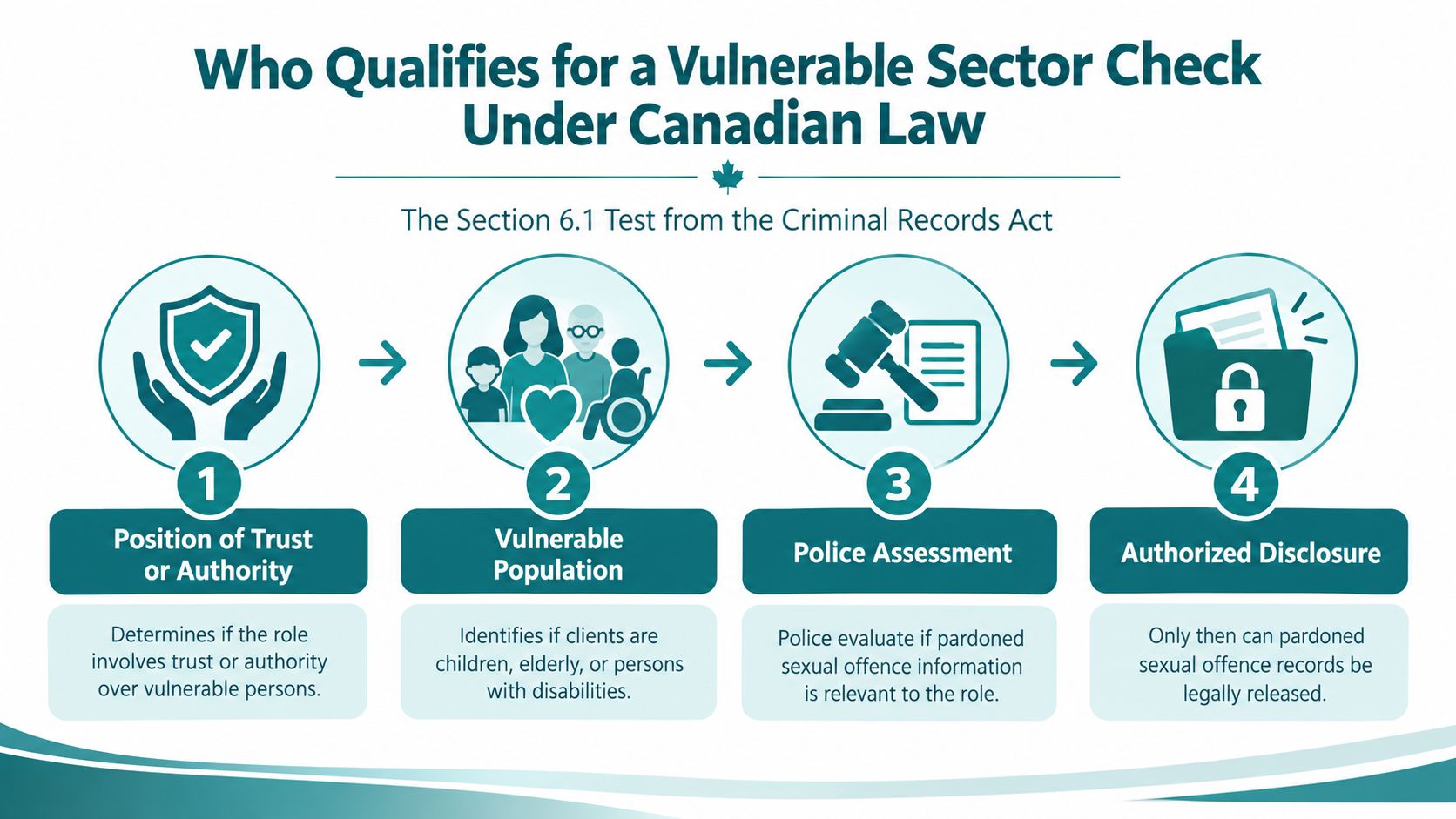
The legal test matters more than the job title. “Teacher,” “coach,” or “care aide” usually makes the case obvious. “Bus driver,” “after-school supervisor,” and some volunteer coordinators often need a closer look because the decisive issue is whether the person is in a position of trust or authority over vulnerable persons.
The statutory question HR has to answer
Canadian guidance treats a vulnerable person as someone under 18 or an adult who, because of age, disability, or other circumstances, can't seek support in the same way as others. The employer doesn't get to declare a role vulnerable just because it sounds important. The police service processing the request decides whether the role meets the legal threshold.
That means your job description has to do real work. A classroom teacher plainly qualifies. A coach with unsupervised access to minors usually does too. A healthcare aide who enters a residence and provides direct personal care often qualifies. A bus driver transporting students may qualify if the role creates authority, trust, or repeated access to vulnerable riders, but you still need the duty description to show why.
Mixed-role positions are where HR gets sloppy. If only part of the job involves vulnerable persons, document that part. Don't inflate the role and hope the police won't notice. That approach creates rejections, delays, and avoidable privacy exposure.
Volunteers, remote roles, and edge cases
Unpaid volunteers still need a proper rationale. The fact that nobody is being paid doesn't lower the legal bar. RCMP guidance also asks for a volunteer confirmation letter showing no payment where a volunteer request is made RCMP vulnerable sector checks.
Remote and hybrid roles are trickier. If the contact is online, the question becomes whether the worker still has authority or trust over a vulnerable group. Many employers overreach here and request a VSC for ordinary administrative staff. Don't do that. Police services assess eligibility, and mismatched justifications are a common cause of rejection.
If your team is unsure, write the duties first and the screening ask second. That discipline saves time and protects you from turning a sensitive police process into a generic hiring habit.
Consent, Privacy, and Disclosure Rules HR Teams Must Follow
The fastest way to mishandle a vulnerable sector check is to treat consent as a checkbox buried inside the employment contract. That's weak practice. Under PIPEDA, an individual needs knowledge and consent for the collection, use, or disclosure of personal information, except where inappropriate, and the RCMP's privacy guidance points HR teams back to that principle OPC PIPEDA consent guidance.
What a compliant consent form needs
A solid consent form should do four things.
- State the purpose clearly. Tie the request to the actual duties, not a vague “background screening” phrase.
- Name the records being searched. Be explicit about the RCMP National Repository, CPIC data, and local police records where applicable.
- Identify the requester. List the organisation, and if a screening vendor is involved, name that vendor too.
- Set an expiry or revocation term. Candidates should know how long the consent remains valid and how to withdraw it before completion.
Practical rule: if the candidate can't tell what's being searched and why, your consent form isn't ready.
The candidate also needs a fair path to review the result before it's disclosed onward. Background-screening providers generally disclose the result to the individual first, then the individual can consent to employer disclosure. That sequence matters because it protects privacy and reduces careless disclosure inside the organisation. The research brief also notes that the vulnerable sector check cannot be disclosed to the employer through the same direct process that may apply to some basic checks.
What HR can share and what stays locked down
Keep the result inside a need-to-know file. Hiring managers usually need a plain status outcome and the hiring recommendation, not the underlying details. If a result creates an issue, document the decision path carefully and keep the underlying record access limited.
A practical consent template can be short and still work: “I consent to a vulnerable sector check for the role of [title], because the duties involve [specific trust or authority description], and I understand the information may include criminal record information, CPIC data, National Repository data, and local police records where authorised.” That's direct, defensible, and easier for candidates to understand.
| Consent Element | Why It Matters | Common Mistake |
|---|---|---|
| Purpose statement | Shows the check is tied to the role | Using a generic screening phrase |
| Records searched | Defines the data scope | Leaving out local police or CPIC references |
| Requesting party | Creates transparency | Hiding the vendor or employer name |
| Expiry or revocation | Supports informed consent | Treating consent as open-ended |
For a deeper policy lens on privacy language, Alero Background & Identity has a useful overview of Canadian screening consent practice here: PIPEDA background checks guidance.
Provincial Variations That Change How You Request a Check
If you run one screening form across Canada, you're creating headaches for yourself. Provinces and police services don't all process vulnerable sector requests the same way, and the differences affect intake, consent language, and disclosure handling.
Ontario, Quebec, Alberta, and British Columbia are not interchangeable
Ontario is the best example of why local detail matters. Police detachment jurisdictions vary by municipality, and Toronto Police Service uses its own vulnerable sector waiver process separate from RCMP processing. If your candidate lives in Toronto, you need to follow Toronto's channel, not your national default.
Quebec routes screening through provincial police channels and requires French-language consent where the Charter of the French Language applies. If your hiring workflow is English-only, that's a failure, not an oversight. Alberta is more flexible on intake, with RCMP-direct or accredited third-party fingerprinting options, while municipal police services can still decide whether they accept civilian requests. British Columbia relies on RCMP Civil Criminal Record Check forms and volunteer-screening frameworks linked to the Municipal Insurance Association and the B.C. Association of Chiefs of Police.
Build a provincial matrix, not a single national form
The employer's disclosure workflow also changes by province. In some places, the candidate gets the result first and you only receive an authorised disclosure. In others, the process is more restrictive or the validity period for disclosure is handled differently. Don't assume a form that works in Calgary will be accepted in Toronto or Montreal.
A national HR team needs a simple matrix, not a theory. The matrix should track the local processing body, the required consent language, who receives the result, and whether the check has to run through a specific municipal police service. If your process can't answer those questions, it's not ready for multi-province hiring.
| Province | Processing Body | Consent Language | Employer Disclosure |
|---|---|---|---|
| Ontario | Municipal police service, including Toronto Police Service where applicable | Local form requirements may differ by municipality | May be handled through local police or candidate-mediated disclosure |
| Quebec | Provincial police channel | French-language consent may be required | Disclosure follows provincial process |
| Alberta | RCMP-direct or accredited third-party fingerprinting, depending on the case | Use jurisdiction-appropriate wording | Disclosure depends on the route used |
| British Columbia | RCMP Civil Criminal Record Check process and volunteer-screening pathways | Provincial and RCMP forms need to align | Disclosure follows the applicable local process |
Best Practices for Building a Compliant Screening Workflow
The wrong habit is still common. Managers hear “vulnerable sector” and reach for the deepest check available, then ask legal or HR to sort it out later. That's backwards. A compliant workflow starts with duty mapping and ends with disciplined result handling.
Use the role to drive the check
Step one is role classification. Read the actual duties, not the job title, and write down why the position does or doesn't involve trust or authority over vulnerable people. If that rationale isn't in the requisition file, the screening request is too vague.
Step two is check selection. Default to a basic CRC for ordinary roles. Move to a CRJMC when the role has broader sensitivity, such as financial authority or access to sensitive data. Reserve the VSC for unsupervised access to children, vulnerable adults, or persons with disabilities.
Step three is consent capture. Don't blend screening consent into the offer letter and call it a day. Keep a separate consent record, keep the audit trail, and make sure the candidate understands what's being searched before the request goes out.
Handle results like a privacy issue, not an inbox event
Step four is result handling. Define who sees the result, who makes the decision, and what happens if the result raises a concern. That process should include accommodation analysis where human rights obligations apply, because a screening result is only one piece of the hiring picture.
Alero Background & Identity is one option Canadian employers use for criminal record checks and vulnerable sector checks when they need a Canadian workflow with bilingual intake, data residency, and status handling that stays close to HR operations. That kind of setup matters most when multiple recruiters are touching the same file and nobody wants a privacy gap.
My advice: if your workflow can't be explained to a hiring manager in one minute, it's too messy to run at scale.
The best teams also document a recheck cadence policy instead of assuming the hire-time screen is enough forever. For regulated or child-facing roles, ongoing review is often more defensible than a one-time screen followed by silence.
Turnaround Times, Fingerprints, and What to Expect
Most screening delays don't come from the policy. They come from identity friction. A clean name-based check can move quickly, but once there's ambiguity, the process often shifts into fingerprint verification or local police review.
Build the hire plan around the slowest likely path
Digital name-based checks are often returned within hours to a few business days when there's no match issue. Once a record match is unclear, fingerprint escalation can add roughly 10 to 30 days, and peak hiring periods can stretch that further. For process planning, Alero Background & Identity notes a typical 24 to 48 hour turnaround for clear screening results, which is useful for straightforward cases Alero screening services.
Fingerprint escalation tends to happen when a name and birthdate match an existing record, when a pardoned conviction needs verification, when aliases create ambiguity, or when the candidate can't produce suitable identity documents. In those cases, don't guess. Tell the candidate the check needs extra verification and that start dates may move.
Communicate early and keep the message narrow
Use a script like this: “Your screening request is in progress. Some checks return quickly, but if police need additional verification, the process can take longer. We'll update you as soon as we have the result.” That tells the truth without exposing sensitive status information.
Candidates with prior military or RCMP service, recent immigrants, or out-of-country backgrounds can route through different record systems and often need more coordination. Those cases should be flagged before the offer date if the role is sensitive. If the role can't start without screening, say so early and document the reason.
For a timing policy your team can align with internal onboarding, compare your own buffers with the guidance on how long background checks can take in Canada here: how long a background check can take in Canada.
A Practical Checklist for Canadian HR and Hiring Managers
If you want fewer delays and fewer compliance mistakes, run every request through the same five-part checklist. This isn't about adding bureaucracy. It's about making sure the police process is justified before your team sends anything out.
Keep the workflow tight
- Duty-Description Mapping: Write the actual duties, identify whether the role fits CRC, CRJMC, or VSC, and save the rationale in the requisition file.
- Check Justification: Document why the role has trust or authority over vulnerable persons if you're asking for a VSC.
- Candidate Consent: Use a separate, plain-language consent form and collect it before submission.
- Privacy and Storage: Restrict access, store results securely, and follow provincial retention rules.
- Adverse Action Protocol: Review concerns fairly, check for accommodation issues, and document the hiring decision.
Use vendors as process support, not decision-makers
Compliant screening vendors help with intake, workflow, and record handling, but they don't replace the police service's gatekeeping role. Your team still has to qualify the request, justify the level, and protect the candidate's data through the full retention cycle. That's the part too many employers miss.
Bottom line: over-screening exposes you to human-rights complaints and privacy criticism. Under-screening leaves vulnerable people exposed and puts your organisation at risk.
If you're building or cleaning up a Canadian screening workflow, Alero Background & Identity can help you structure criminal record checks, vulnerable sector checks, identity verification, and bilingual intake around the way Canadian hiring works. Visit Alero Background & Identity and compare your current process against a model that's built for Canadian privacy, police screening rules, and faster candidate turnaround.
Drafted with the Outrank tool