The right check depends on the role: use a basic Criminal Record Check for most positions, a Criminal Record and Judicial Matters Check for roles handling money or sensitive data, and a Vulnerable Sector Check only when the role places the applicant in a position of authority or trust over children or vulnerable adults. Public Safety Canada estimates that approximately 3.8 million Canadians possess a criminal record, so the way an employer selects and interprets a check can affect a substantial part of the workforce. Public Safety Canada's estimate and explanation of Canadian record data also make clear that police databases can contain information beyond convictions.
A recruiting coordinator orders a Vulnerable Sector Check for a warehouse picker, then has to explain why the company paid for a highly restricted screening product when the position involves neither children nor vulnerable adults. That's not just an avoidable expense. It signals that the employer hasn't tied screening to the actual risk of the job.
A sound criminal record check Canada programme starts with role design, not a vendor order form. The three main police record check levels exist to match disclosure depth with the trust placed in the candidate. Your requisitions should record that reasoning before the job is posted.
Table of Contents
- Why Criminal Record Checks Matter in Canadian Hiring
- The Three Types of Police Record Checks Explained
- How CPIC and RCMP Processing Actually Works
- Consent, Retention, and PIPEDA-Aligned Workflows
- Matching the Right Check to the Right Role
- What a Criminal Record Check Can and Cannot Reveal
- Building a Frictionless Candidate Screening Experience
- Putting It All Together for Your Hiring Workflow
Why Criminal Record Checks Matter in Canadian Hiring
A police record check is a compliance decision. Treating it as a standard checkbox creates three problems at once: unnecessary collection of sensitive information, a worse candidate experience, and a file that may be difficult to defend if an applicant challenges the screening level.
Canadian employers should establish a role-based standard:
- Basic Criminal Record Check: Use it for most general positions where the employee won't exercise authority over vulnerable people or hold a heightened fiduciary responsibility.
- Criminal Record and Judicial Matters Check: Use it for roles involving cash, customer funds, financial controls, sensitive personal information, or comparable trust.
- Vulnerable Sector Check: Request it only where the position places the applicant in a position of authority or trust over children or vulnerable adults. The RCMP's vulnerable sector guidance says the organisation must explain in writing how the role creates that authority or trust.
That distinction protects more than the employer. It prevents candidates from being assessed using information that has no meaningful connection to the work. It also helps HR separate a legitimate safety requirement from a blanket policy that screens everyone as if they occupy the same position.
Practical rule: Write the risk rationale into the requisition before requesting consent. “Required for all employees” is weaker than “the role supervises children without another employee present.”
The issue is especially important because the Canadian record-check system isn't binary. Federal estimates have varied, and Public Safety Canada notes that Canada doesn't maintain updated national statistics on the number of people with criminal records. The RCMP dataset used for an earlier estimate can include withdrawn charges, which means the number of people affected by police information is not identical to the number of people with convictions.
Your hiring policy should therefore answer four questions for every role:
- What access, authority, or responsibility does the position create?
- Which check reveals information relevant to that risk?
- Who can access the result?
- When will the organisation securely dispose of it?
That simple record of reasoning prevents the warehouse-picker mistake from becoming a company-wide habit.
The Three Types of Police Record Checks Explained
The three checks aren't interchangeable. A hiring manager should choose the narrowest check that addresses the genuine risk of the role.
Basic Criminal Record Check
A basic Criminal Record Check, often called a CRC, is the starting point for ordinary employment. It generally addresses criminal-record information such as convictions and applicable discharges or orders that the police service is authorised to disclose under the relevant rules.
A CRC fits roles such as:
- retail associate
- warehouse worker
- office administrator
- general labourer
- customer-service employee without access to funds or vulnerable people
It isn't designed to provide the broadest possible view of police information. A clear CRC also isn't a guarantee that no police information exists anywhere. The result reflects the check type, the information accessible to the requesting police service, the candidate's identity details, and the applicable provincial disclosure rules.
Criminal Record and Judicial Matters Check
A Criminal Record and Judicial Matters Check, or CRJMC, goes further than a basic CRC. It's appropriate where the employer needs information about judicial matters connected to the position, such as active charges, warrants, court orders, or pending matters that the relevant police service is permitted to disclose.
Choose a CRJMC for roles such as:
- finance clerk handling customer funds
- payroll or accounts-payable employee
- IT administrator with privileged access to sensitive data
- healthcare-data administrator
- contractor with access to confidential client records
The CRJMC still isn't a licence to collect everything a police service may hold. Disclosure remains governed by consent, minimisation, and provincial rules. HR should never treat a broader check as a substitute for a relevance assessment.
Vulnerable Sector Check
A Vulnerable Sector Check, or VSC, is the most restricted of the three. It's intended for employment or volunteer positions involving children or vulnerable persons where the applicant occupies a position of authority or trust. The RCMP says the hiring organisation decides whether a VSC is necessary, but it must provide a written explanation of the role's authority or trust relationship.
A VSC may be relevant for:
- school teacher
- youth coach
- childcare worker
- long-term care worker with direct authority over residents
- support worker serving vulnerable adults
A third-party screening provider can't issue a VSC wherever the employer wants one. RCMP policy on police dissemination of criminal-record information states that the applicant must request the vulnerable-sector verification through the police agency or authorised body in the local jurisdiction where they live.
| Check Type | Depth of Disclosure | Typical Role Fit |
|---|---|---|
| Criminal Record Check | Convictions and other information authorised for a basic criminal-record check | Most general employment |
| Criminal Record and Judicial Matters Check | A broader judicial view, which may include active charges, warrants, court orders, and pending matters where disclosure is authorised | Finance, data access, healthcare administration, and comparable trust roles |
| Vulnerable Sector Check | A restricted check for roles involving authority or trust over children or vulnerable adults, including the specialised vulnerable-sector search where legally authorised | Teachers, coaches, childcare staff, and direct-care roles |
Absolute discharges, conditional discharges, youth records, and non-conviction information don't follow one universal disclosure rule. The check type and provincial framework matter. Ontario's current framework, for example, distinguishes police record check categories and positions involving pupils or vulnerable people. Ontario's police record check regulation should be reviewed for Ontario-specific requirements.
How CPIC and RCMP Processing Actually Works
Most employers experience the process as a status update, but the underlying workflow has two very different paths.
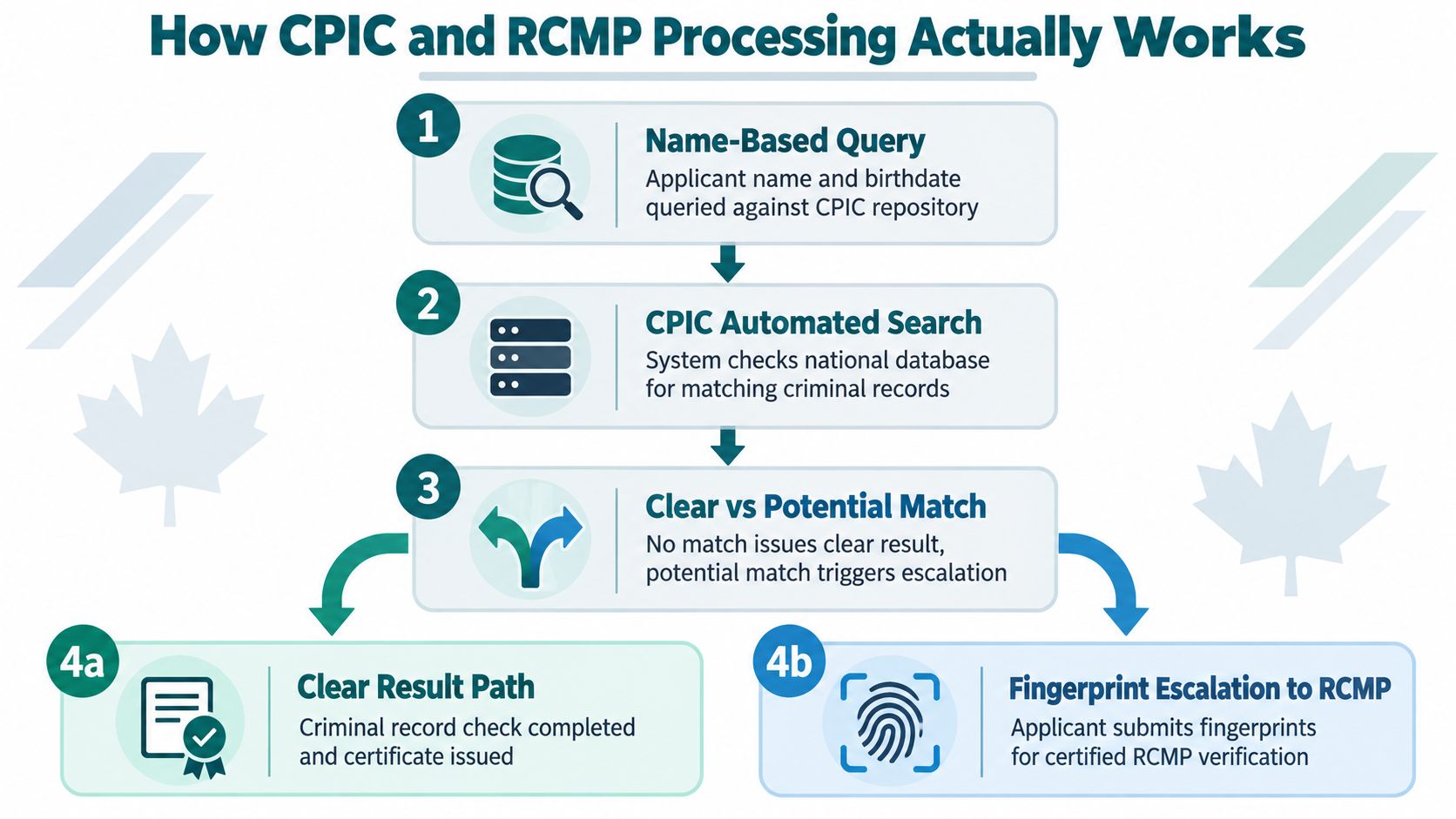
A name-based check uses the candidate's name and biographical details to search the Canadian Police Information Centre, or CPIC. If the information produces no criminal-record match, the requesting police service can generally complete the check electronically without asking the candidate for fingerprints.
The RCMP reports that electronic submissions with no criminal-record match are typically processed in three business days or less, while files requiring manual processing or possible-match review can take up to 120 business days. Those are not vendor promises. They reflect the difference between a clean electronic submission and a file requiring identity confirmation or human review. RCMP processing times and fees explain the distinction.
Where delays begin
A possible match doesn't prove that the candidate has a criminal record. It means the police service needs stronger identity evidence. The applicant may have to submit fingerprints so the RCMP can compare them against its national records.
The practical sequence is:
- Candidate provides consent and accurate identity details.
- The police service or approved process submits the name-based search.
- CPIC returns a clear result or a possible match.
- A possible match triggers manual review or fingerprint escalation.
- The RCMP and relevant police authorities confirm identity and process the result.
- The requesting authority issues the final certificate or report.
Operational reality: Fingerprint escalation and local police workload create the biggest turnaround variance. A screening vendor can submit accurate information, but it can't remove an RCMP verification queue or a police detachment's review obligation.
That's why employers should build hiring service levels around two paths, not one average promise. Capture identity information correctly at intake, explain possible-match delays before the candidate starts the process, and avoid promising a fixed start date until the required screening outcome is available. For more workflow detail, see how long a background check takes in Canada.
A short visual explanation can help recruiters set expectations without turning the process into a legal lecture.
Consent, Retention, and PIPEDA-Aligned Workflows
PIPEDA requires meaningful knowledge and consent for the collection, use, or disclosure of personal information. It also applies a reasonableness limit: an organisation should collect only information that a reasonable person would consider appropriate in the circumstances. The Office of the Privacy Commissioner's PIPEDA guidance is the starting point for building the process.
Four controls HR should document
Specific consent should identify the hiring purpose, the type of check, the information being collected, and any third-party disclosure involved. Don't bury it in a general application declaration that candidates may not understand.
Purpose limitation means the check must relate to the role for which consent was obtained. If the candidate moves into a position with materially different duties, assess whether a new check and new consent are necessary.
Restricted access keeps the result with the people who make or support the hiring decision. A supervisor who doesn't need to see a VSC outcome shouldn't receive the report.
Defined retention prevents screening results from becoming permanent personnel-file content. For an unsuccessful candidate, use the shortest period needed to manage the hiring decision, legal obligations, and any documented challenge. Don't describe a universal retention period unless your privacy counsel has confirmed the rule for the organisation's jurisdiction and circumstances.
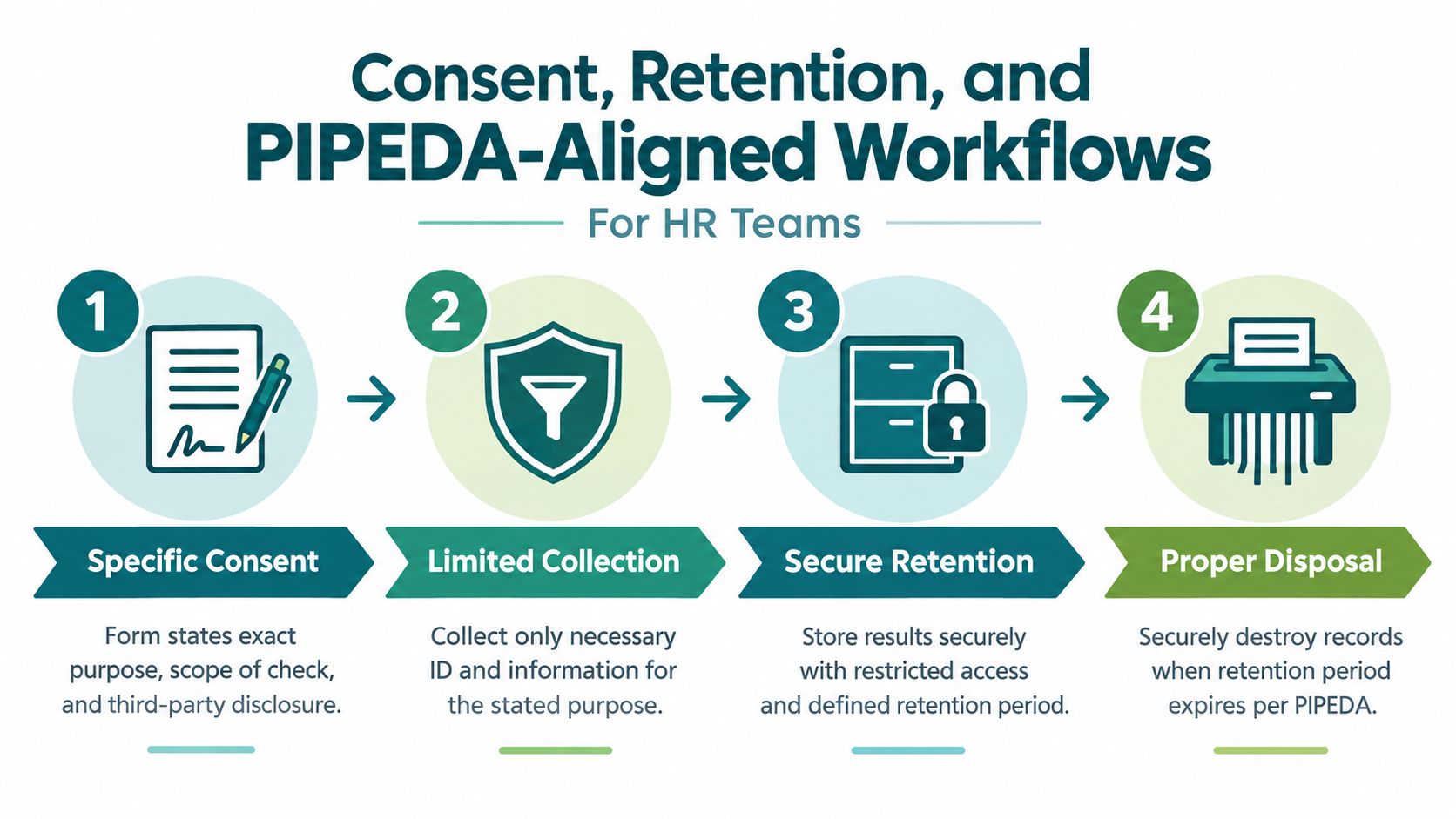
The intake-to-destruction sequence
- Define the role: Record why the position needs a CRC, CRJMC, or VSC.
- Obtain informed consent: Present the purpose, scope, identity requirements, and disclosure path separately from generic application terms.
- Collect minimally: Request only the identity and employment information needed to complete the selected check.
- Limit internal visibility: Give HR decision-makers the appropriate status or review information, not unrestricted access to raw documents.
- Document the decision: Record the role-related reasoning and outcome without retaining unnecessary personal details.
- Dispose securely: Delete or destroy the result according to the approved retention schedule and confirm that copies in email, downloads, and shared drives are included.
For a practical policy review, use PIPEDA background-check guidance for Canadian employers. The important point is discipline. A signed consent form doesn't cure excessive collection, indefinite retention, or casual internal sharing.
Matching the Right Check to the Right Role
York Regional Police draws a practical line between a Criminal Record and Judicial Matters Check and a Vulnerable Sector Check. Its CRJMC guidance covers roles that need more than a basic check, including board members, administrative staff, contractors, and people working in schools, hospitals, or care facilities without authority over vulnerable persons. York Regional Police's CRJMC explanation gives hiring teams a useful boundary: the workplace setting alone does not determine the check.
Apply that boundary to the duties, access, and authority attached to the position.
A property manager with master-key access enters occupied units, handles tenant information, and may respond alone to urgent incidents. A CRJMC can be defensible where the role includes broader responsibility for property, records, or resident interactions. A VSC is not automatic. It requires a legally permitted vulnerable-sector purpose and duties involving trust or authority over vulnerable people.
A hospital billing clerk handles health information and payment records but normally has no direct care relationship with patients. A CRJMC may fit the role's access to sensitive information. A VSC would usually be difficult to justify unless the position also gives the employee direct authority or ongoing unsupervised contact with vulnerable persons.
A community-program driver may transport adults with disabilities or children without providing clinical care. The employer should examine who is in the vehicle, whether the driver works alone, and whether the role creates direct authority over passengers. If that relationship meets the applicable vulnerable-sector threshold, request the VSC through the appropriate police authority. If it does not, select the check that matches the actual access and duties.
The decision should also account for processing reality. Basic and judicial-matters checks often begin with a name-based search, while identity concerns, possible matches, or local police requirements can trigger manual review or fingerprint escalation. A VSC must go through the applicant's local police authority or another authorised body. Turnaround time is therefore driven less by the screening vendor than by fingerprint escalation and provincial police workload.
Use this workflow for each requisition:
- Map the employee's authority, access, supervision, and contact with vulnerable people.
- Select the least intrusive check that addresses the documented risk.
- Confirm whether provincial rules or the receiving organisation require a particular check.
- Explain any fingerprint requirement and possible delay before the candidate consents.
- Record the check selected, the duties supporting it, and the decision path.
If the role has ordinary workplace access and no authority over vulnerable persons, use a basic CRC unless a provincial requirement or another legitimate obligation calls for more. Choose a CRJMC for broader judicial information tied to the duties. Reserve a VSC for legally eligible roles involving direct trust or authority over vulnerable persons.
What a Criminal Record Check Can and Cannot Reveal
The phrase “clear or not clear” causes bad hiring decisions. A police record check isn't a complete biography, and a possible match isn't a finding of wrongdoing.
A basic CRC may disclose convictions and other information permitted under the applicable rules. A CRJMC can add judicial information such as warrants, court orders, or pending matters where disclosure is authorised. A VSC has a separate purpose and legal threshold, and it can include a vulnerable-sector search that ordinary checks don't.
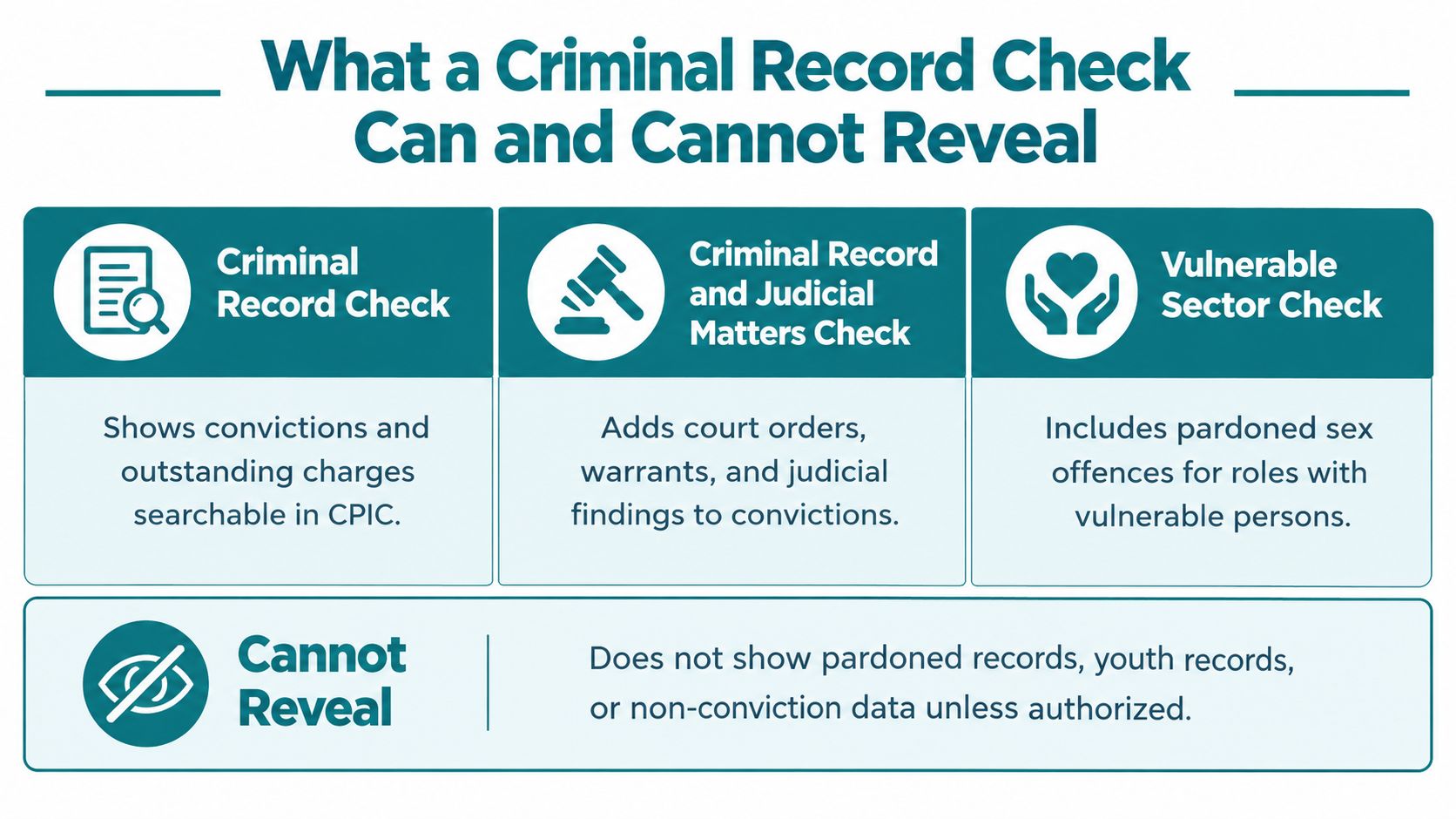
Non-conviction information changes the analysis
The Uniform Law Conference of Canada's working-group report says hundreds of thousands of Canadians undergo a criminal record check each year. It also reports that about 43% of criminal cases in Ontario result in stays of proceedings or withdrawn charges, producing thousands of non-conviction records annually that may still be present in police information. The working-group material and Canadian police-check context also cites a Vancouver Police Department study in which 72% of reports that produced a result contained only non-conviction information.
Those figures explain why HR must read the actual result rather than assume that every disclosed item is a conviction. A withdrawn charge, stay, or other non-conviction entry doesn't establish criminal guilt. It may still create an administrative review issue, depending on the check type and provincial disclosure rules.
Youth records are governed by separate protections, and pardoned or suspended information is subject to specific limits. Absolute and conditional discharges also require careful interpretation. Recruiters shouldn't ask an applicant to explain information that the applicable check should not disclose, and they shouldn't treat a review status as proof of misconduct.
Use a disciplined decision rule
When a result requires review:
- Confirm the candidate's identity and whether the result belongs to that person.
- Identify the check type and the exact category of information disclosed.
- Ask whether the information is legally disclosable and relevant to the role.
- Give the candidate a fair opportunity to correct an error or provide context.
- Document the job-related reason for any decision.
A “no match” name-based result also isn't the same as a universal guarantee that no record exists. If the police service identifies a possible match, fingerprint verification may be required before HR can rely on the outcome. The employer's job is to interpret the authorised result proportionately, not to conduct its own investigation.
Building a Frictionless Candidate Screening Experience
Candidates shouldn't have to decipher a fragmented process. The best intake flow makes consent, identity verification, and status tracking clear from the first screen, while still collecting the information needed for escalation.
Fix the first five minutes
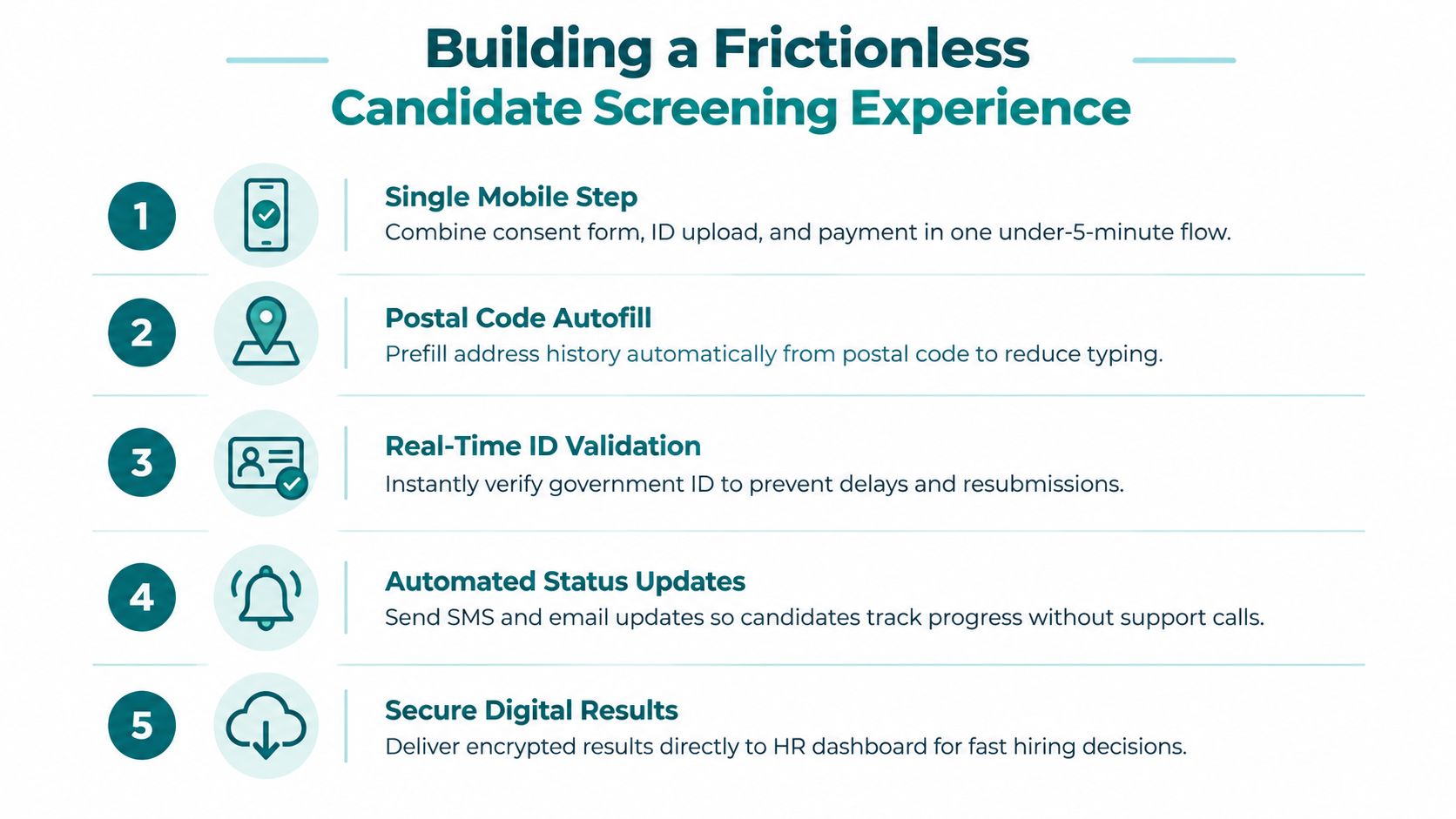
Combine the consent form, ID upload, and payment into one mobile-friendly flow that candidates can complete in under five minutes. Use postal-code lookup to prefill address history where appropriate instead of forcing applicants to retype every field.
Capture two pieces of government-issued identification at submission when the selected workflow requires them. Waiting until a possible match appears to discover missing identity details turns a manageable review into a preventable delay.
Make escalation understandable
If a possible match triggers additional verification, tell the candidate quickly and use plain language. Explain that the result needs identity confirmation, not that the candidate “failed” the check. Identify whether the next step involves fingerprints, local police, or another approved verification route.
Your candidate checklist should include:
- Mobile intake: Let the applicant consent and upload documents without switching between systems.
- Identity validation: Check government ID at submission to reduce rework.
- Status notifications: Send clear email or SMS updates so candidates don't need to call HR for every change.
- Human review: Give a trained reviewer responsibility for exceptions and possible matches.
- Accessible results: Deliver the decision status securely, with a route for correction questions.
Re-screening should follow a documented, role-based cadence rather than an informal annual habit. For high-trust roles, organisations may choose a twelve-month cycle, while standard CRC roles may use a twenty-four-month cycle, provided the approach is justified, consented to, and consistent with applicable privacy and employment rules. Re-screen immediately after an internal incident or role change only where policy and law support that response.
For teams connecting screening to an HR system, Alero's HRIS and ATS integrations can be assessed alongside other approved workflow options. The selection criteria should remain practical: accurate identity capture, clear status handling, Canadian privacy controls, and an escalation path that candidates can understand.
Putting It All Together for Your Hiring Workflow
A defensible programme connects three operating standards: the right disclosure, realistic processing expectations, and respectful candidate handling. Miss one, and the process becomes either legally exposed or operationally slow.
Start by mapping each role family before recruiting begins:
- General operations and retail roles usually receive a basic CRC.
- Finance, payment, payroll, and sensitive-data roles receive a CRJMC where the duties justify it.
- Teaching, coaching, childcare, and direct vulnerable-person care roles receive a VSC only when the authority or trust threshold is met.
Record the rationale in the hiring policy and requisition. Don't let a recruiter select the check from a drop-down menu without seeing the role rule behind it.
Measure the process you actually control
Route requests through a consistent approved workflow that handles consent, identity information, status updates, and secure results. Measure vendor submission quality separately from police and RCMP processing time. A provider can reduce avoidable intake errors, but it can't control manual review queues or local police capacity.
Set an escalation standard for possible-match files:
- Notify the candidate that additional verification is required.
- Explain the next document or fingerprint step.
- Tell the hiring manager that the file is pending, without exposing unnecessary personal information.
- Record the date of each action.
- Prevent the recruiter from making an adverse decision before the authorised process is complete.
Review refusal rates, turnaround patterns, correction requests, and retention logs on a regular schedule. Public-sector demand illustrates why capacity matters. York Regional Police reported 54,670 employment police record checks and 14,928 volunteer checks in 2025, while another major service provider reported that total record checks fell 7.5%. York Regional Police's 2025 annual statistics report shows why employers should plan for uneven workload rather than assume every jurisdiction behaves the same way.
The next step this week is concrete: choose your three highest-trust role families, assign each a check tier, and write the job-related rationale into your hiring policy. Then have privacy, HR operations, and recruiting test the consent, escalation, access, and disposal steps using one real requisition.
Alero Background & Identity offers Canadian criminal record checks, identity verification, credential checks, and HRIS or ATS-connected screening workflows designed for employer use in Canada. Visit Alero Background & Identity to review an approach that can help your team match screening depth to role risk while keeping candidate intake and status tracking organised.