A hiring manager has a candidate ready for a finance, operations, or systems role. A basic criminal record check feels too narrow, but a vulnerable sector check seems difficult to justify because the job doesn't involve authority or trust over children or vulnerable persons. That gap is where the Criminal Record and Judicial Matters Check, or CRJMC, usually earns its place.
Canadian screening decisions work best when the check matches the actual duties. A basic Criminal Record Check, or CRC, focuses on a narrower set of records. A CRJMC adds important judicial information, including certain outstanding matters and discharges. A Vulnerable Sector Check, or VSC, has a distinct legal purpose and process. Choosing the wrong level can create two problems at once: you may collect information you can't justify, or miss information that matters to the role.
Table of Contents
- Why the Middle Check Matters for Canadian Hiring
- The Three Levels of Criminal Record Screening in Canada
- What a Criminal Record and Judicial Matters Check Actually Returns
- Where Canadian Judicial Records Come From
- Matching the Right Check to the Role
- How to Interpret CRJMC Results
- Employer Obligations Under Canadian Privacy Law
- Putting a CRJMC Workflow Into Practice
Why the Middle Check Matters for Canadian Hiring
The practical question isn't whether a more detailed check is always better. It isn't. The question is whether the information requested is relevant to the position, authorised by the candidate, and handled under Canadian privacy requirements.
A CRJMC often fits roles where the employer needs more than conviction history but doesn't meet the threshold for a vulnerable sector verification. It can surface outstanding charges, warrants, judicial orders, peace bonds, probation, prohibition orders, and certain discharges, depending on the applicable disclosure rules. That matters for a position involving financial authority, sensitive systems, regulated work, secure facilities, or unsupervised public contact.
A basic CRC can leave decision-makers without information about active judicial status. That doesn't make the CRC defective. It means the employer ordered a narrower product. The RCMP explains that criminal record checks determine whether a person has been charged or convicted, while police information checks can have a different scope depending on the service and use case.
Start with the role, not the candidate
Before sending a screening request, write down what the employee will do:
- Handle money or valuable assets: Consider whether unresolved judicial matters or restrictions could affect the trust decision.
- Access confidential systems: Match the check to the sensitivity of the data and the level of independent access.
- Work with vulnerable people: Determine whether a VSC is legally and operationally required.
- Enter client sites or secure premises: Check whether a contract, regulator, or site owner specifies a screening tier.
- Work in an ordinary office role: A basic CRC may be enough where the duties don't create a material need for broader judicial information.
Practical rule: The CRJMC is often the thoughtful middle tier for a non-vulnerable-sector position, but the job description must support the request.
Canadian screening isn't a single national product with identical results everywhere. Police services, provincial rules, role requirements, and local jurisdiction all affect the process. HR teams should document why the selected check fits the role before the candidate starts an identity and consent workflow.
The Three Levels of Criminal Record Screening in Canada
Canadian employers commonly work with three police information check levels: the Criminal Record Check, the Criminal Record and Judicial Matters Check, and the Vulnerable Sector Check. They aren't interchangeable, and the person who orders the check isn't always the person who completes the police verification.
| Check Type | Scope of Disclosure | Who Can Request | Typical Use Case |
|---|---|---|---|
| Criminal Record Check, or CRC | A narrower check focused on criminal convictions and outstanding criminal charges, subject to applicable disclosure rules | The employer or organisation through an authorised screening process, with candidate consent | Roles where conviction and charge information is relevant but broader judicial information isn't needed |
| Criminal Record and Judicial Matters Check, or CRJMC | Convictions and specified judicial information, which can include outstanding charges, warrants, judicial orders, peace bonds, probation, prohibition orders, and certain discharges | The employer or organisation through an authorised screening process, with candidate consent | Finance, operations, technology, logistics, and other non-VS roles with elevated trust or access |
| Vulnerable Sector Check, or VSC | The applicable criminal record information plus a separate search for pardoned sexual-offence convictions where authorised under federal law | The hiring organisation must make the request for a specific position, while the candidate gives consent | Roles involving authority or trust over children or vulnerable persons |
The CRJMC's scope is the important step up from a CRC. In Ontario police guidance, it can include criminal convictions from CPIC and local databases, summary convictions for five years, outstanding entries where authorised, and absolute and conditional discharges for one or three years respectively. The York Regional Police CRJMC guidance sets out these categories and illustrates why a judicial matters check can reveal more than a conviction-only search.
A VSC is not just a CRJMC with an extra checkbox. The RCMP says the hiring organisation must make the VSC request, tied to a specific position and organisation. The applicant provides consent, but doesn't independently request the check as a general personal service.
The distinction is especially important for staffing agencies and employers operating across provinces. The RCMP's dissemination policy states that only the police agency or authorised body in the applicant's local jurisdiction can conduct the VSC verification. A police service can't conduct a VSC for someone outside its local jurisdiction.
What a Criminal Record and Judicial Matters Check Actually Returns
A CRJMC is designed to give an employer a more current picture of judicial status than a basic CRC. The candidate first provides consent, and the authorised police or screening process searches the relevant systems under the selected check type and applicable disclosure rules.
The result can include criminal convictions, subject to the governing rules on disclosure and record suspension. It can also identify outstanding criminal charges and warrants, which are unresolved matters rather than findings of guilt. HR shouldn't describe a charge as a conviction, and a result shouldn't be treated as proof that an allegation is true.
Read each category for what it means
A CRJMC may also return absolute and conditional discharges within the relevant disclosure period. A discharge isn't the same as a conviction, but it can indicate that a court dealt with the matter without entering a conviction. The employer should record the information accurately and consider whether it has a rational connection to the duties.
Other possible entries include peace bonds, probation, prohibition orders, and judicial orders. These can signal current restrictions or supervision that affect a role involving clients, equipment, driving, security, or regulated access. The operational issue is not what happened in the past. It's whether a current order conflicts with an essential job duty.
Ontario police guidance also describes CRJMC disclosures involving certain matters under appeal or subject to a judicial stay, where authorised by the applicable rules. A stayed matter requires careful handling because the employer must distinguish the status of the proceeding from a final conviction.
Know what the report doesn't establish
A CRJMC isn't a general record of every interaction a person has had with police. It doesn't automatically disclose non-conviction contact data, youth records protected under the Youth Criminal Justice Act, or pardoned offences outside information lawfully eligible for disclosure. The exact report language and local process matter.
A clear result means the selected search didn't return disclosable information under that check. It doesn't guarantee that a candidate has never been investigated, charged in every jurisdiction, or involved in conduct that falls outside the product's legal scope.
The right response to a result is a role-based review. Confirm the record, understand its legal status, invite the candidate to address accuracy or context, and assess relevance. Don't turn a judicial information report into an automatic rejection code.
Where Canadian Judicial Records Come From
A CRJMC isn't produced by one database containing a complete, real-time history of every Canadian court event. The process depends on information contributed by police services, court systems, the RCMP, and authorised screening channels.
The Royal Canadian Mounted Police maintains CPIC, the Canadian Police Information Centre, which serves as a national index for police information. Local and provincial police services contribute records and maintain their own systems. Court registries hold disposition information, and police or authorised providers may need to verify how an entry was resolved.
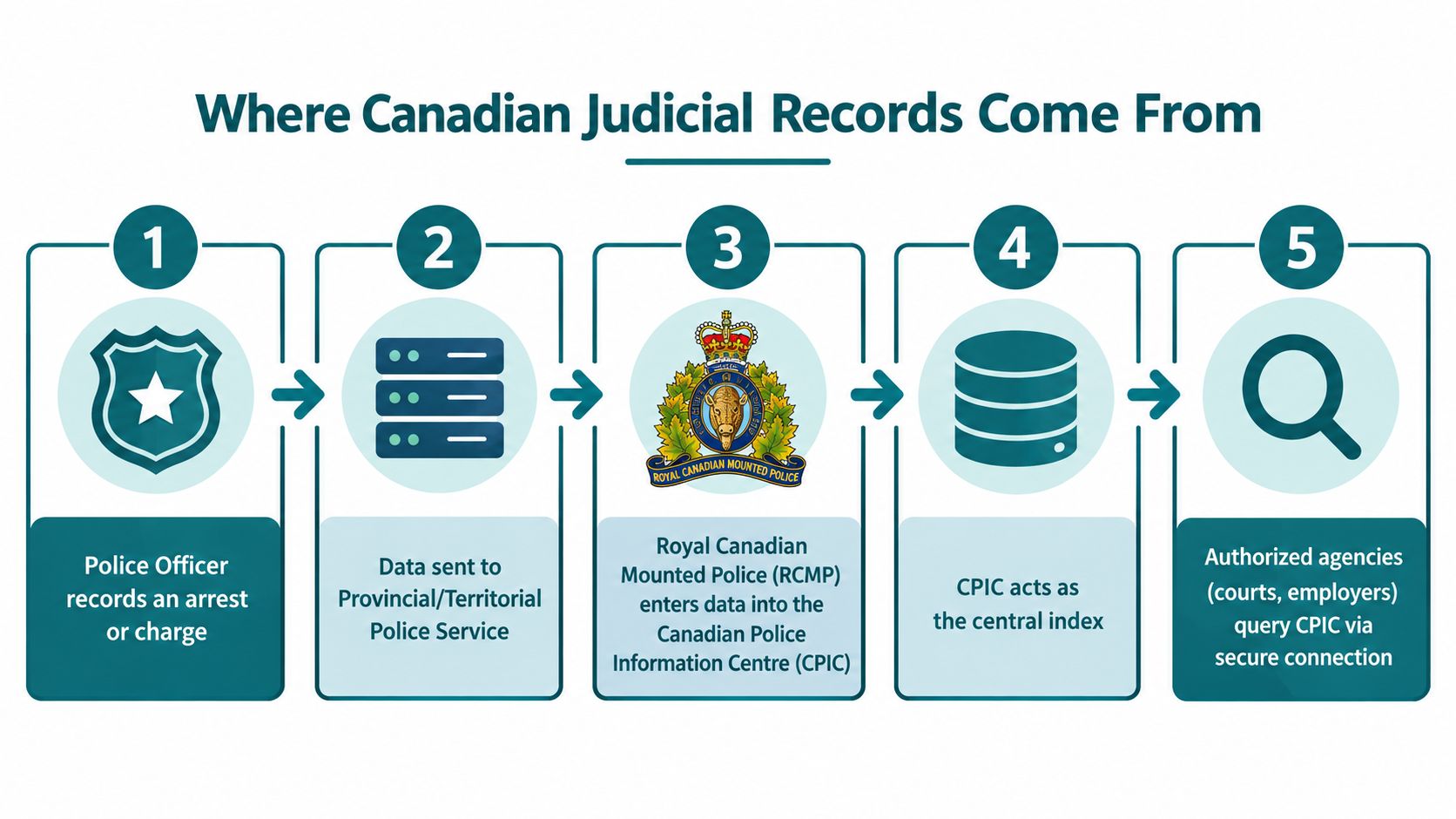
The data path has several owners
A simplified workflow looks like this:
- A police service records an event: An arrest, charge, warrant, or other judicial entry is created in the relevant local system.
- The contributing service updates its records: Municipal, provincial, or federal police systems manage the information and its status.
- CPIC provides a national index: The RCMP's system allows authorised searches against information contributed to the national network.
- Local records provide context: Police services and court registries may verify dispositions, restrictions, or updates that aren't adequately represented by an index entry.
- The authorised screening channel reports the result: The employer receives a product limited by the check type, consent, jurisdiction, and disclosure law.
The Ontario Information and Privacy Commissioner describes CPIC as containing databases relating to people with criminal records, pending charges, findings of not criminally responsible, probation, and prohibition orders. That structure explains why a judicial matters check can reveal active legal status, while also showing why access controls and accurate interpretation are essential.
Records can change after a query. A court disposition may be pending, a record may be sealed or purged under applicable rules, or a local police update may not yet appear in every connected system. Turnaround and completeness can vary by jurisdiction, so an employer should avoid promising that a report is an infallible, permanent account of a person's history.
Matching the Right Check to the Role
The right check follows the exposure created by the job, not the employer's desire to collect the most information available. A small business hiring an office administrator may need a different product from a healthcare organisation placing a contractor in a long-term care setting.
| Role Category | Recommended Check | Rationale |
|---|---|---|
| General office administrator | CRC or CRJMC | Use a CRC for ordinary duties. Choose a CRJMC if the role includes meaningful access to money, confidential records, or operational authority. |
| Financial staff or payroll | CRJMC | Broader judicial information can be relevant to a role involving funds, payment systems, or sensitive financial records. |
| Driver or delivery worker | CRJMC, plus role-specific driving checks where required | Review the job's transport, client-contact, and asset risks. A criminal check isn't a substitute for a provincial driver's abstract. |
| Warehouse or logistics worker | CRC or CRJMC | Use the CRJMC where the employee has independent access to high-value goods, restricted sites, or customer property. |
| IT administrator | CRJMC | System privileges and access to sensitive personal information support a documented need for a broader non-VS check. |
| Educator or youth-program worker | VSC where the position involves authority or trust over children | The organisation must request the VSC for the specific position, and the local-jurisdiction rule applies. |
| Healthcare worker or contractor | VSC or CRJMC, depending on duties and governing requirements | Direct care, unsupervised contact, and provincial or facility rules may require a VSC. See Alero's healthcare screening information when mapping these workflows. |
A CRJMC is often the sensible default for non-VS roles with greater trust, access, or operational responsibility. A CRC can be appropriate for lower-risk work where the employer's documented assessment doesn't support broader collection.
Step up to a VSC when the role involves authority or trust over children or vulnerable persons, not merely because the organisation operates in healthcare, education, or social services. A regulated profession, child-welfare rule, contract, or licensing body may impose a requirement that overrides the employer's preferred workflow.
How to Interpret CRJMC Results
A CRJMC should produce a structured risk signal, not an automatic pass or fail. A clear result can close the screening step. A result with information should start a consistent review process.
Begin by identifying the category and status. A conviction, an outstanding charge, an absolute discharge, a conditional discharge, a peace bond, and a warrant don't carry the same meaning. The adjudicator should never collapse them into a single label such as “criminal record present”.
Apply the same questions every time
A written framework should ask:
- What is the legal status? Is the matter a conviction, an unresolved charge, a discharge, an order, or another judicial entry?
- How old is the matter? Time since the event can affect the assessment, particularly where the person has demonstrated stable conduct since then.
- What was the nature of the conduct? Consider the conduct itself, not a broad category that hides important differences.
- What sentence or court outcome followed? Completion of a sentence, compliance with conditions, and current restrictions may all be relevant.
- What evidence of rehabilitation exists? Look for reliable, job-relevant information rather than demanding irrelevant personal detail.
- How does it relate to the role? Tie the finding to money, access, safety, clients, confidential data, driving, or another genuine duty.
An outstanding charge indicates unresolved exposure, not guilt. A discharge indicates court involvement without a conviction, and a peace bond or prohibition order may impose current obligations. Each finding needs its own treatment.
The strongest adjudication note explains both the finding and the job-based reason for the decision.
Give the candidate a fair opportunity to challenge an inaccurate match or explain context, especially where names or identifiers could create confusion. Document the decision, the evidence considered, and why the outcome is consistent with the employer's policy and human rights obligations.
Employer Obligations Under Canadian Privacy Law
Criminal screening creates a privacy obligation before the search begins. Under PIPEDA, personal information includes factual or subjective information about an identifiable individual. A CRJMC report therefore needs to be treated as regulated personal information, not as an ordinary recruiting attachment.
The Office of the Privacy Commissioner of Canada explains PIPEDA's personal-information and accountability principles. The employer should identify a legitimate hiring purpose, collect only information necessary for that purpose, obtain meaningful consent, limit access, and retain the result only as long as there is a defensible business or legal reason.
Design the workflow around purpose
Consent should identify what check is being requested, why the employer needs it, and how the result will be handled. It shouldn't be buried in vague language that authorises unrelated searches. If the role changes materially, revisit whether the original purpose still supports the requested information.
Provincial privacy laws can add requirements. Quebec's Act 25, for example, creates additional governance expectations for organisations handling personal information. Employers should also account for provincial privacy statutes, human rights codes, sector rules, and contractual requirements rather than assuming a single federal template works everywhere.
Retention needs a defined endpoint. Store reports securely, restrict them to people who need the information for the decision, and destroy or anonymise them when the purpose and applicable obligations no longer require retention. A vendor should support that process with auditable permissions and documented handling.
Over-collection creates its own risk
Ordering a VSC for every employee because it appears more thorough can be difficult to justify. Ordering only a CRC for a role with current judicial restrictions may leave the employer unable to assess a material risk. The defensible position is the narrowest check that addresses the documented job requirement.
For a practical overview, HR teams can review PIPEDA and background checks in Canadian hiring, then confirm any province-specific requirements with privacy or employment counsel.
Putting a CRJMC Workflow Into Practice
A workable process starts before the requisition reaches the candidate. Write the role-risk rationale, select the check type, confirm any provincial or client requirements, and prepare a consent notice that names the purpose and process.
Use a provider that can identify the candidate reliably, route the request through the proper Canadian channel, and show the status of the case. Identity verification is particularly important when the report will influence access to money, systems, facilities, or vulnerable clients. Alero's identity verification service is one option for employers that want identity proofing connected to a broader screening workflow.
A practical operating sequence
- Define the job risk: Record the duties, access rights, client contact, and any regulator or contract requirements.
- Select the tier: Choose CRC, CRJMC, or VSC based on that documented assessment.
- Obtain consent: Give the candidate clear information about the check, purpose, handling, and opportunity to correct identity details.
- Verify identity: Use reliable identity evidence before associating a judicial result with the applicant.
- Review the report: Separate clear results from review cases and distinguish charges, convictions, discharges, and orders.
- Escalate fairly: Where information may affect hiring, use a consistent adjudication process and invite the candidate to respond.
- Record the decision: Note the role-related rationale without copying unnecessary sensitive details.
- Secure and dispose: Limit access, apply retention rules, and destroy or anonymise the report when the purpose ends.
Speed matters because manual follow-up can delay a start date and frustrate candidates. Accuracy matters more than a fast result, especially when local police data or court updates need clarification. Alero Background & Identity offers Canadian criminal screening and identity verification workflows, including candidate intake and employer review tools, but employers should still own the role assessment and final hiring decision.
Alero Background & Identity supports Canadian employers with criminal record checks, identity verification, and privacy-conscious screening workflows suited to role-based hiring decisions. Visit Alero Background & Identity to explore options for selecting, ordering, and managing CRJMC-related screening in your Canadian hiring process.