A finalist is waiting for a screening result, a hiring manager wants to send the offer, and your HR team is trying to decide whether a standard criminal record check is enough. The pressure is familiar, but speed doesn't excuse an unsuitable check, weak consent language, or an undocumented decision.
Criminal background checks for employment in Canada should be tied to the role, the people the employee will serve, and the assets or information they'll access. A warehouse picker, a school teacher, a controller, and an in-home caregiver don't present the same screening risk. Treating them as if they do creates unnecessary privacy exposure and can also leave a high-risk role under-screened.
This guide sets out the practical standard. You'll see how Canadian check types differ, what consent and human-rights rules require, how to match screening to a job, how to handle turnaround and candidate communication, and what to put in a policy that managers can follow.
Table of Contents
- Why Criminal Background Checks Matter for Canadian Employers
- The Three Types of Criminal Record Checks in Canada
- Legal and Privacy Obligations Canadian Employers Must Meet
- Matching the Right Check to Each Role
- Designing a Compliant Screening Workflow
- Turnaround Times and Candidate Experience in Practice
- Building a Sample Background Check Policy
- Key Decisions and a Practical Checklist
Why Criminal Background Checks Matter for Canadian Employers
A logistics firm hires a driver without screening for a safety-sensitive role. The driver later causes a fatal collision involving an undisclosed impaired-driving conviction. The employer must then explain whether it took reasonable steps before placing that person behind the wheel. A background check would not remove every hiring risk, but a documented process tied to the role could show that the employer assessed a foreseeable concern instead of ignoring it.
The reverse creates its own liability. A healthcare network that orders the same intrusive check for every position collects information unrelated to some jobs and increases the risk of unfair treatment. Reserve vulnerable-sector screening for positions involving authority or trust over vulnerable people, in line with the legal framework described by the Royal Canadian Mounted Police.
Practical rule: Screen for the risk created by the position, not for a general fear of applicants.
Criminal background checks for employment in Canada sit at the intersection of privacy, human rights, and hiring risk management. In Ontario, the Police Record Checks Reform Act, 2015 established three employer-requestable check types and requires the individual's knowledge and consent before a check is requested. Ontario guidance also generally places the check after a conditional offer. That timing reduces discrimination risk and gives HR a clear control point in the hiring workflow. The Ontario government's police record check guidance sets out disclosure limits and timing expectations.
The employment impact also matters. Public Safety Canada reports that only about half of people released from federal institutions find employment after an average of 14 years, with post-prison employment rates approximately 50%. Its research describes criminal history as a major barrier to reintegration. Ontario protections also limit how employers may use pardoned convictions and provincial offence records. Review the Public Safety Canada employment research before adding a blanket exclusion to a policy.
A defensible screening programme requires five decisions:
- Check type: Choose whether the role needs a CRC, CRJMC, or VSC.
- Legal threshold: Confirm consent, timing, disclosure, and human-rights obligations.
- Role fit: Connect the result to fiduciary exposure, system or site access, safety, or contact with vulnerable people.
- Workflow: Set up identity verification, ATS status tracking, human review, data residency, and retention controls.
- Candidate treatment: Explain the process clearly and give the candidate a fair opportunity to respond.
Speed matters, but a fast result from the wrong check leaves the hiring decision difficult to defend. Build the workflow around the role, the required evidence, and the systems HR can control.
The Three Types of Criminal Record Checks in Canada
A hiring manager filling a remote bookkeeping role needs a different record check from one hiring a youth counsellor. The right choice depends on the employee's authority, access, contact with vulnerable people, and the evidence the organisation must defend later. It also affects turnaround, candidate experience, data residency, and whether the result can be tracked cleanly in the ATS.
Criminal Record Check
A Criminal Record Check, or CRC, is the basic option. It generally uses the candidate's name and date of birth to search the RCMP's Canadian Police Information Centre, or CPIC. It can disclose convictions where no pardon has been granted, subject to applicable disclosure rules.
A CRC may fit a lower-risk office, remote, or operational role where the employee has no authority over vulnerable people and does not handle unusually sensitive assets. It is often the most proportionate choice when the role's exposure is limited and a faster, simpler workflow matters.
A CRC is not a “safe to hire” certificate. It does not provide the same scope as a broader police information check, and a basic check does not include a vulnerable-sector search. The RCMP's explanation of basic criminal record checks helps recruiters explain that distinction to candidates.
Criminal Records and Judicial Matters Check
A Criminal Records and Judicial Matters Check, or CRJMC, covers more than a basic CRC. Depending on the police service and applicable disclosure rules, it may include additional judicial information, such as outstanding charges or other matters. Confirm the exact report definition with the provider before building it into the hiring workflow.
Use a CRJMC where the role involves financial authority, sensitive operational responsibility, or a higher level of trust. A finance administrator with payment access may justify its broader scope, while a low-risk role may not. Do not order it merely because a manager wants “the most complete” report. More information creates more work to interpret, protect, retain, and justify.
Vulnerable Sector Check
A Vulnerable Sector Check, or VSC, is restricted to eligible paid or volunteer roles involving authority or trust over children or other vulnerable persons. It combines a police information check with a search for record suspensions, also known as pardons, for sexual offences, where legally permitted.
The organisation must make the request. The applicant gives consent but does not request the VSC directly. The RCMP's vulnerable-sector guidance explains this division of responsibility. Confirm eligibility with the relevant police service before presenting the check as a condition of employment.
| Check Type | Scope of Records | Source | Typical Role Fit |
|---|---|---|---|
| CRC | Convictions where no pardon has been granted, subject to applicable disclosure rules | CPIC-based police process | Lower-risk office, remote, or operational roles without vulnerable-sector authority |
| CRJMC | Broader police and judicial information, which may include additional matters such as outstanding charges under applicable rules | Police service and relevant Canadian record systems | Roles with greater financial, fiduciary, operational, or trust exposure |
| VSC | Police information plus a search for record suspensions for sexual offences, where legally permitted | Police service process under the Criminal Records Act | Roles involving authority or trust over children or other vulnerable persons |
Apply the population, access, and consequence test. Identify who the employee will interact with, what systems or assets they can access, and what harm could reasonably follow from a failure in that role. Then select the narrowest check that meets the role's legal and operational requirements, and configure the ATS, provider, storage location, and review process around that decision.
Legal and Privacy Obligations Canadian Employers Must Meet
A screening policy needs more than a checkbox that says “candidate agrees.” The organisation should tell the candidate what it will collect, why it needs the information, who will process it, and how the result will affect the hiring decision. Capture consent before the check is ordered, and keep the record separate enough that the candidate can understand what they're authorising.
Federal privacy obligations and provincial private-sector rules can apply differently depending on the employer, location, and activity. Quebec employers, for example, must account for the Act respecting the protection of personal information in the private sector. A practical overview of consent, necessity, and handling considerations is available in this guide to PIPEDA and background checks.
Consent must be specific and documented
Use plain language. The consent request should identify:
- The purpose: Explain the employment decision and the role involved.
- The scope: Name the CRC, CRJMC, or VSC being requested.
- The provider: Identify the screening organisation or police service involved.
- The information: Describe the categories of records that may be disclosed.
- The handling: Explain access, storage, retention, and secure disposal.
- The choice: Explain what happens if the candidate withdraws consent.
Don't bury consent in a long application or assume that accepting an offer authorises every later search. A candidate's knowledge and consent are explicit requirements under Ontario's police record check framework, and similar privacy principles make informed authorisation the defensible Canadian baseline.
Human rights change how you use the result
A record isn't an automatic rejection. Provincial human-rights codes restrict discrimination based on criminal records in relevant circumstances and require employers to assess whether the information is directly related to the job. Ontario employers must not discriminate based on a pardoned conviction or a provincial offence record, and screening should be connected to a bona fide occupational requirement.
For Ontario hiring, timing is a legal control, not a courtesy. The province generally expects criminal background checks after a conditional job offer, rather than at the initial application stage. Employers operating elsewhere should confirm the applicable provincial rules before copying an Ontario workflow across the country.
Necessity includes the information you don't use
The Office of the Privacy Commissioner's RCMP investigation found that the RCMP contravened the Privacy Act when it used certain non-conviction information in screening. The operational lesson is direct: don't collect or rely on information just because a vendor can return it.
Set a defined retention period, restrict access by role, and securely destroy or return candidate information when the business purpose ends. Review whether your vendor stores data in Canada, particularly if a U.S.-based provider or parent company is involved. A signed consent form won't cure unnecessary collection, uncontrolled access, or an adverse decision that ignores human-rights duties.
Matching the Right Check to Each Role
The fastest defensible decision is made before the requisition opens. Write the screening level into the job profile, explain the risk it addresses, and require HR approval before a manager upgrades the check “just to be safe.”
| Role | Recommended Check | Rationale |
|---|---|---|
| Retail cashier | CRC, where the role's duties justify screening | The position may involve customer contact and transactional responsibility, but the employer should assess the actual level of financial access rather than assume a broader check is needed. |
| Warehouse picker | CRC, where role-related screening is justified | The focus is operational trust and workplace risk. A VSC isn't appropriate unless the position independently creates authority or trust over vulnerable persons. |
| Financial analyst | CRJMC, if justified by financial access and responsibility | The role may involve sensitive financial information, authority, or fiduciary exposure. Document why the broader scope is necessary. |
| School teacher | VSC | The role involves authority or trust over children. The organisation must make the request and provide the required role explanation. |
| Long-haul truck driver | CRC or a broader check if the role-specific risk assessment supports it | Consider the actual driving, safety, and trust duties. Don't treat a criminal record check as a substitute for driver's licence or abstract verification. |
| In-home caregiver | VSC | The employee may hold authority or trust over vulnerable people in a private setting, making role-based VSC eligibility central. |
| IT administrator with system access | CRJMC, if the access and responsibility justify it | The relevant risk is privileged access to systems and data. The policy should explain why a broader check is proportionate. |
A VSC is lawful only when the position itself creates authority or trust over vulnerable persons. The RCMP says the organisation must provide a written explanation of the role and why the check is required. If the position doesn't meet the Criminal Records Act requirements, the police service can't conduct the check. Review the RCMP's role-based VSC explanation before adding VSC language to a broad job category.
Education, childcare, and certain health roles may also be subject to provincial or sector-specific requirements. Confirm the rule for the province and regulator instead of assuming that a job title alone creates eligibility.
“ No check” is rarely a sensible paid-employment default where the employer has a documented, job-related reason to screen. Volunteers and unpaid interns may follow a different risk assessment, but privacy and consent obligations still apply. Reference conversations should sit beside, not replace, the record-check decision. Use a structured approach such as reference checks that work to gather job-relevant evidence without expanding the criminal-screening scope.
Designing a Compliant Screening Workflow
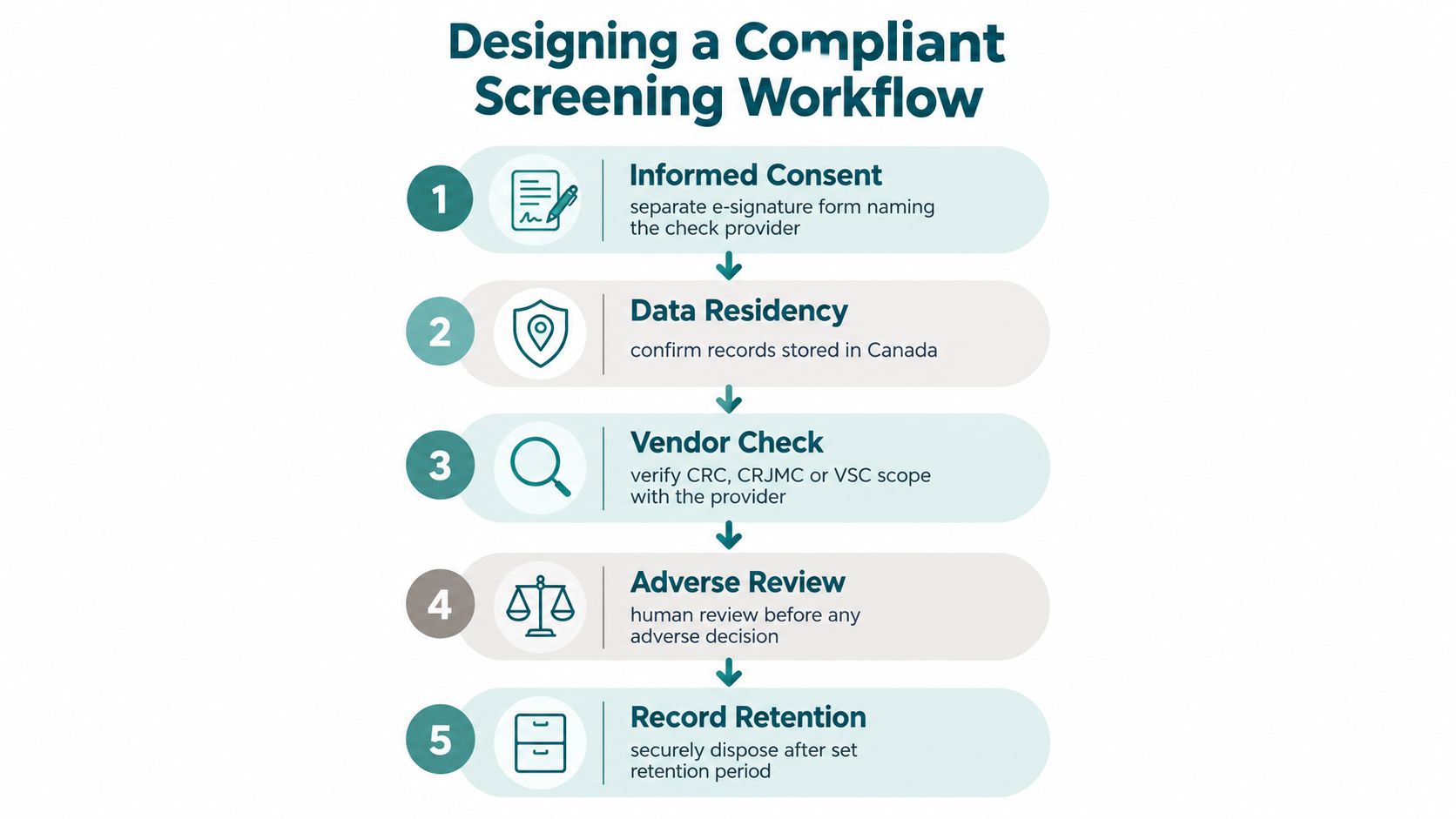
A compliant process should feel simple to the candidate and leave a detailed trail for HR. Build it as a controlled sequence rather than a series of emails between a recruiter, manager, candidate, and vendor.
Start with consent and identity
Use a separate consent form or e-signature step. It should name the provider, the check type, the purpose, and the location where applicant data will be stored. Don't bundle consent into the offer letter. A conditional offer can establish the timing milestone, but it shouldn't obscure the separate authorisation for the check.
Verify identity with two government-issued documents before releasing the check to the provider. Match the details consistently, record the verification status, and limit access to staff who need it. If the candidate withdraws consent, pause the check. Don't treat withdrawal as a retroactive cancellation of an offer without a documented human-rights review and appropriate legal advice.
Control recency, access, and status
Criminal-record information can become inaccurate over months, weeks, or even days, according to RCMP guidance on why criminal record checks are conducted. Don't assume a stale report is current merely because it has a familiar candidate name on it. Set a documented recency rule, commonly expressed as a range such as 90 to 180 days, but validate that rule for the role, jurisdiction, and any regulator involved.
Store results in the ATS or HRIS with role-based access and an audit trail. Keep the canonical status in one system, then connect provider callbacks to platforms such as Workday, Greenhouse, or BambooHR. Recruiters should see whether a check is pending, complete, or requires human review without chasing email attachments.
Workflow test: If a manager can download a report, forward it to a personal inbox, and make a decision without an audit entry, the process isn't controlled.
Keep the review human
A status such as “review” should trigger an authorised HR assessment, not an automatic rejection. Confirm the candidate's identity, distinguish a record from an allegation, check whether disclosure is permitted, and assess relevance to the exact duties. Document the reasoning and the accommodation steps before communicating an outcome.
Turnaround Times and Candidate Experience in Practice
A controller finalist has waited eleven days for a vulnerable-sector result while another employer's offer remains open. The hiring manager blames the candidate for going quiet, but the actual failure is the absence of a screening plan that matched the role's processing reality.
A basic check may move quickly through an accredited provider. A broader judicial check can take longer when police or courthouse queries require manual handling. A VSC can take still longer because the responsible police service must determine whether the position meets the legal test and complete the required search. The Canadian background check turnaround guide can help your team set expectations without promising a result the issuing authority controls.
Speed needs context
Fast processing is useful, but it isn't automatically accurate or sufficient. A shallow result delivered quickly may be less useful than a properly scoped check that takes longer. The RCMP also warns that record information may not remain accurate for long, which creates a second operational question: when was the result obtained, and is it still actionable for this decision?
Build the hiring plan around that distinction:
- At requisition stage: Decide the check level before the candidate reaches the offer stage.
- At offer stage: Send the conditional offer and separate consent request together, where permitted.
- During processing: Tell the candidate what has been received, what remains pending, and who controls the next step.
- During delay: Give a realistic update rather than repeating “still in progress.”
- At review: Pause the decision while HR assesses relevance and gives the candidate a meaningful opportunity to respond.
Give candidates an off-ramp
A candidate may flag an old conviction before the report is complete. Don't ask them to defend their entire history to a hiring manager. Route the issue to a trained HR reviewer, ask only for information relevant to the role, and protect the candidate's privacy.
Candidates can decline an offer, withdraw consent, or decide that a slow process no longer works for them. That isn't a reason to cut controls. It is a reason to explain the process early, choose the narrowest lawful check, and avoid ordering a VSC for a role that doesn't qualify.
Building a Sample Background Check Policy
A defensible policy starts with purpose. State which risks the organisation is addressing and identify the roles affected. “All employees must pass a criminal check” is weak language because it doesn't explain necessity, scope, or how the organisation will handle information that isn't relevant.
Clauses your policy should contain
- Purpose and role coverage: Identify the positions that trigger screening and the risk each check addresses.
- Check scope: Define when the organisation will order a CRC, CRJMC, or VSC.
- Consent: Require express written consent before any check is ordered, with separate language naming the provider and purpose.
- Identity verification: Set the document and matching standard, including who can approve an exception.
- Timing: For Ontario hiring, state that the check generally occurs after a conditional offer, consistent with provincial guidance.
- Relevance review: Require an individual assessment of the result against the job's actual duties.
- Disclosure limits: Prohibit reliance on information the employer isn't entitled to use, including protected records.
- Data residency: Disclose where screening data is stored and identify any cross-border processing risk.
- Retention: Set a defined retention period, access controls, and secure disposal method.
- Adverse action: Require pre-decision disclosure, a meaningful opportunity to respond, and documented reconsideration.
- Accommodation: Direct HR to assess accommodation duties under the applicable provincial human-rights framework.
- Escalation: Name the HR and Legal contacts responsible for unusual results, disputes, and regulator questions.
A VSC clause must be narrow. It should require confirmation that the position creates authority or trust over vulnerable people and that the organisation can provide the written role explanation required by the police service. Don't write “VSC required for all customer-facing roles.” Customer contact alone doesn't establish the legal threshold.
Turn policy into practice
Train recruiters and hiring managers on what they may ask, when they may ask it, and what they must not do with a report. Use a standard review form that records the role, check type, information considered, candidate response, accommodation assessment, and final rationale.
A signed policy isn't evidence of compliance by itself. Your audit trail should show that the right person ordered the right check, obtained consent first, restricted access, reviewed the result individually, and disposed of the information on schedule. Review the policy whenever provincial rules, regulator expectations, vendor processing, or the organisation's role profile changes.
Key Decisions and a Practical Checklist
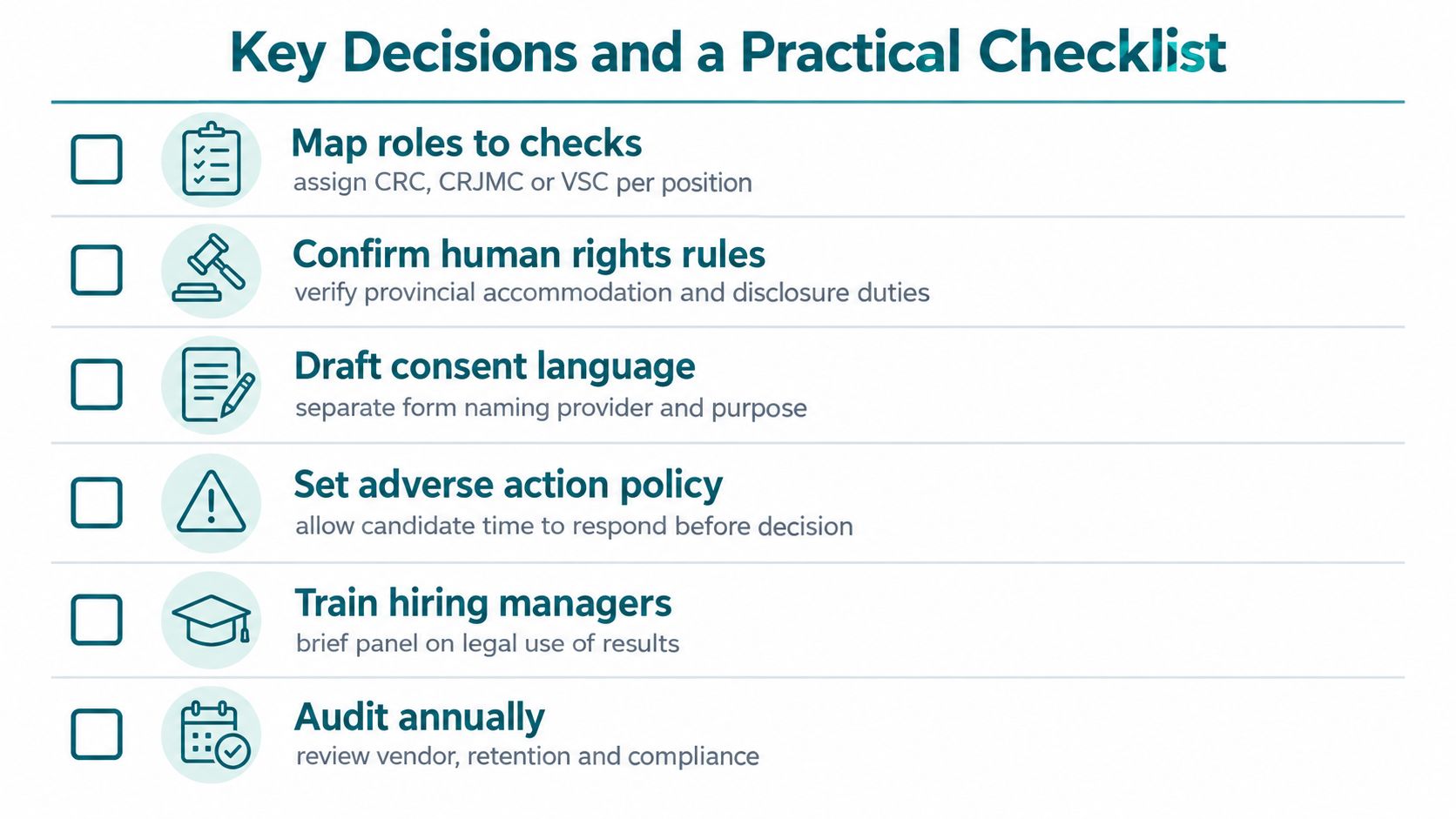
A defensible screening programme is a set of decisions, not a pile of reports. Make each decision visible in the requisition, consent record, ATS status, review file, and retention log.
- Map roles to checks: Assign CRC, CRJMC, or VSC per position, based on duties, access, and authority.
- Confirm human-rights rules: Verify provincial accommodation, disclosure, and timing duties before requesting a check.
- Draft consent language: Use a separate form that names the provider, purpose, scope, and data-residency location.
- Set the review process: Require human assessment and candidate response before an adverse decision.
- Control identity and access: Verify identity, restrict report visibility, and maintain an auditable status history.
- Connect the workflow: Send provider status callbacks into the ATS or HRIS so recruiters work from one canonical record.
- Set retention and disposal: Define how long results remain necessary, then securely destroy or return them.
- Review vendor performance: Assess accuracy, processing delays, Canadian data storage, support, and integration reliability.
- Train hiring managers: Teach managers that a record isn't an automatic rejection and that HR owns the interpretation.
- Audit the policy: Review the workflow against current provincial obligations, case developments, role changes, and vendor performance.
The operational standard is clear: use the narrowest check that answers the role's legitimate risk question, and use the result through a documented human review. That approach protects candidates from unnecessary scrutiny while giving hiring managers a process they can defend.
Alero Background & Identity provides Canadian criminal record checks, vulnerable-sector checks where applicable, identity verification, and ATS or HRIS-connected screening workflows with applicant data stored in Canada. Review the available options and build a role-based process with Alero Background & Identity before your next hiring cycle.