You're probably dealing with one of two hiring moments right now. Either a manager has asked for a credit check “just to be safe,” or you're filling a finance, procurement, or senior signing-authority role and need to decide whether credit data belongs in the file at all.
My view is simple. In Canada, a credit check for employment isn't a default screening step. It's a narrow tool for narrow jobs. If you treat it like a standard pre-hire filter, you create privacy risk, fairness risk, and a messy candidate experience for very little decision value.
Table of Contents
- What a Credit Check Means in Canadian Hiring
- The Legal Framework Every Canadian Employer Must Follow
- Why Credit History Is a Weak Signal in Today's Economy
- Getting Consent and Timing the Check Correctly
- Matching the Right Check to the Role
- A Practical Workflow for a Finance and Treasury Hire
- Do and Don't Checklist for Canadian Employers
What a Credit Check Means in Canadian Hiring
An employment credit check is not the same thing as a background check package.
When employers talk loosely about “running a background check,” they often bundle together criminal screening, identity verification, references, education checks, and maybe a credit file. That's sloppy practice. Each check has a different legal basis, a different relevance test, and a different impact on the candidate.
What a credit check actually shows
A credit check for employment in Canada generally means reviewing a consumer credit history report. In practical terms, that report may show:
- Open credit accounts
- Payment history
- Outstanding balances
- Public-record style financial events, where available through the reporting process
That's very different from a criminal record check or a police information check. It also tells you something very specific. It shows a financial profile, not a complete integrity profile.
A lot of employers also confuse a credit score with a complete screening result. That's a mistake. A score, on its own, doesn't verify identity, confirm employment history, or tell you whether someone is suitable for a role involving vulnerable people, regulated duties, or access to protected systems.
A credit file can answer a narrow hiring question. It can't answer all of them.
What this tool should and shouldn't do
Use a credit check only when the role itself justifies it. In Canada, the legal and policy direction is consistent on this point. Credit checks are tied to necessity, consent, and proportionality, not convenience. The BC Civil Liberties Association guidance on employment-related privacy states that an employer can request consent for a credit check only if the information is necessary for the job, and if the information is used in a hiring decision it must generally be kept for one year so the applicant can request access.
That one rule tells you almost everything you need to know. If the job doesn't create a real financial-risk question, don't run the check.
Keep it in its lane
A sensible screening package separates checks by purpose:
- Criminal record checks address role-related criminal risk
- Judicial or police information checks are narrower or broader depending on the role and local process
- Vulnerable sector checks are reserved for roles involving children or vulnerable adults
- Credit checks address financial-risk questions in jobs where that issue is tied to duties
That's the lens for the rest of your workflow. Put credit checks behind a necessity gate. Don't make them your starting point.
The Legal Framework Every Canadian Employer Must Follow
The legal baseline in Canada is tighter than many employers assume. You can run an employment credit check in some circumstances. That doesn't mean you should use one broadly.
Start with federal privacy rules
For private-sector employers under PIPEDA, credit information is personal information, and the consent standard matters. Federal privacy rules require employers to obtain informed written consent, explain why they're collecting the information, and limit the collection to what's necessary and relevant to the role. The Office of the Privacy Commissioner also states that PIPEDA applies to personal information about employees of federally regulated organizations, and that collection without knowledge and consent is limited to narrow employment-context situations rather than blanket screening permission, as outlined by the Office of the Privacy Commissioner of Canada.
For HR teams, that means two things. First, generic consent language is weak. Second, “we always do this” is not a lawful purpose.
Provincial rules narrow the lane further
Ontario allows employment credit checks under the Consumer Reporting Act, but only with notice or consent and only when the information is relevant to the position. A useful summary of the Canadian framework notes that under federal rules and Ontario practice, the employer must keep the process tightly tied to role relevance, and that Public Services and Procurement Canada's personnel security screening includes mandatory credit checks for some roles with the report kept confidential in the screening file, as explained in this overview of employment credit checks in Canada.
If you're building internal policy, that federal security-screening example matters. It shows how government treats credit history. Not as a universal hiring screen, but as a controlled risk signal for specific security outcomes.
For a broader policy reference point, Alero's Canadian background screening compliance guidance is useful for mapping privacy and screening obligations into hiring workflows.
Federal vs Provincial Rules for Employment Credit Checks
| Jurisdiction | Key Statute | Consent Form | Key Restriction |
|---|---|---|---|
| Federal private sector and federally regulated employers | PIPEDA | Informed written consent | Collection must be necessary and relevant to the role |
| Ontario | Consumer Reporting Act | Notice and consent | Information must be relevant to the position |
| British Columbia | Private-sector privacy framework | Role-specific consent practice | Credit information should be requested only if necessary for the job |
| Quebec | Provincial private-sector privacy rules | Higher, explicit consent standard | Treat separate consent and narrow purpose as the safer approach |
Human rights risk is where employers get careless
The legal problem isn't just privacy. It's adverse impact.
Blanket credit screening can screen out applicants facing financial strain for reasons that have nothing to do with honesty or job performance. That can create human rights exposure when the policy disproportionately affects groups already facing barriers in the labour market. If you can't explain why the job itself requires this information, your process is already offside from a risk-management standpoint.
Practical rule: If your role analysis can't defend the check in writing, your consent form won't save you.
Why Credit History Is a Weak Signal in Today's Economy
Your hiring manager is down to two finalists for a treasury-adjacent role. One has a recent dip in credit after a divorce and higher housing costs. The other has a clean file but weaker control experience. If your team treats the credit report as a shortcut for character, you risk rejecting the better hire for the wrong reason.
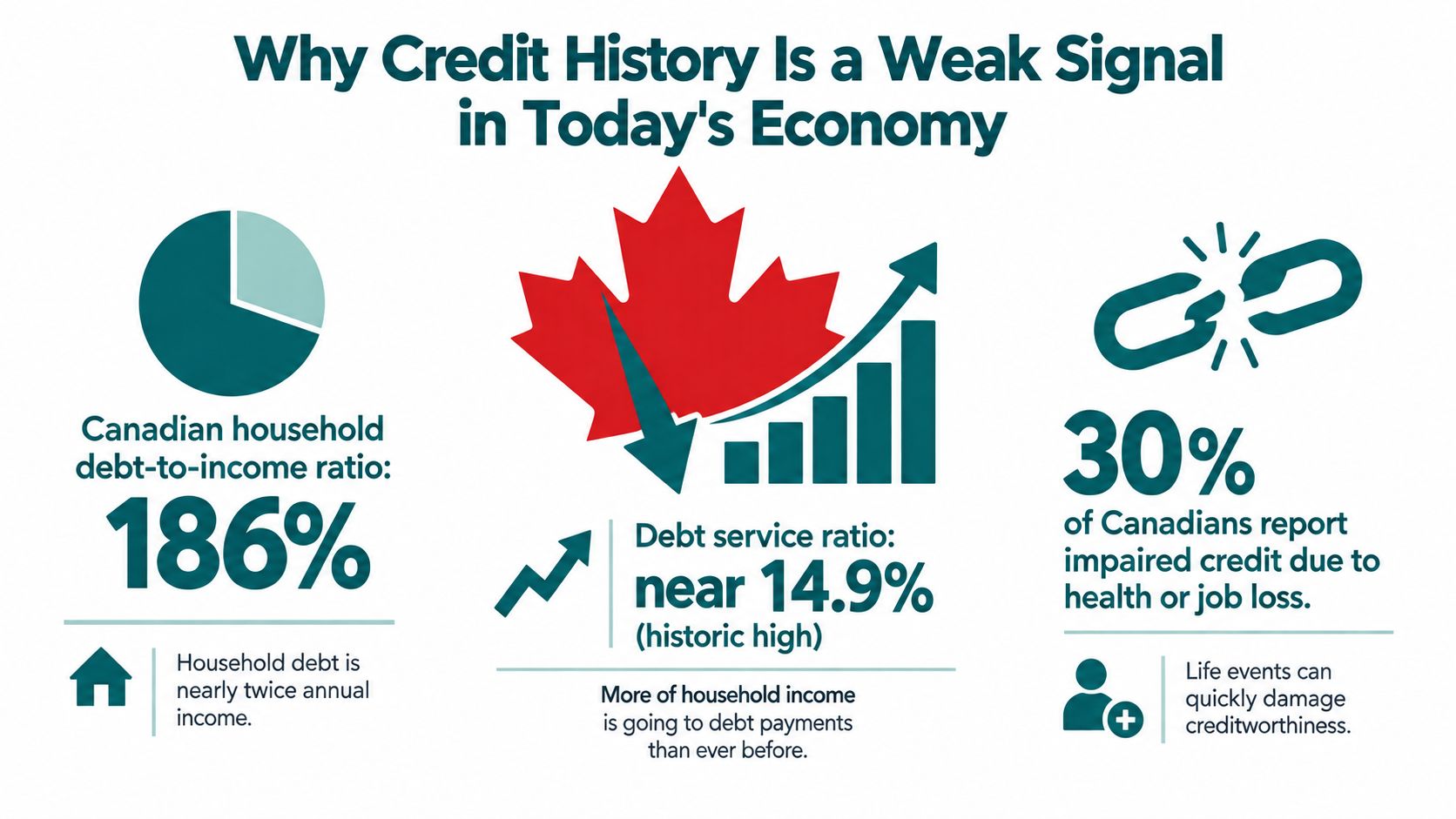
That is the core problem with employment credit checks in Canada. In a high-debt economy, personal credit history often reflects cost pressure, family disruption, illness, or thin borrowing history more than honesty or judgment.
Statistics Canada reports that Canadian households held about $3.01 trillion in credit market debt in Q2 2026 in its national balance sheet and financial flow accounts reporting. Read that number for what it means in hiring. Financial strain is common. It is not a character finding.
Weak credit does not prove poor judgment
A damaged file can follow from rent inflation, separation, caregiving, medical leave, or a period of contract work. A thin file can mean the candidate is young, new to Canada, or cautious about borrowing. None of that shows the person will falsify expenses, bypass approval controls, or mishandle payroll.
Employers still overread credit reports. That is a mistake.
Credit history is a weak hiring predictor unless the role has real fiduciary exposure. If the job does not involve signing authority, treasury access, control over disbursements, control design, or unsupervised authority over cash or valuable assets, the report usually adds noise, not decision-quality evidence.
The fairness risk is bigger than many employers admit
Blanket credit screening acts like a socioeconomic filter. It predictably hits younger applicants, newcomers, people coming out of separation or illness, and candidates dealing with affordability pressure. Those groups are common in the labour market. Screening them out does not make your process sharper. It makes it narrower and harder to defend.
Public-sector practice points the same way. Even in federal personnel screening, credit information is treated as sensitive and tightly contained. Employers should take the hint. Sensitive data with weak predictive value should not be used as a routine character test.
If your team reads bad credit as bad ethics, your process is measuring financial strain, not trustworthiness.
Use a role-based trigger, not a blanket rule
My recommendation is simple. Default to no credit check. Add one only after you can tie it to the actual risks of the role and only after a conditional offer.
Good candidates for a credit check include:
- Treasury and finance leadership
- Roles with material signing authority
- Positions that control disbursements, reconciliations, or banking access
- Security-screened jobs with direct access to protected assets or sensitive financial systems
For most other roles, use better evidence. References, identity verification, credential checks, conflict-of-interest questions, and role-specific assessments will tell you more about reliability than a consumer credit file ever will.
Getting Consent and Timing the Check Correctly
Most compliance failures happen before the report is even ordered. The problem isn't usually bad intent. It's bad sequencing.
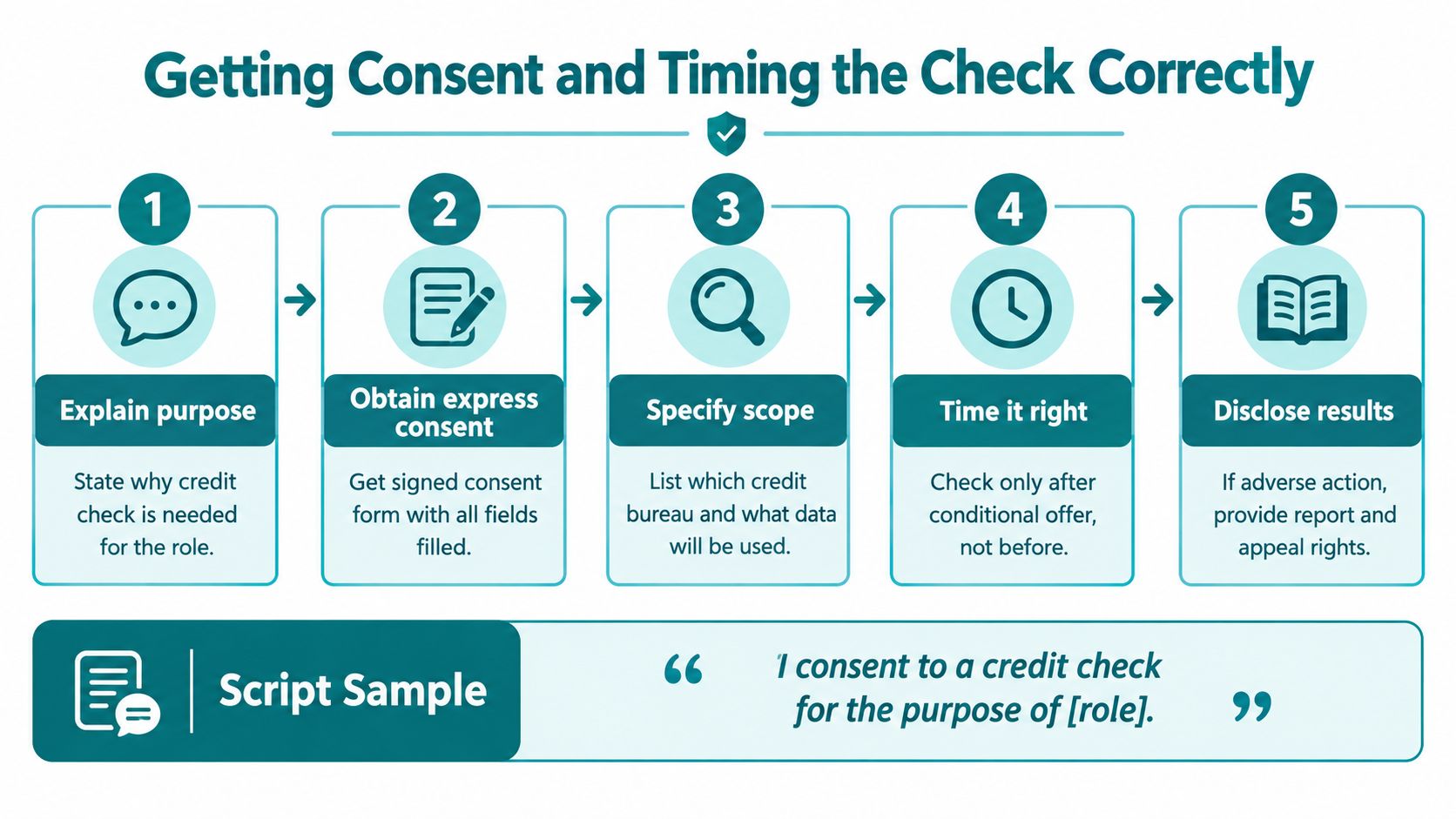
In Canada, the safest approach is to make a credit check a post-offer, role-specific step. Ontario-focused legal commentary has long pointed to this sequence because collecting date of birth to run the check before a conditional offer can create privacy and human-rights risk. A similar point appears in the federal-screening context, where applicants for new, renewed, or upgraded clearances must consent through a prescribed process and the credit check is tied to a specific security outcome, as discussed in this article on PIPEDA and pre-employment due diligence.
The right sequence
Run the workflow in this order:
Assess the role first
Decide whether credit is relevant to the duties. Write that rationale down before you recruit.Recruit and interview without the credit file
Shortlist on capability, experience, references, and job fit.Extend a conditional offer
Make the offer conditional on specific post-offer checks.Present a separate credit-check consent form
Don't bury it inside a generic onboarding package.Give the candidate a fair review opportunity
If the report raises an issue, let the candidate respond before the result affects the final decision.
For a practical privacy checklist, Alero's article on PIPEDA background checks in Canada is a helpful operational reference.
What your consent form should cover
Your consent form should be plain language, not legal wallpaper. Include:
Purpose
State exactly why the credit check is needed for the role.Scope
Identify that the employer is requesting a credit report for employment assessment.Provider details
Name the reporting bureau or screening provider involved.Use and retention
Say who will review the report, how it will be stored, and how long related hiring records will be retained under your policy.Candidate rights
Explain that the candidate may raise accuracy concerns and provide context before a final hiring decision.
Sample disclosure wording
Use direct language such as:
We are requesting your written consent to obtain a credit report for the purpose of assessing your suitability for a role that includes financial responsibility. We will use this information only for that hiring decision and will limit access to staff involved in the assessment.
That works because it tells the candidate what, why, and who.
Three mistakes to stop making
Bundled consent
Don't fold credit authorization into a catch-all background check paragraph.Pre-offer credit pulls
Don't run the report early because the manager wants “extra diligence.”Automatic rejection
Don't treat refusal or weak credit as instant disqualification without reviewing relevance and context.
Matching the Right Check to the Role
Most employers don't need more checks. They need better matching.
A credit check for employment in Canada should sit beside other screening tools, not replace them. If you're choosing checks by habit, you're overscreening some roles and underscreening others.
The role-based matrix
Here's the framework I recommend.
| Role Category | Recommended Checks | Include Credit Check? |
|---|---|---|
| Treasury, controller, senior finance leadership | Identity verification, reference checks, education or designation verification, criminal record check where role-relevant, targeted credit review | Yes, if the role has real fiduciary authority |
| Procurement with high spending authority | Identity verification, references, employment verification, role-specific fraud-control interview questions | Sometimes, if authority is substantial and documented |
| Payroll and accounts payable | Identity verification, employment verification, references, criminal record check where relevant to duties | Sometimes, depending on access and control level |
| Branch management with signing authority | Identity verification, references, credential verification, role-based interview assessment | Sometimes, if financial discretion is material |
| Sales roles | Identity verification, references, employment verification, driver checks if role requires driving | Usually no |
| General administration | Identity verification, references, education or employment verification as needed | No |
| Entry-level operations or retail | Identity verification, criminal record check only if role-justified, references | No |
| Childcare, elder care, youth-serving roles | Identity verification, appropriate criminal screening, Vulnerable Sector Check where legally applicable | No, unless the role separately has material financial authority |
Keep criminal screening categories straight
Canadian employers often blur terms.
The RCMP distinguishes check types based on role risk. A basic police information check is for employment or volunteer roles that do not involve children or vulnerable adults, and it is limited to criminal convictions, outstanding charges and warrants, and other judicial orders, according to the RCMP's police information check guidance. A Vulnerable Sector Check includes a criminal record check plus a search for record suspensions for sexual offences and is intended for roles involving children or vulnerable adults, as the RCMP explains in its guidance on criminal record checks and vulnerable sector checks.
For employers, the point is simple. Don't substitute a credit report for the check the role requires.
Document business necessity
If you decide to include credit, record the reason in the job file. Note the duties, the financial exposure, and why less intrusive checks are not enough.
If you need a vendor option for that narrow use case, Alero's credit and financial checks service is one Canadian example that fits into a broader screening workflow.
A Practical Workflow for a Finance and Treasury Hire
Let's use a real-world hiring pattern. You're hiring a treasury manager at a mid-sized manufacturer. The role oversees cash positioning, banking relationships, payment controls, and parts of liquidity reporting.
That job can justify a credit check. But the check shouldn't drive the process.
Start with role evidence, not personal finance data
The first screen should focus on the candidate's ability to handle control-heavy work:
- Structured behavioural interviews about segregation of duties
- Scenario questions on payment approvals, exception handling, and fraud escalation
- Verification of accounting designations where listed
- Reference checks with prior controllers, CFOs, or finance leaders
- Employment verification tied to actual treasury or cash-management scope
Those signals usually tell you more about risk than a raw credit file.
Hire for control judgment first. Use credit only as a secondary risk input.
Where the credit check fits
Once you've selected the preferred candidate, issue a conditional offer. In the condition letter, list the required checks. Then obtain a separate written consent for the credit report, with a documented note in the file explaining why the role justifies it.
At that point, the credit check becomes one input among several. If the file shows concern, don't jump straight to rescission. Compare it against the rest of the evidence. A candidate with strong references, verified treasury experience, and clear control thinking may still be the right hire if the issue reflects past hardship rather than present misconduct.
Use the right criminal screening lens too
For a finance role, avoid broad or mismatched police screening. If you need criminal screening, keep it role-related and lawful. You are not hiring into a vulnerable-sector role, so don't ask for a Vulnerable Sector Check. Match the check to the duties, not to managerial anxiety.
This short explainer is useful if your hiring team needs a quick reset on screening scope.
What should outweigh the credit report
In a treasury hire, I'd put more weight on:
- Past responsibility for cash, banking, and disbursement controls
- How the candidate handled override requests from senior leaders
- Accuracy and consistency across résumé, interviews, and references
- Professional reputation from finance references
- Ability to explain control trade-offs in realistic scenarios
That's a better hiring method because it ties your decision to the actual job.
Do and Don't Checklist for Canadian Employers
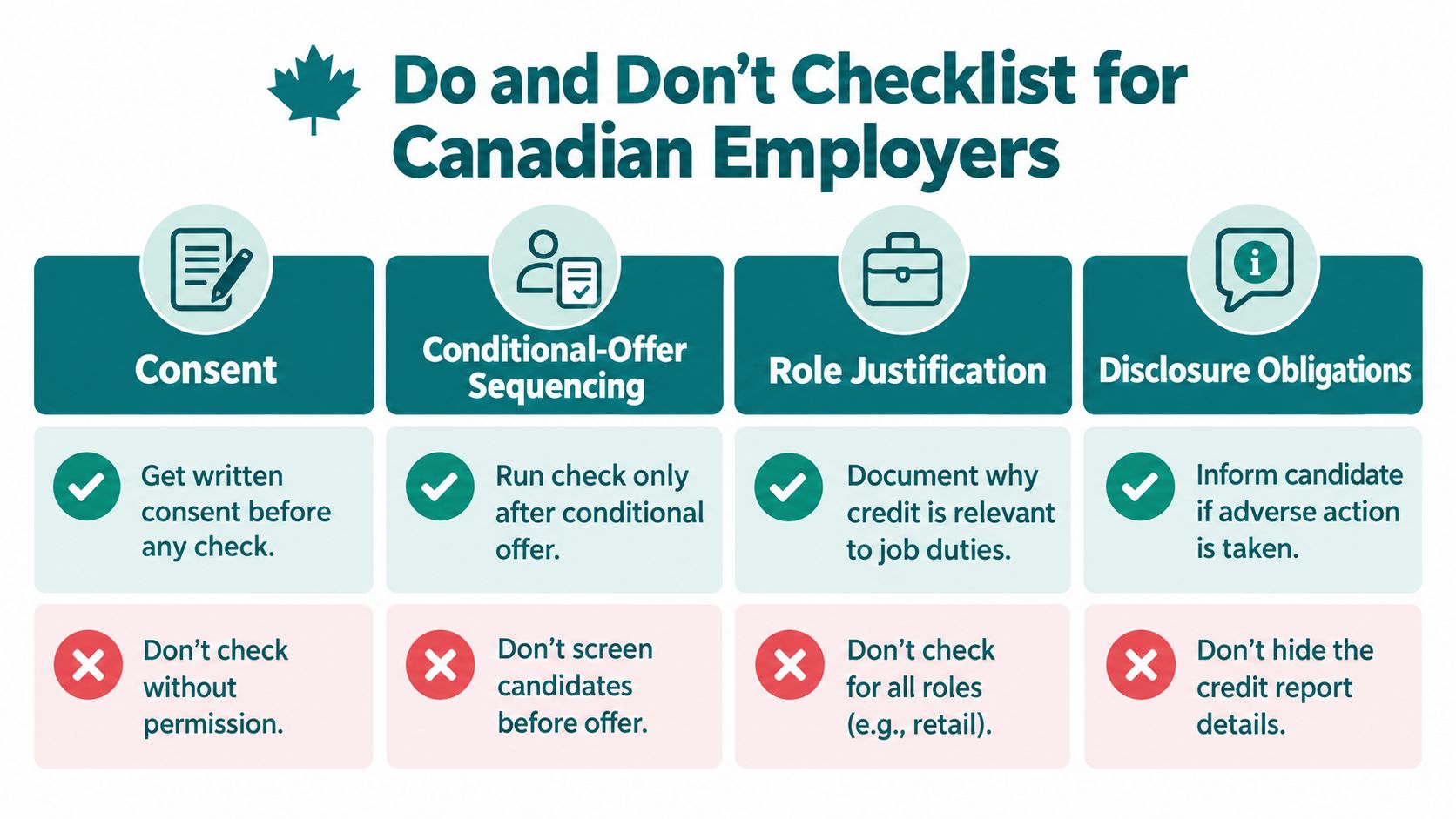
If your team needs a one-page rule, use this one. It's strict on purpose.
Consent and Timing
- Do get written, role-specific consent before any credit check. Under PIPEDA-style principles, the candidate should know what you're collecting and why.
- Do wait until the conditional-offer stage when the role justifies a credit review.
- Don't bundle consent into a general employment form and hope that covers you.
- Don't collect more than you need just because your screening package allows it.
Scope and Role Justification
- Do write down the business necessity for any credit check. Tie it to fiduciary duty, financial control, or security-sensitive access.
- Do choose the right screening tool for the role. Criminal record checks, police information checks, Judicial Matters checks where locally used, and Vulnerable Sector Checks all serve different purposes.
- Don't run blanket credit screens for admin, retail, junior operations, or general office roles.
- Don't confuse a credit report with a complete background check. It isn't one.
Disclosure and Records
- Do limit access to the report to staff involved in the hiring decision.
- Do give the candidate a chance to respond if the information may affect the decision.
- Do keep records according to your retention rules and role-related obligations.
- Don't circulate the report internally beyond the people who need it.
- Don't treat confidentiality as optional. Public-sector screening practice is much tighter than many private employers realise, and that's the safer model to follow.
Alternatives and Fairness
- Do use stronger predictors first. References, identity verification, credential checks, and role-based assessment usually carry more hiring value.
- Do account for context if a report shows problems. Financial stress doesn't automatically equal workplace risk.
- Don't treat refusal as automatic disqualification without considering whether the check was necessary.
- Don't ignore the disparate impact problem. Credit screening can become a backdoor screen against applicants facing economic pressure.
Escalate for legal review before any credit check that isn't clearly tied to documented financial authority, security-sensitive access, or another defensible business necessity.
Alero Background & Identity helps Canadian employers run role-appropriate screening with PIPEDA-aligned consent workflows, Canadian data residency, criminal record checks, identity verification, and credit-related screening where it's justified. If you want a cleaner, faster hiring process that keeps credit checks in the right lane, visit Alero Background & Identity.