A candidate arrives for a security role with a licence card, a confident explanation, and a start date that's already been promised to the client. The card looks legitimate, but nobody has checked whether the licence is active, whether the person is tied to the right province, or whether the name matches the individual being hired. That gap is where a straightforward recruitment decision can become a compliance problem.
To check security licence status properly in Canada, treat the physical card as supporting evidence, not final proof. Verify the current provincial registry status, match the result to the candidate's identity, complete only the record checks the role requires, and document what you confirmed and when.
Table of Contents
- The Compliance Reality of Security Hiring in Canada
- Gathering the Right Details for Registry Searches
- Navigating Provincial Verification Portals
- Aligning Criminal Record Checks with Licensing Rules
- Handling Expired, Pending, and Digital Licences
- Streamlining Verification with Automated Screening Partners
The Compliance Reality of Security Hiring in Canada
A client may expect a guard on site tomorrow while the candidate's licence status remains unclear. The card appears genuine, the candidate has worked recently, and the hiring team has already planned the schedule. Yet a licence may be expired, suspended, revoked, or recorded under details that do not match the application. A physical card confirms what was issued at one point, not necessarily what the provincial authority recognizes today.
That distinction affects employers, staffing firms, property managers, and vendors. Assigning an unlicensed person can trigger contractual problems, insurer questions, and difficulty proving reasonable care in hiring and deployment. The same outcome can follow from a rushed name search or from assuming that a licence issued in one province applies elsewhere in Canada.
Practical rule: Review the card, then verify the current provincial registry record before assigning the person.
Ontario shows why this needs a defined workflow. The 2024–2025 annual report for Ontario's Private Security and Investigative Services Branch records 161,484 licensed individuals, 1,122 licensed agencies, and 501 registered employers. It also records 115,384 individual and agency licence applications received during that reporting year and 101,618 licences issued. A busy licensing system leaves little room for informal checks completed only when a manager asks.
Why a national shortcut doesn't work
Security licensing is provincial. No single Canadian search screen confirms every candidate, and registry systems differ in search fields, access rules, and status labels. Someone who has worked in Ontario, British Columbia, and Quebec may therefore require separate checks, each tied to the province where the assignment will take place.
Set up the workflow around the job, not the candidate's travel history:
- Identify the work province: Confirm the licence required for the actual assignment, even if the candidate lives or previously worked elsewhere.
- Check the issuing authority: Use the regulator responsible for that province and licence category.
- Match the person: Compare the registry result with government-issued identity information and the application.
- Record the snapshot: Keep the search date, method, result, and any follow-up evidence.
A documented process supported by the Canadian compliance resources available from Alero can fit into a wider screening policy. It does not remove the employer's duty to apply the provincial rule governing the role, especially when a digital record is pending or a status requires follow-up before deployment.
Gathering the Right Details for Registry Searches
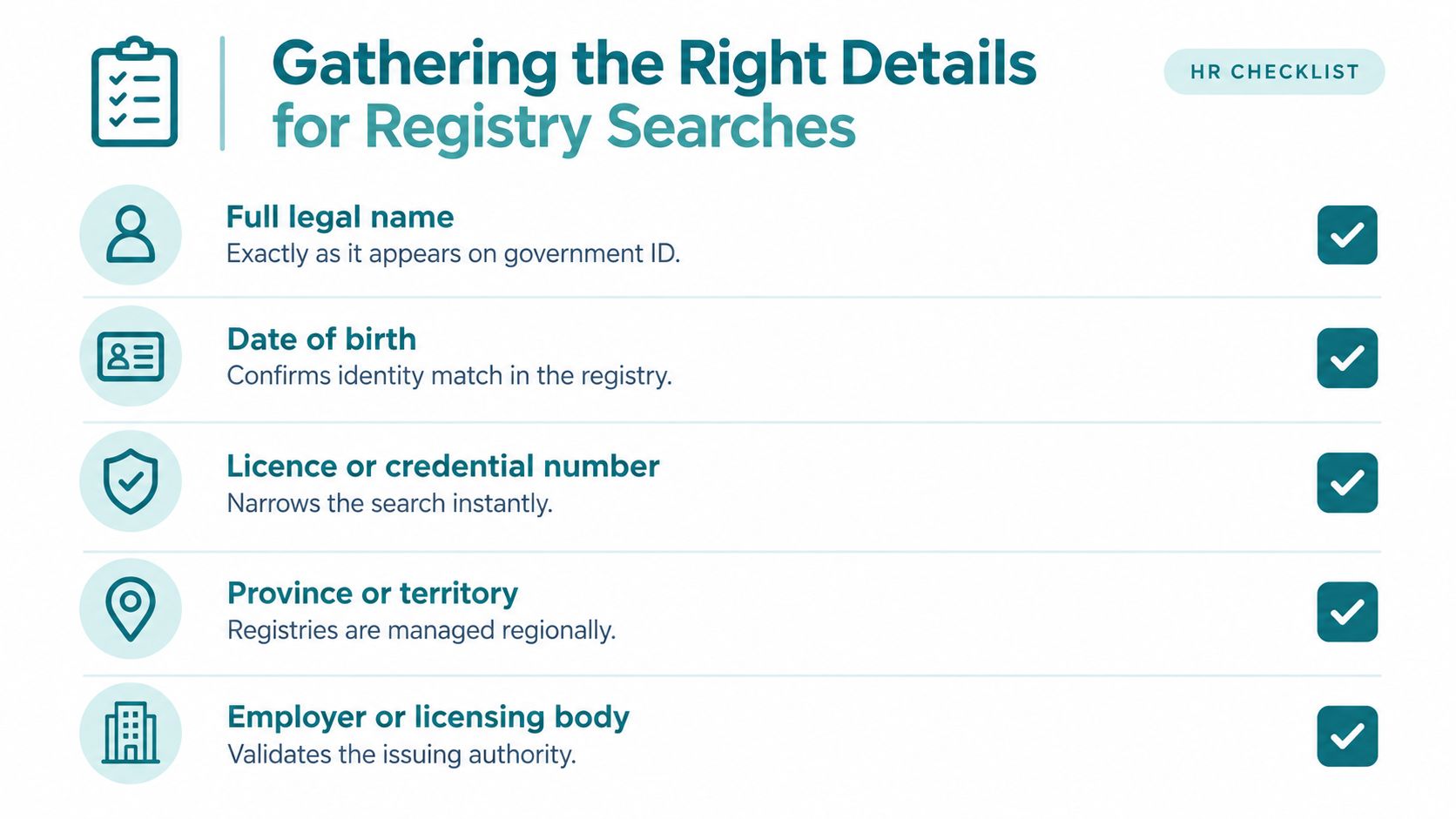
The quality of a registry search depends on the information entered. Before opening a government portal, ask the candidate for the details that distinguish them from people with similar names and from businesses operating under different legal identities.
Start with the licence number
For an Ontario individual search, capture the 6–8 digit licence number exactly as issued. The number is usually more reliable than a name because it narrows the result to a specific credential. Ask the candidate to enter it into your intake form rather than relying on a photograph that may be blurry or cropped.
For agencies, record the agency licence number and the legal business name. A trade name on a uniform, website, or invoice may not be the name used by the registry. Employer registration is a separate check, so capture the registration number or exact legal business name where the hiring organisation needs to confirm registered-employer status.
Use names carefully
Ontario's registry supports an individual lookup by licence number or exact first and last name. Exact spelling matters. Hyphens, middle names, accents, former names, and typographical errors can all lead to a false “no result” or, more dangerously, a match to the wrong person.
Use this intake sequence:
- Ask for the full legal name shown on government identification.
- Capture the licence number, if available, without spaces or transcription changes.
- Record the province and licence type connected to the assignment.
- Collect the agency or employer's legal name when the candidate will work through a vendor.
- Note any name change that could explain a mismatch, then resolve it through a lawful identity-verification process.
British Columbia's system takes a different approach for business searches. It allows a search using at least three letters of the company name, which is convenient but can return multiple possible businesses. Employers still need to compare the legal business name, trade name, licence number, status, and licence type with the vendor's documents.
Don't use a common name as the sole basis for approval. The safer approach is to pair the registry result with candidate consent, identity proofing, and a record of the identifier used. A Canadian identity-verification workflow can help resolve identity ambiguity, but the hiring team should still retain the underlying registry evidence.
Navigating Provincial Verification Portals
Provincial portals don't provide the same level of detail, so employers need to interpret the output rather than treat every result as equivalent. Ontario offers a public registry for individuals, agencies, and registered employers. British Columbia focuses on a direct validity result, while Quebec distinguishes several different status conditions.
| Province | Search Method | Output Details |
|---|---|---|
| Ontario | Individual licence number or exact first and last name. Agency and registered employer searches can use a licence, registration number, or legal business name. | Confirms whether the individual, agency, or registered employer has an active status. |
| British Columbia | One or more worker licence numbers, or a business search using at least three letters of the company name. | Worker results return VALID or INVALID. Business results show legal business name, trade name, licence number, licence status, and licence type. |
| Quebec | Search the provincial security register using the available identifying information. | Status categories explicitly distinguish valid, suspended, revoked, and expired. |
Ontario's public security guard and private investigator licence information is useful because it separates individual, agency, and registered-employer verification. Don't search only the contractor's brand name if the assignment depends on the agency's authorisation. Check the entity supplying the worker and confirm the individual separately.
British Columbia's VALID result is operationally efficient, but it tells you less than a detailed status history. It doesn't, by itself, explain the candidate's identity match, employment relationship, or any documentation the client may require. Quebec's more descriptive labels are helpful for escalation because “suspended” and “expired” call for different follow-up questions.
Interpret the result in context
A status result answers one question: what the registry reports for the searched record at that point. It doesn't automatically confirm that the candidate is legally permitted to perform every assignment, that the business name on a contract is correct, or that the role's record-check requirements have been met.
For cross-provincial candidates, keep separate records for each jurisdiction. If one province reports a valid credential and another reports an expired or suspended credential, don't average the results or rely on the newest-looking card. Confirm which province governs the proposed work, ask the candidate to explain the discrepancy, and escalate to the regulator or qualified legal counsel where the status remains unclear.
Aligning Criminal Record Checks with Licensing Rules
Licence verification and criminal screening answer different questions. The registry confirms the credential's status. A record check helps an employer assess information relevant to the role, subject to consent, privacy obligations, and human rights limits.
A basic Criminal Record Check generally addresses criminal-record information within the applicable police-check process. A Criminal Record and Judicial Matters Check, often called a CRJMC, can include convictions, outstanding warrants, charges, and judicial orders, depending on the police service and the result. Waterloo Regional Police explains the intended role of criminal record and judicial matters checks and distinguishes them from the more restricted Vulnerable Sector Check.
A Vulnerable Sector Check, or VSC, isn't a stronger version that employers can order for every applicant. The RCMP's guidance on vulnerable sector checks states that the hiring organisation must make the request, while the individual provides consent. The check is intended for positions involving trust or authority over children or vulnerable persons.
Match the check to the duties
The right screening level depends on the worker's duties. A security officer assigned to a commercial lobby may have access to sensitive information and property, but that fact alone doesn't establish that the role involves authority over a vulnerable population. A guard working in a hospital, school, shelter, or care setting may require a different analysis based on the duties and the people served.
The RCMP distinguishes a VSC from a basic criminal record check because it includes a criminal record check and a search for suspensions for sexual offences. That restricted search should be requested only where the role meets the legal threshold.
Use a role-based matrix:
- Basic CRC: Consider where the job requires a criminal-record review but doesn't justify broader judicial or vulnerable-sector information.
- CRJMC: Use where the role and applicable process call for information about judicial matters beyond convictions.
- VSC: Request only when the position involves trust or authority over children or vulnerable persons, with the organisation initiating the request.
Ontario's licensing process may involve its own documentation and record-check requirements, so don't assume a private employer's preferred check automatically satisfies the regulator. The Canadian criminal record screening options available through Alero can be evaluated alongside the specific provincial licensing rule and the actual job description.
Scope matters: Requesting more personal information than the role requires can create privacy and human rights risk without improving the hiring decision.
Handling Expired, Pending, and Digital Licences
A candidate may be ready for a scheduled shift while the physical licence card is expired, a renewal remains under review, or the credential is available only online. Cross-provincial hiring makes this harder because each registry uses its own status labels and verification process. Approving an explanation without checking the official record creates exposure. Rejecting anyone without a current plastic card can also delay a qualified hire unnecessarily.
In Ontario, individual security guard licences are valid for two years, agency licences for three years, and renewal applications may be filed up to 90 days before expiry, according to the annual report cited earlier. The Ontario licensing portal supports application-status checks. Ontario guidance also allows applicants to download a temporary digital licence while they wait for the permanent card. The registry or official portal should therefore carry more weight than the date printed on the card.
Use a documented decision path
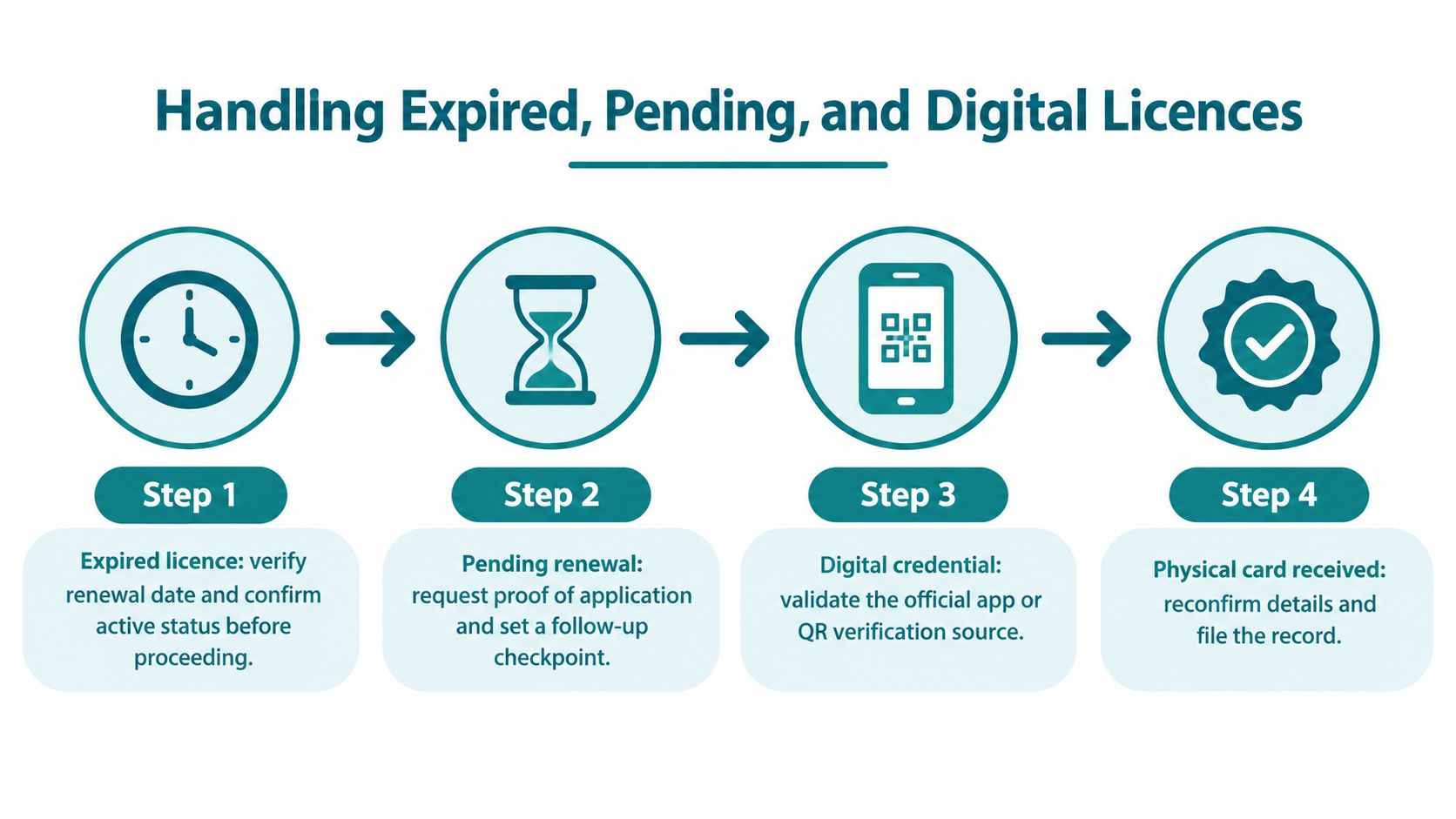
If the card is expired: Search the current registry and save the result with the search date. An active status can support deployment when the candidate's identity, licence type, and assigned duties match. An inactive result requires a pause until the licensing issue is resolved.
If renewal is pending: Request the application evidence, check the status through the official portal, and record a follow-up date. Pending does not automatically mean the person may work. Confirm what the regulator permits during processing before assigning shifts, especially where the employer operates across provinces and cannot transfer assumptions from one registry to another.
If the licence is digital: Validate it through the government source, official application, or approved verification method. A forwarded screenshot or an unverified QR destination is not enough. Match the candidate's name, licence number, status, and licence type to the role.
If the result is suspended or revoked: Stop deployment, preserve the search record, and notify the compliance or operations lead. Give the candidate a clear opportunity to explain or provide updated official evidence. Do not alter the record to meet a planned start date.
Ontario changed its process in February 2024, requiring applicants to obtain their own criminal record and judicial matters check, and began accepting authorised third-party checks in July 2024, according to the same Ontario annual report cited earlier. Those procedural changes can affect what appears in a hiring file while an application is being processed. Missing physical paperwork is not, by itself, proof that no application exists.
Streamlining Verification with Automated Screening Partners
Manual registry searches work for occasional hiring, but they become fragile when recruiters manage multiple provinces, vendors, licence types, and start dates. Someone has to retype names, interpret different status labels, save evidence, request consent, chase police-check information, and remember when a pending record needs another review. Each handoff creates an opportunity to verify the wrong person or leave the result undocumented.

An integrated workflow should keep the controls visible:
- Identity first: Match the candidate to government-issued information before treating a registry result as theirs.
- Consent and privacy: Collect purpose-specific consent and retain only what the organisation needs under its applicable privacy obligations.
- Role-based checks: Select the CRC, CRJMC, or VSC based on the duties and legal threshold.
- Exception handling: Route expired, pending, mismatched, suspended, or revoked statuses to a human reviewer.
- Auditability: Store the search date, source, result, reviewer, and follow-up decision.
A Canadian provider such as Alero Background & Identity offers identity proofing, criminal record checks, credential verification, and HRIS or ATS integrations, with applicant data stored on Canadian servers and PIPEDA-aligned consent and retention workflows. That kind of platform can reduce repetitive administration, but it shouldn't remove human judgement from ambiguous provincial results.
The practical objective isn't to automate every decision. It's to make the correct decision easier to repeat, easier to explain to a candidate, and easier to defend when a client, regulator, insurer, or internal reviewer asks how the person was cleared.
For Canadian employers, Alero Background & Identity combines identity verification, criminal record checks, credential screening, and trackable hiring workflows to help teams manage provincial licensing checks without unnecessary candidate friction. Visit Alero to build a documented screening process that keeps licence status, consent, and follow-up actions in one place.