
A candidate has performed well in interviews, supplied polished documents, and named two former managers as referees. The hiring team is ready to make an offer, but the reference process is still sitting in an inbox. Calling quickly with, “Was this person a good employee?” may feel efficient, yet it rarely gives a hiring manager enough reliable information to assess judgement, conduct, or performance in the role.
A proper check for reference is more than a courtesy call. It is a controlled process that connects the right identity to the right employment history, obtains meaningful consent, asks consistent job-related questions, and records evidence that can withstand internal review. For Canadian employers, the process also has to fit privacy obligations, human rights considerations, and the specific type of record check being requested.
Table of Contents
- Why Reference Checks Matter for Canadian Hiring
- Preparing for Legal Compliance and Consent
- Developing Structured Reference Questions
- Evaluating Results and Managing Risks
- Implementing a Best Practice Workflow
Why Reference Checks Matter for Canadian Hiring
A logistics company once hired an operations supervisor after a strong interview and an impressive résumé. The candidate described experience managing urgent deliveries, resolving staff disputes, and coordinating a busy warehouse. The hiring manager contacted one referee, who confirmed the dates of employment and offered a generally positive response. No one asked for examples of how the candidate handled safety procedures, attendance problems, or conflict with drivers.
After the hire, supervisors discovered that the candidate struggled to document incidents and regularly avoided difficult conversations with staff. The operational disruption didn't come from a single dramatic event. It came from missed handoffs, unresolved issues, and a team that no longer trusted its manager. A structured conversation with the most recent direct supervisor could have tested those specific competencies before the offer was made.
A reference check validates the distance between a candidate's self-reported history and their observed conduct at work. It can help confirm:
- Scope of responsibility: Did the candidate perform the duties described, or did they support someone who owned them?
- Observable behaviour: How did they respond to pressure, feedback, deadlines, safety requirements, or disagreement?
- Reliability: Did they meet commitments and communicate when circumstances changed?
- Role fit: Which strengths are likely to transfer to the position being filled?
- Development needs: What support, supervision, or onboarding would help the person succeed?
The check shouldn't become a search for gossip or personal opinions. It should connect evidence from a previous workplace to the competencies required in the new role.
Practical rule: A reference is useful when it gives you a specific example that helps you assess a defined job requirement.
The Canadian context
Reference checks also sit alongside criminal record screening, identity verification, credential checks, and employment verification. That combination matters in healthcare, finance, logistics, government contracting, and other environments where a hiring decision can affect clients, assets, confidential information, or public safety.
Canadian screening results need careful interpretation. A result from a police record check isn't automatically proof of a conviction or workplace misconduct. The employer's process must distinguish between information that is relevant to the role and information that merely creates an anxious reaction.
The national working-group report on criminal record checks notes that hundreds of thousands of people undergo criminal record checks across Canada each year. It also reports that, in Ontario, about 43% of criminal cases end in stays of proceedings or withdrawn charges, and cites a Vancouver Police Department study in which 72% of reports that produced a result contained only non-conviction information. A reference narrative can add context, but it can't turn non-conviction information into a conviction or establish misconduct without job-relevant evidence.

What a weak check gets wrong
A single friendly referee, a written recommendation, or a conversation recorded only as “positive” leaves too much room for bias and overconfidence. Written references are often uniformly favourable, and they may omit the detail a hiring manager needs to compare candidates.
A better process uses the same core questions for each candidate, chooses referees who have direct knowledge of the work, and records the response with enough precision to support a fair decision. It also gives the candidate a clear opportunity to explain an apparent inconsistency before the employer reaches a conclusion.
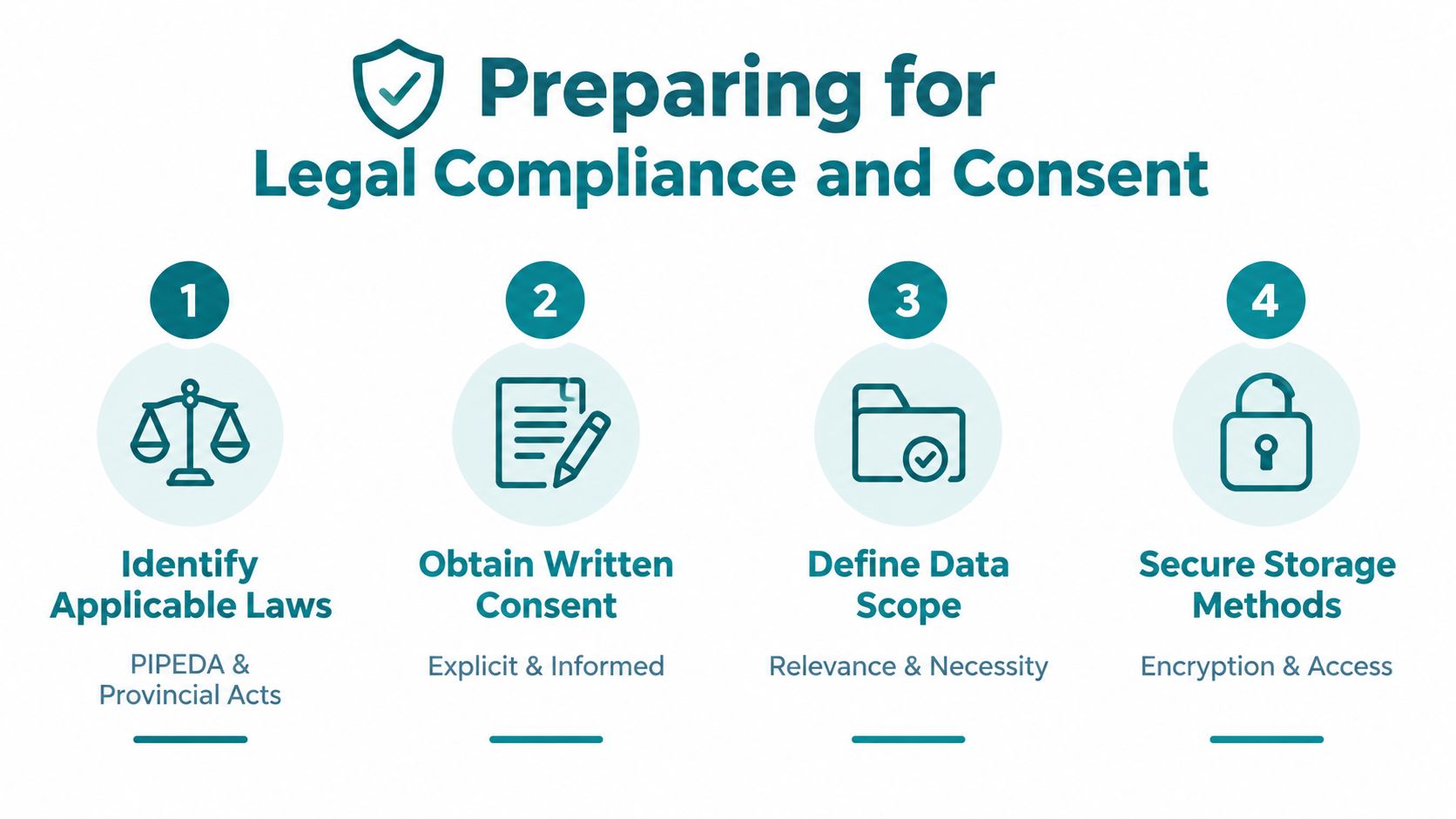
Preparing for Legal Compliance and Consent
Before a referee is contacted, establish who is being screened, what information is needed, why it is needed, and how it will be handled. This sequence prevents a common mistake: asking for broad permission to collect information and then treating that permission as a licence to investigate anything available.
Start with the applicable privacy framework
PIPEDA governs personal information in the course of commercial activity, including employee-related information, although provincial privacy legislation can also apply depending on the organisation, location, and activity. The Office of the Privacy Commissioner's explanation of PIPEDA consent states that an individual's knowledge and consent are generally required for the collection, use, or disclosure of personal information, unless an exception applies.
For a reference check, consent should be:
- Specific: It names reference checks, employment verification, or another defined screening activity.
- Informed: It explains the purpose, the categories of information requested, the parties who may receive it, and the handling process.
- Voluntary and meaningful: The candidate can understand what they are authorising rather than accepting vague language buried in a general privacy notice.
- Limited: The employer collects only information necessary for the hiring purpose.
The consent record should identify the candidate, the employer or screening provider, the role or hiring purpose, the permitted checks, and the date of authorisation. Keep the signed form or electronic audit trail with the screening file, along with any later change in scope.
For a practical explanation of Canadian privacy considerations, use this guide to PIPEDA background checks as a process reference, then confirm the requirements that apply to your organisation and province.
Verify identity before relying on a reference
Identity verification is not a separate administrative task that can wait until the end. It is the foundation for connecting a résumé, a reference, a credential, and a police record to the same person. If the identity supplied at intake is wrong or incomplete, a reference may describe another employee with a similar name, while a credential check may be attached to the wrong record.
The Government of Canada personnel security screening guidance says applicants must provide specific documentary evidence of identity and that greater scrutiny is required to provide assurance that the person is who they claim to be. Employers should therefore define an identity-proofing standard before requesting references, particularly for remote hiring and regulated roles.
Use an approved document and verification method that fits the role and the risk. Record what was verified, by whom, when, and whether the identity details align with the candidate's consent form. Don't collect identity documents casually through unprotected email or retain more information than your retention policy requires.
Keep the scope defensible
A reference call should focus on employment-related facts and behaviour. Don't ask about family status, disability, religion, gender identity, marital status, age, pregnancy, or other protected grounds under applicable human rights codes. Avoid questions that invite a referee to disclose medical information or unrelated personal history.
The federal justice and public safety background report describes criminal records as a mainstream issue for Canadian hiring policy, with federal material estimating that about 1 in 10 Canadians aged 19 and over had a criminal record in 2005, roughly 2.9 million people out of 24.8 million adults. Another nationally reported estimate in the same material puts the number at about 4 million Canadians, or roughly 10% of the population. Those figures reinforce why employers need a consistent, privacy-conscious process rather than informal screening based on assumptions.
Use secure storage, role-based access, a documented retention period, and a process for correcting inaccurate information. Consent doesn't authorise indefinite retention or unrelated uses.
A short visual summary of this preparation sequence appears below.
A reference process also works better when the candidate knows what will happen and can provide current contact details. This short video can help teams explain the screening experience consistently.
Developing Structured Reference Questions
The question “Was this person a good employee?” produces a predictable answer. It encourages a referee to be polite, gives the interviewer no scoring framework, and makes one candidate's reference impossible to compare with another's.
The Public Service Commission guidance on structured reference checks recommends planning the check, gathering information, and assessing each competency against behavioural indicators. That approach is useful in any Canadian workplace because it turns a conversation into a repeatable assessment.
Build questions from the job
Start with the position description. Select the competencies that matter, then define what acceptable evidence would look like. A warehouse supervisor may need safety judgement, planning, coaching, and conflict management. A financial analyst may need accuracy, confidentiality, deadline management, and the ability to explain risk clearly.
For each competency, prepare a primary question and a probe. Keep the wording consistent across candidates.
| Competency | Primary question | Useful probe |
|---|---|---|
| Reliability | How did the candidate manage commitments when priorities changed? | What was the outcome, and how did the candidate communicate? |
| Conflict management | Tell me about a disagreement the candidate handled with a colleague or customer. | What did the candidate do personally, and what happened next? |
| Quality of work | What kind of review did the candidate's work usually require? | Can you describe a specific error, correction, or improvement? |
| Integrity | How did the candidate respond when they identified a risk or mistake? | Did they raise it promptly, and what action followed? |
| Leadership | How did the candidate give feedback or address poor performance? | What behaviour changed after the conversation? |
Ask about the candidate's own actions, not just the team's result. “We reduced delays” doesn't establish what the person did. “The candidate reorganised the handoff process, explained the change to the team, and monitored exceptions” gives the hiring manager something to evaluate.
Use the same core questions for everyone
A structured check doesn't mean the interviewer must sound robotic. It means every candidate is assessed against the same job-related areas. You can ask a follow-up when a response is unclear, but don't give one candidate extensive opportunities to recover while moving quickly through another candidate's call.
Use a simple rating scale that your organisation defines in advance, such as evidence that is strong, mixed, limited, or unavailable. The scale should describe the evidence, not the referee's personality. A warm referee who provides no examples shouldn't automatically receive the same assessment as a reserved referee who gives detailed, relevant observations.
Contact two to three references, ideally including the candidate's most recent immediate supervisor, in line with Canadian public-sector guidance. Saskatchewan guidance indicates that three to four references are typically sufficient, although more may be needed to confirm an ongoing pattern of behaviour or cover every required qualification. These figures and recommendations are set out in the Canadian guidance on checking references.
Record evidence, not impressions
Write notes during the call, distinguishing direct observations from your interpretation. Capture the referee's examples as close to verbatim as practical, identify the context, and record whether the referee directly supervised the candidate.
At the end, confirm factual details such as job title, dates, reporting relationship, and eligibility for rehire only if that question is relevant and lawful in your process. Don't pressure a referee to disclose confidential personnel information or speculate about matters outside their knowledge.
A reference note should allow another trained reviewer to understand what was said without relying on the interviewer's memory.
Before closing, ask one neutral question that can reveal support needs without inviting an unfair character judgement: “What type of environment or management approach helped this person perform at their best?” The answer can improve onboarding even when the hiring decision is positive.
For more ideas on building a consistent interview process, see this resource on reference checks that work.
Evaluating Results and Managing Risks
The difficult part begins after the calls end. A hiring manager may have a favourable reference, an identity result that requires review, and a police record check containing information that isn't a conviction. Treating all three as equivalent is a serious process error.
Assess each result according to what it can establish. Identity verification answers whether the submitted identity evidence aligns with the applicant. Employment verification confirms dates, title, or other employment facts when the source can verify them. A professional reference provides observations about performance and conduct. A criminal record check is a distinct police information product with its own disclosure rules and limits.
Read the result in context
A record-check “hit” doesn't automatically invalidate a reference or prove that the candidate was dishonest. It may reflect non-conviction information, a name similarity, an outdated record, or information that requires clarification through the screening provider or police agency. The employer should never ask a referee to interpret police information unless that referee has direct, lawful knowledge of the matter and the question is genuinely relevant.
The Ontario police record-check guidance distinguishes a basic Criminal Record Check from a Criminal Record and Judicial Matters Check. The CRJMC can include criminal convictions, summary convictions for five years, outstanding charges and warrants, judicial orders, peace bonds, probation and prohibition orders, and absolute and conditional discharges within their disclosure periods. It is intended for roles requiring more than a basic CRC but not a Vulnerable Sector Check.
A Vulnerable Sector Check is narrower still. The RCMP explanation of Vulnerable Sector Checks says it is reserved for people working or volunteering in positions of trust or authority over children or vulnerable persons. The hiring organisation decides whether to request it, while the applicant gives consent but doesn't make the request themselves. The applicant must request it through the police service where they live, and RCMP police dissemination policy states that only the police agency or authorised body in the applicant's local jurisdiction can conduct the vulnerable-sector verification.
Apply a fair review process
When information requires review, pause the decision and give the candidate a meaningful opportunity to respond. Explain the category of information at issue without unnecessarily disclosing protected information, then ask for relevant clarification and supporting documentation through a secure channel.
Use a consistent decision matrix:
- Role relevance: Does the information relate directly to the duties, access, authority, or trust involved?
- Recency and pattern: What does the verified record establish, and is there evidence of a continuing workplace concern?
- Source quality: Is the information direct, documented, and attributable to an authorised source?
- Consistency: Do multiple references and employment records support the same account?
- Proportionality: Is the proposed hiring action proportionate to the verified risk?
- Candidate response: Has the candidate had a fair chance to correct an error or explain the context?
Don't use a reference check to manufacture certainty. A referee may decline to answer, a former employer may have a policy of confirming only dates, or a candidate may have limited access to a previous supervisor. Record those limitations rather than treating silence as a negative finding.
The final assessment should separate facts, evidence gaps, risk analysis, and the decision. That structure helps HR explain why a result was cleared, escalated, or followed by additional safeguards such as supervision, restricted access, or a role-specific condition.
Implementing a Best Practice Workflow
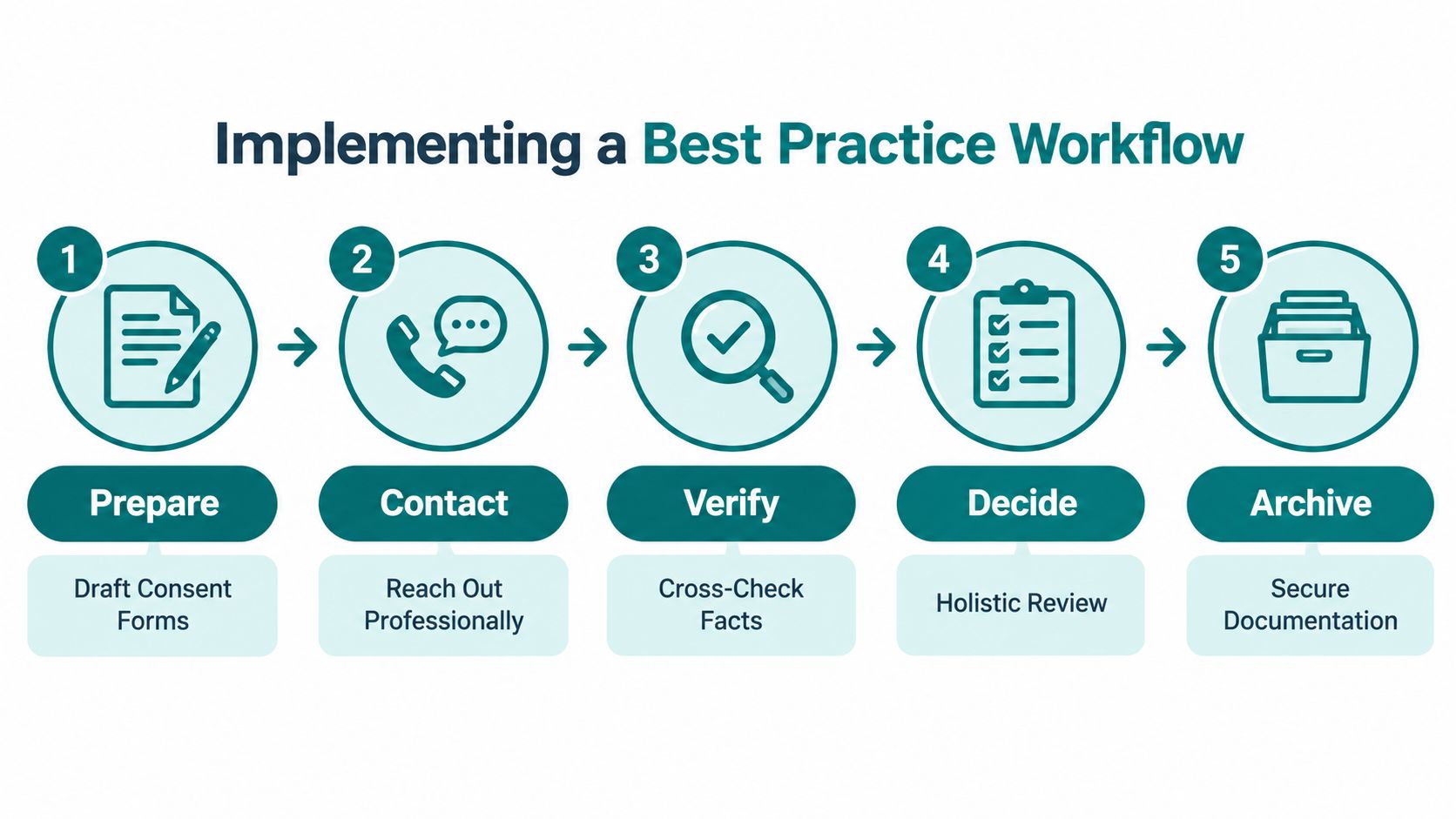
A workable process should be rigorous without making candidates repeat the same information across disconnected portals. Assign one owner, use a clear status for every check, and tell the candidate what remains outstanding.
A practical operating sequence
Prepare the role file. Define the competencies, checks, identity standard, consent language, permitted users, and retention rule before the requisition opens.
Obtain consent. Give the candidate a plain-language explanation of the reference purpose and any separate criminal, credential, or identity checks. Capture the authorisation and its audit trail.
Verify identity. Confirm documentary identity through an approved method, reconcile the details with the application, and resolve discrepancies before attaching reference or credential information to the file.
Collect referee details. Ask for current contact information, relationship to the candidate, dates of supervision, and permission to contact each person. Confirm whether the referee is appropriate for the competency being assessed.
Conduct structured calls. Use the same core questions, ask evidence-based probes, and record concrete examples. A secure eReference platform or an HRIS workflow can reduce manual chasing, but technology doesn't replace interviewer judgement.
Cross-check facts. Compare reference responses with identity, employment, credential, and record-check results. Investigate contradictions without assuming which source is correct.
Review fairly. Apply the same relevance and proportionality criteria to every candidate. Give the candidate a clear route to respond to information that may affect the decision.
Document and archive. Record the decision rationale, unresolved limitations, access history, and disposal date. Restrict access to people who need the information for the hiring decision.
The workflow can be handled internally, through an HRIS integration, or with a specialist provider. Alero Background & Identity offers professional reference checks by phone or email with configurable questionnaires, alongside identity proofing, employment verification, credential checks, and Canadian data storage. Employers should compare any provider's consent controls, audit trail, data location, candidate experience, and escalation support before selecting a service, including the reference and credential check service.
Final hiring checklist
Before approving the hire, confirm that:
- Consent is documented: The candidate authorised the relevant checks for a defined purpose.
- Identity is aligned: The identity evidence matches the applicant and the screening records.
- References are suitable: The referees had direct knowledge of relevant work.
- Questions were consistent: Each candidate was assessed against the same core competencies.
- Notes are evidence-based: The file contains examples, not just positive or negative labels.
- Check types are correct: The employer requested a CRC, CRJMC, or VSC only where the role and legal framework support it.
- Risks were reviewed fairly: The candidate had an opportunity to address material discrepancies.
- Access is controlled: The organisation can explain who viewed the file, why, and how long it will be retained.
A reliable check for reference protects more than the hiring decision. It gives the candidate a clearer process, gives managers evidence they can use during onboarding, and gives the organisation a defensible record of how it reached a conclusion.
Alero Background & Identity helps Canadian employers combine consent-led reference checks with identity verification, employment and credential screening, and secure candidate workflows. Visit Alero Background & Identity to review screening options for your next hire and build a reference process that is accurate, compliant, and easier for candidates to complete.