A hiring manager needs someone cleared before a start date, the candidate is asking whether the check can be completed from a phone, and the recruiting team is trying to avoid a last-minute delay. That situation is common across Canadian workplaces. The phrase Canadian criminal record check online sounds simple, but the process behind it isn't just a commercial database search.
An online request still depends on consent, identity verification, police processing, and the rules that apply to the type of check and the applicant's location. The right workflow can produce a fast, candidate-friendly result. The wrong one can create delays, collect more information than the role requires, or leave HR with a report it can't confidently interpret.
Table of Contents
- What an Online Canadian Criminal Record Check Does
- Choosing the Right Check Type for the Role
- How the Online Application Workflow Runs
- Where to Apply and Which Channel Fits Your Hiring Volume
- Turnaround Times and What Triggers a Review
- Employer Handling Under PIPEDA and Human Rights Law
- HR Checklist for a Clean Screening Workflow
What an Online Canadian Criminal Record Check Does
You are hiring a warehouse supervisor, the candidate is completing the request from a phone, and the hiring team wants a clear result before setting a start date. The online form may feel like a quick vendor transaction. Behind it, the request follows a police-mediated workflow connected to Canada's national criminal-record infrastructure.
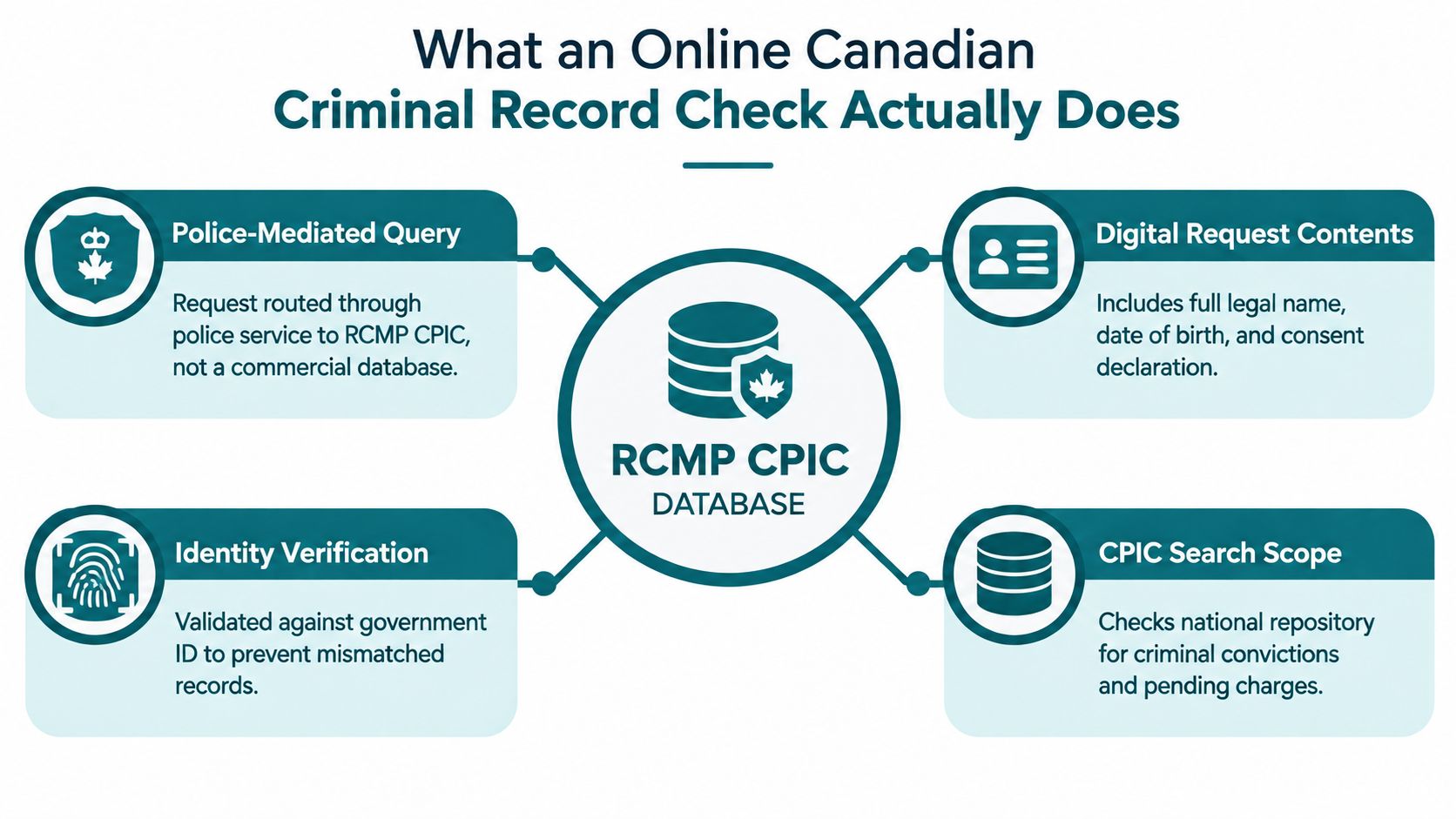
The RCMP describes a CPIC check as a police-agency query of the Identification Data Bank using a person's name and date of birth. The federal government identifies the RCMP's national repository as the core database for name-based checks, with approximately 4.2 million records. CRIMS updates and maintains more than 600,000 criminal records annually. The federal explanation of Canadian criminal record background checks sets out the repository's role and these figures.
The information behind the request
The candidate provides identifying details, including their full legal name, date of birth, gender, address history, and consent declaration. The provider or police service checks that information against government-issued identification. A possible name match can send the file to additional police review or fingerprinting.
A name-based result may show information available through the relevant police and RCMP systems, including criminal convictions and other information allowed for the selected check type. It is not a complete copy of every Canadian court file. Youth records, information sealed under the Youth Criminal Justice Act, provincial court records, record suspensions, and local police information may follow separate disclosure rules.
Practical rule: Online delivery changes how the request begins and how the result reaches the applicant. It does not remove police authority, consent requirements, identity controls, or disclosure limits.
The RCMP states that applicants can submit an online check through a third-party company. The company securely transmits the information to a police agency, and that police agency releases the final response. For HR, that distinction affects how a report should be understood. The portal supplies the interface, while the check remains subject to police release procedures and the national repository.
Choosing the Right Check Type for the Role
Employers often make one of two mistakes. They request a Vulnerable Sector Check for every position, or they order a basic check when the duties justify a broader review. Start with the work being performed, not the vendor's menu.
Canadian employers should distinguish among the Criminal Record Check, the Criminal Record and Judicial Matters Check, and the Vulnerable Sector Check. The precise application route and disclosure rules can vary by police service and province, so confirm eligibility before sending the candidate into an online workflow.
CRC vs CRJMC vs VSC at a glance
| Check Type | What's Included | Typical Role Fit | Eligibility |
|---|---|---|---|
| Criminal Record Check, CRC | A basic name-based review focused on disclosable criminal-record information, including applicable convictions. | General office, retail, warehouse, administrative, and other roles that don't involve vulnerable persons or heightened fiduciary duties. | Usually requested with the candidate's informed consent. Local police policy and residency rules still apply. |
| Criminal Record and Judicial Matters Check, CRJMC | A broader review that can include disclosable convictions, outstanding charges, certain warrants, and absolute or conditional discharges subject to applicable rules. | Roles involving company assets, financial authority, regulated operations, or duties where pending judicial matters are materially relevant. | The employer must have a role-related reason for requesting it, and the police service or provider must accept the request under its local process. |
| Vulnerable Sector Check, VSC | A CRC-level review plus the permitted search for record suspensions relating to sexual offences, along with other information allowed under the governing rules. | Positions involving children, older adults, or persons with disabilities where the applicant has authority, trust, or unsupervised access. | It isn't a general employer upgrade. The role must meet the vulnerable-sector criteria, and the applicant usually needs to apply through the appropriate local police service. |
The RCMP says the VSC was created in 2000 to protect children and vulnerable persons, adds a search for record suspensions for sexual offences, and is governed by section 6.3(3) of the Criminal Records Act. Employers shouldn't request it merely because a more detailed report feels safer.
A VSC also has strict geographic limits. The RCMP states that VSC results must stay within Canada, and federal guidance explains that the check can rely on the National Repository, intelligence and investigative databanks, and local police records when authorised. Read the RCMP policy on police dissemination of criminal record information before designing a role-specific policy.
How the Online Application Workflow Runs
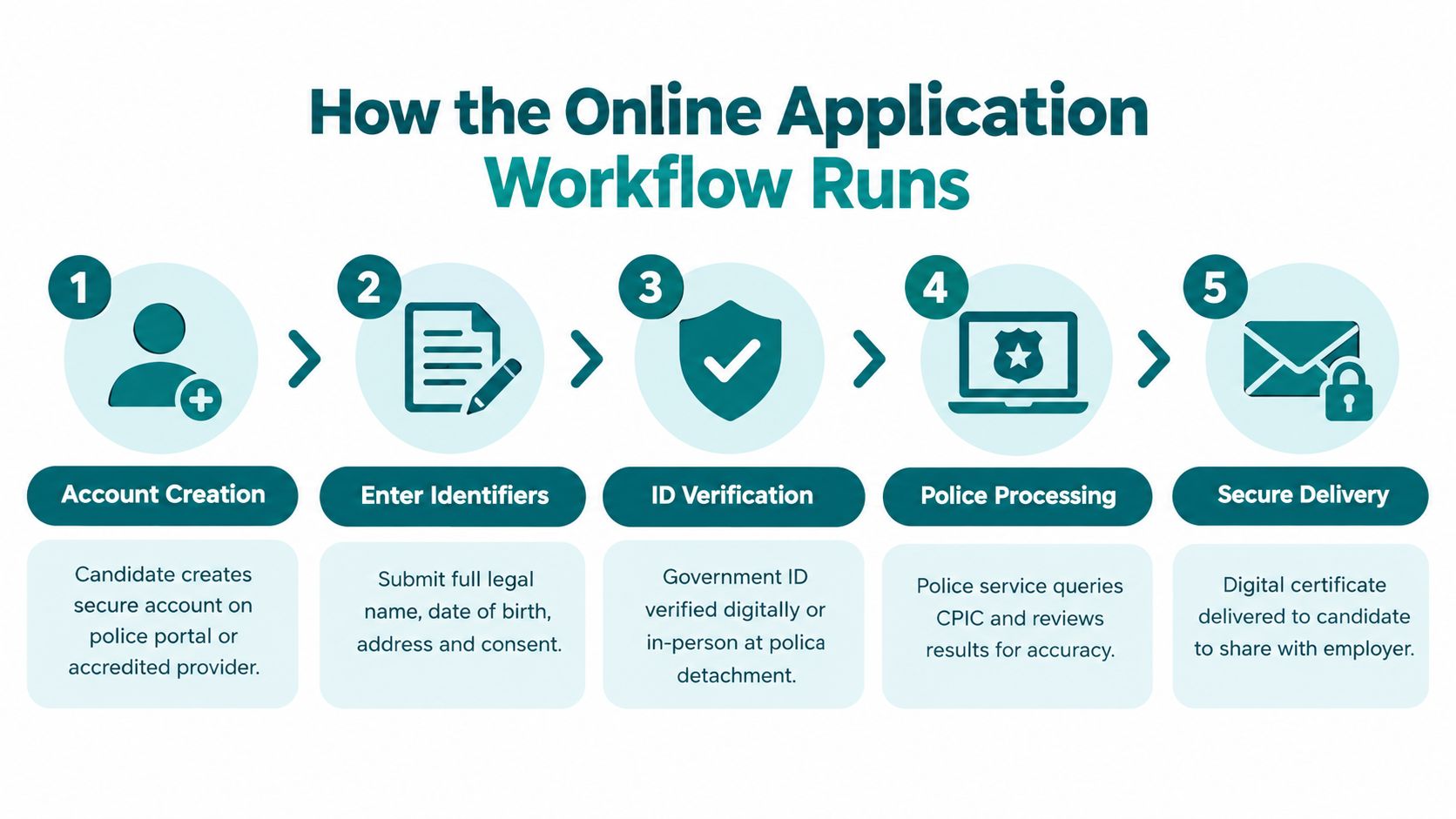
The candidate usually starts by creating an account through a police portal or an accredited provider. The form asks for identifying details, commonly including the full legal name, date of birth, gender, current and previous addresses, and the purpose of the check. The candidate must also provide informed consent for the query and for the result to be released through the approved process.
Identity verification is the first practical control. The candidate may upload government-issued identification, complete a live selfie comparison, use an electronic identity method, or attend a police facility when the local process requires it. The RCMP's requirements include secure transmission, physical identity verification, and informed consent before the request reaches a police agency, as described in the RCMP criminal record check guidance.
What the candidate experiences
After the form and consent are complete, the police service or authorised workflow reviews the request. A clear file may be released digitally. A potential match, inconsistent identity information, incomplete address history, or poor-quality identification can move the request into manual review.
The candidate may also need to pay the applicable fee, correct a portal error, or provide additional information. HR should avoid telling applicants that a clear result is guaranteed because the request was submitted online. The online portion removes administrative friction, but police-side review remains the decisive part of the process.
The Alero identity verification service is one example of a workflow that can place identity proofing before the record-search stage. Whatever provider you use, ask exactly how consent is captured, how failed verification is handled, and whether the candidate or employer receives the final document.
The cleanest process tells the candidate who controls release, what information they need, and what happens if a name-based search can't confidently distinguish them from another person. That explanation reduces avoidable support tickets and prevents recruiters from treating a pending status as a negative finding.
Where to Apply and Which Channel Fits Your Hiring Volume
There are three practical channels for an online Canadian criminal record check. A direct police portal gives the applicant a close connection to the issuing service, but the candidate usually drives the application, pays or submits the request independently, and sends the result back to HR. That can work for occasional hiring. It becomes difficult when recruiters need consistent tracking across many open roles.
An accredited third-party provider manages the intake, identity verification, consent capture, and communication under contract. The provider may submit an electronic request to the RCMP repository through the permitted police workflow and return the result or status to the employer. Before signing, verify accreditation, jurisdictional coverage, storage location, escalation handling, and the exact meaning of each report status.
Compare the channels before you commit
| Channel | Turnaround | Candidate Effort | Employer Integration | Data Residency | Best Fit |
|---|---|---|---|---|---|
| Direct police portal | Depends on the police service and request type. | Higher, because the candidate manages more of the process. | Limited tracking and workflow control. | Confirm with the issuing service. | Occasional local hiring and applicants who can manage the request themselves. |
| Accredited third-party provider | Often faster for clear name-based requests, subject to police review and eligibility. | Lower when the provider offers mobile intake and digital verification. | Employer dashboard, status tracking, reporting, and possible bulk ordering. | Confirm contractually and in the provider's privacy materials. | Recurring hiring, distributed teams, staffing firms, and employers needing consistent controls. |
| HRIS-integrated platform | Can reduce handoffs inside the ATS, but the police process still controls the result. | Usually low because the request is embedded in onboarding. | Strongest workflow integration, with less flexibility in some configurations. | Confirm where applicant data and support operations are located. | Larger recruiting operations that need automated ordering and audit trails. |
The RCMP confirms that third-party online applications are routed to a police agency, and that the police agency releases the completed check. That makes vendor language important. A provider shouldn't imply that it independently owns or adjudicates the official police result.
Ask for a sample redacted report, a data-flow description, a retention policy, and a description of how the provider handles a potential match. For higher-volume teams, test whether the system supports role-specific check selection, candidate reminders, status exports, and HRIS or ATS integration. For smaller employers, a polished self-serve portal may matter more than a complex integration.
Turnaround Times and What Triggers a Review
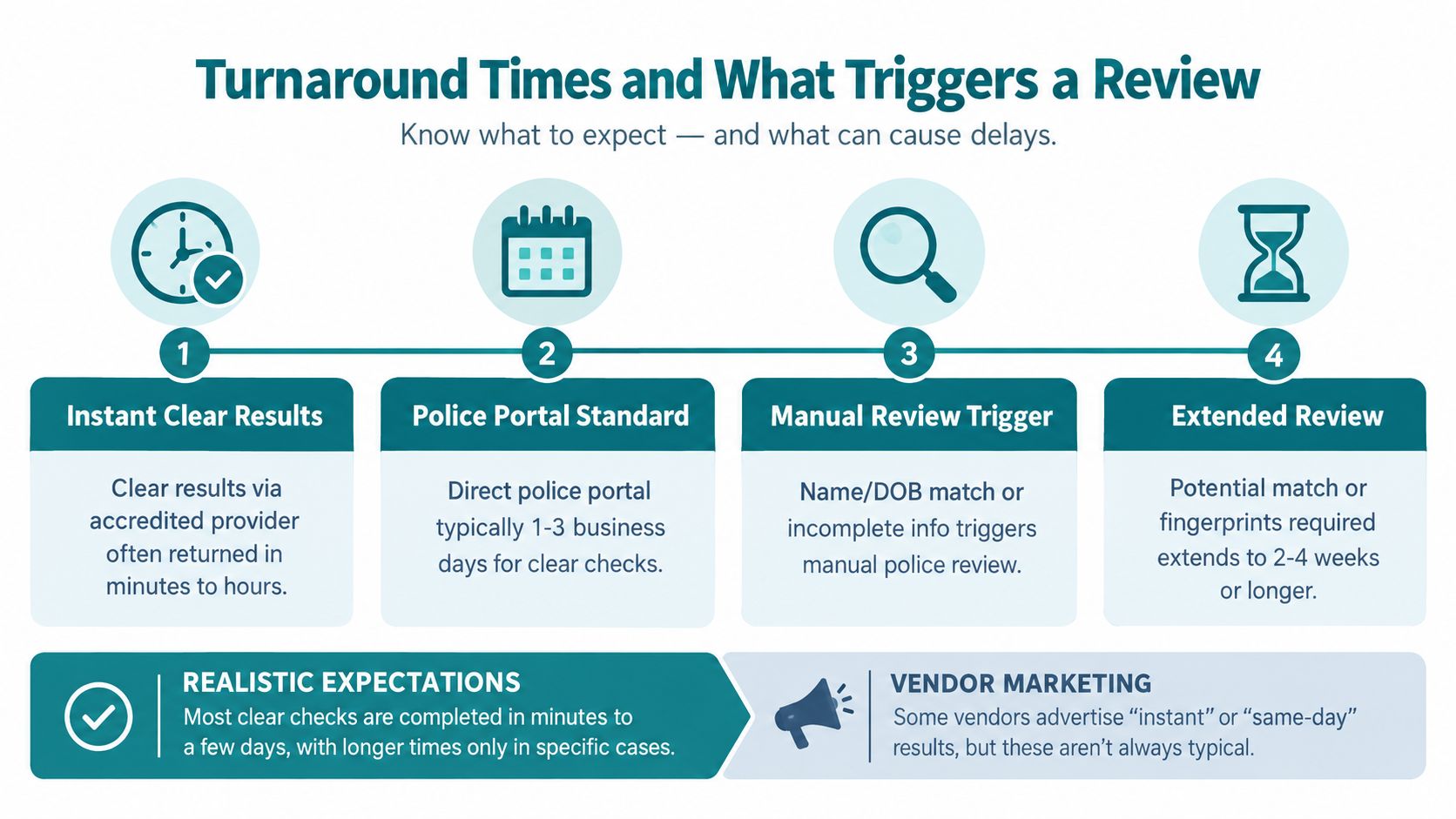
A Canadian service page states that many name-based criminal record checks can be completed within 15 minutes during business hours, while some results can take up to 24 hours. The Commissionaires criminal record check service also explains that applicants can begin online, while the RCMP confirms that the final check is released by a police agency.
Those timelines describe many straightforward requests, not every applicant's total experience. The candidate still needs to complete consent, upload acceptable identification, resolve errors, and meet any residency or check-type requirements. A direct police portal may take longer than a well-managed third-party workflow, particularly when the local service requires manual handling.
Read statuses without overreacting
In Progress generally means the request hasn't reached a final result. Pending CPIC Review indicates that the file needs additional police-side assessment, often because the system can't confidently complete an automated name-based result. Referred for Fingerprints means the applicant may need to prove identity through a fingerprint-based process.
A review status isn't proof of a conviction. Common triggers include a possible name and date-of-birth match, shared identifiers, incomplete information, or an identity discrepancy. Fingerprints can add substantial time because the applicant must complete another appointment or submission and the police service must process the result.
Hiring-manager guidance: Don't set a start date against the fastest advertised result. Set it against the possibility that the candidate needs manual review or fingerprints.
Give recruiters a short script before they send the request. Tell candidates that clear files may move quickly, but a review can delay the result and doesn't by itself indicate adverse information. For more operational detail on planning hiring dates, use this Canadian background check turnaround guide.
Employer Handling Under PIPEDA and Human Rights Law
The employer's obligations begin before the candidate opens the application. Under PIPEDA, private-sector organisations should identify a legitimate purpose, collect information that is reasonably necessary for that purpose, obtain meaningful consent, protect the information, and retain it only as long as the business need and applicable obligations require. The Office of the Privacy Commissioner of Canada guidance on PIPEDA remains the practical starting point for private-sector privacy governance.
A defensible program connects every check to the duties of the role. A basic office position shouldn't automatically receive the same screening treatment as a role with unsupervised access to vulnerable people or authority over sensitive assets. Provincial privacy laws, employment standards, and human rights codes may also apply, so national employers need a jurisdiction-aware policy rather than one universal form.
Build controls around the decision
Use a written policy that answers four questions:
- Purpose: What job-related risk does the requested check address?
- Access: Which trained HR or compliance staff can view the result?
- Assessment: Who reviews a potential issue, and how can the candidate explain it?
- Retention: When is the report deleted or securely destroyed after the hiring decision?
Human rights compliance requires care with non-conviction information, youth records, pardoned offences, and information that has no rational connection to the job. An adverse result shouldn't trigger an automatic rejection without an individualised assessment of relevance, recency where legally appropriate, the duties involved, and the candidate's explanation.
Cross-border processing deserves a direct question during procurement. Ask whether applicant data, identity images, support tickets, and reports remain in Canada, or whether a vendor transfers any part of the workflow elsewhere. Keep consent records separate from broad marketing permissions, restrict downloads, and document the reason for retaining a report.
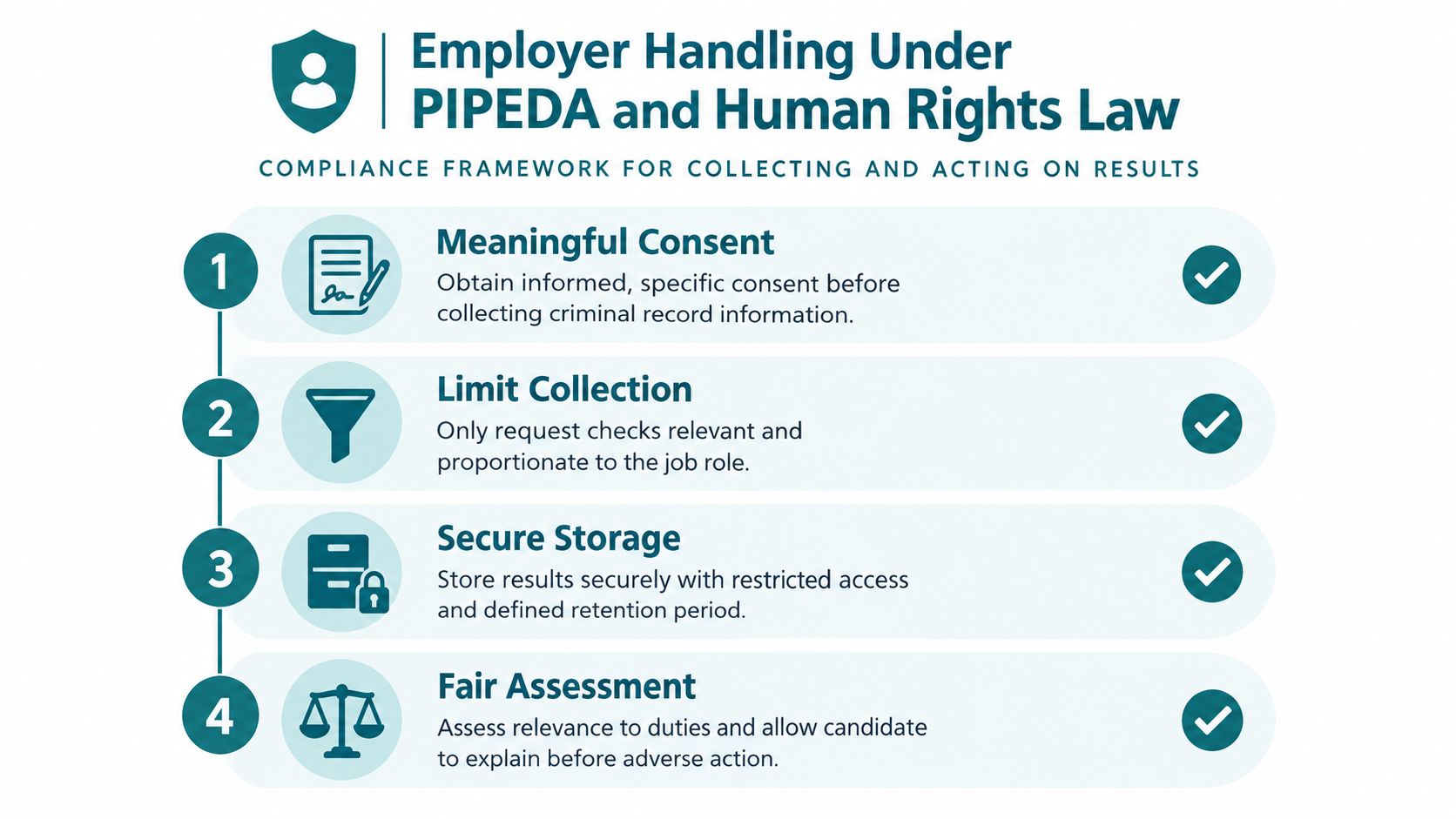
A useful PIPEDA background check framework should leave an audit trail without turning every candidate into a permanent file. The goal is a proportionate, secure process that supports a hiring decision, not an unrestricted collection of personal history.
HR Checklist for a Clean Screening Workflow
A screening lead should be able to hand the following checklist to recruiters and onboarding coordinators. It creates a common operating standard without forcing every role through the same level of review.
- Confirm the role: Write down the duties, access, supervision level, and vulnerable-person contact before selecting a CRC, CRJMC, or VSC.
- Confirm eligibility: Check the applicant's location, residency, age where relevant, and the police service's rules before collecting identity data.
- Choose the channel: Use a direct police portal for occasional straightforward requests, an accredited provider for recurring hiring, or an HRIS-integrated platform when workflow automation justifies the added complexity.
- Verify the provider: Request accreditation details, a redacted sample report, data-residency information, retention terms, support procedures, and the provider's definition of each status.
- Capture specific consent: Make the purpose, check type, requesting employer, and result-release process clear before the candidate submits anything.
- Check identity carefully: Confirm that the submitted legal name and identification belong to the candidate. Escalate mismatches rather than asking recruiters to interpret them.
- Set timing expectations: Explain that a clear name-based request may be quick, while a CPIC review or fingerprint referral can delay the start date.
- Protect access: Limit reports to people who need them, use secure systems, and prevent casual forwarding through email or shared drives.
- Review adverse information fairly: Give the candidate a meaningful opportunity to clarify information, then assess relevance to the actual duties instead of applying an automatic exclusion.
- Close the file: Record the hiring decision and consent evidence, follow the approved retention schedule, and securely destroy information when the legitimate purpose ends.
Alero Background & Identity offers Canadian criminal record checks, identity verification, candidate intake, status tracking, and HRIS or ATS workflow support for employers that want these controls in one process. Visit Alero Background & Identity to review its Canadian screening and identity-verification options and decide whether the workflow fits your hiring volume and privacy requirements.