A hiring manager has a qualified driver, a route that starts soon, and no appetite for discovering a licensing problem after the first shift. The candidate may interview well and provide strong references, but neither tells you whether the person is currently prohibited, has recent driving offences, or holds the licence class the job requires.
For Canadian employers, the BC driver abstract is the practical starting point for that decision. It gives you an official, time-bounded view of the applicant's British Columbia driving history. It also has limits. A responsible screening process uses the abstract to assess driving risk, then adds only the other checks the role requires.
Table of Contents
- A Quick Scenario for Hiring Managers
- What a BC Driver Abstract Actually Contains
- Ways to Request a BC Driver Abstract
- How ICBC Driver Penalty Points Change the Risk Picture
- Criminal Record Checks and Driver Abstracts Are Different Screens
- PIPEDA Rules That Shape Every BC Driver Abstract Request
- Pairing a Driver Abstract With Other Canadian Background Checks
- A Clean BC Driver Abstract Workflow for HR Teams
A Quick Scenario for Hiring Managers
A Vancouver courier company is filling a Class 5 driving role for a 12-month route contract. The work crosses British Columbia, includes evening highway shifts, and is union-eligible. The start date is close, and several applicants look equally qualified on paper.
A hiring manager should not choose the person who feels safest. Set a consistent question instead: What does the official provincial record show about the applicant's recent driving conduct and current licence position?
A BC driver abstract gives HR that decision point. ICBC maintains it as an official record of driving history, with licence information and tickets or other offences from the previous five years. It is a defined record, not an unlimited account of everything a driver has ever done.
For a courier, field technician, home-care worker, sales representative, or fleet operator, the abstract addresses a work-related risk that interviews and references cannot establish. It can support a consistent review before HR considers a criminal record check, identity verification, or another check tied to the duties.
Use the document for driving risk, not character judgments. It cannot show whether someone will treat customers well, maintain a vehicle, or follow a route plan. It also cannot support assumptions about events outside the period or information ICBC reports.
Privacy rules should shape the timing. Under PIPEDA, an employer should identify a legitimate, job-related purpose, obtain the applicant's meaningful consent, and limit collection to information needed for that purpose. Pull the abstract when driving is a real duty and the result could affect hiring, placement, or continued assignment. Do not create a broad background file because the applicant applied.
Practical rule: Request a driver abstract because the job requires driving, then pair it with a criminal record check only when the role and risk assessment justify both screens.
Document the driving requirement, explain the checks, control access to the results, and retain only what your process needs. That approach gives HR a defensible record review without treating every applicant as subject to unlimited surveillance.
What a BC Driver Abstract Actually Contains
A hiring manager reviewing a courier, field technician, home-care worker, sales representative, or fleet operator needs one answer first: can this person legally and safely perform the driving duty? A BC driver abstract helps answer that question by consolidating licensing information and recent driving-related entries into a record an employer can compare with the role.
The basic abstract can show when the licence was first issued, along with tickets and other offences from the previous five years, as described by ICBC's driver-record guidance. The defined lookback gives HR a consistent period for assessing recent conduct. It also sets a clear boundary. The document is not an unlimited history of everything a driver has done.
Review these areas against the position:
- Licence status and history: Confirm that the applicant holds the licence required for the work and identify any status issue that could prevent driving.
- Tickets and offences: Focus on entries connected to the duties, particularly frequent, long-distance, passenger, or commercial driving.
- Penalty-point activity: ICBC uses points and annual assessment to attach financial consequences to driving behaviour. This can add context beyond a simple ticket list.
- Prohibitions or suspensions: A current restriction may prevent the applicant from performing the driving duty, regardless of interview performance.
- Commercial information: ICBC also offers the National Safety Code abstract, a commercial driving record available through My ICBC. ICBC's commercial vehicle safety guidance explains the employer-accessible process and the commercial abstract's role.
Basic versus commercial records
Match the record to the work. A basic personal-use abstract is not interchangeable with a commercial record for a regulated fleet position.
| Field | Basic Abstract | Commercial, NSC Abstract |
|---|---|---|
| Primary use | General view of a driver's basic history | Employer-focused commercial driving record |
| Historical scope | Basic driving history for the previous five years | Commercial record used in employer and fleet contexts |
| Best fit | Occasional company driving, mileage roles, general mobile work | Regulated fleet, commercial transport, and safety-sensitive driving |
| Request channel | Candidate or authorised employer process | My ICBC and approved commercial process |
| Employer question | Can this person's recent BC history support the driving duty? | Does this commercial driver's record support fleet assignment and compliance review? |
The abstract leaves important gaps. It does not automatically establish out-of-province tickets, foreign licensing history, or employment history as a driver. If a candidate recently moved to British Columbia, request separate documentation from the previous licensing authority. Do not treat the BC record as a complete background file, and do not use it to make character judgments unrelated to the driving risk.
Ways to Request a BC Driver Abstract
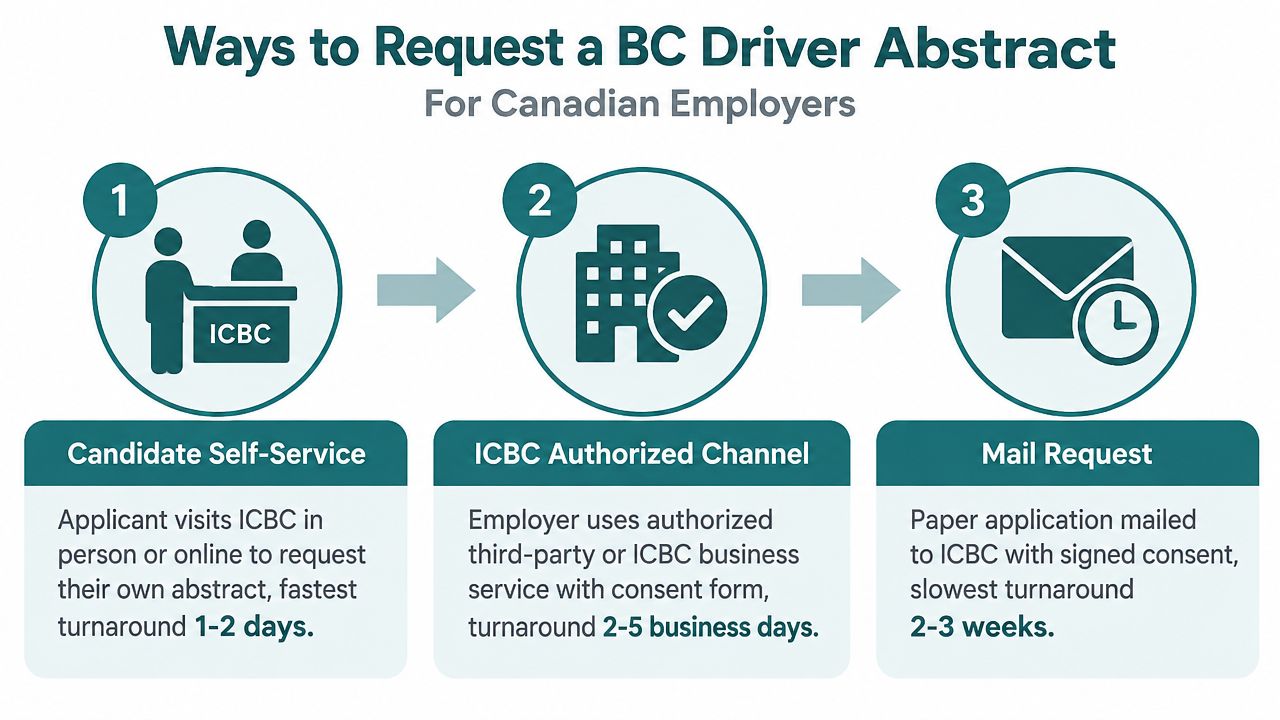
Choose the request channel based on volume, urgency, and who needs to control the original document. The candidate can obtain the record directly, an authorised employer can request it through My ICBC with consent, or a screening vendor can place it inside a broader Canadian workflow.
Candidate self-service
The candidate can request an abstract through an ICBC driver licensing centre and provide it to the employer. This option gives the applicant direct control over the document and can create a clear chain of custody for an ad hoc hire.
It's also the least efficient option for a hiring team managing multiple applicants. The candidate must arrange the request, receive the document, and send it back securely. If the record is incomplete, expired for the purpose of your policy, or difficult to authenticate, HR may need to repeat the process.
Employer request through My ICBC
Employers can request a driver's abstract through My ICBC once the applicant has provided the required authorisation. This is usually the cleanest route for an organisation with recurring driver recruitment because the requester controls the process and can apply the same workflow to every candidate.
Before ordering, confirm:
- The position involves driving.
- The consent form identifies the purpose of the request.
- The candidate understands what information will be collected.
- The person requesting the record is authorised within the organisation.
- The result will be stored and accessed through a controlled process.
The on-screen methods used for individual sales are being phased out, so don't build a long-term process around an informal counter or screen workflow. Use the current authorised channel and keep your process documented.
Screening vendor
A third-party screening vendor makes sense when your organisation hires across provinces, needs identity verification alongside the abstract, or wants one portal and invoice for several checks. It can also reduce manual email handling and give candidates a mobile-first intake experience.
A vendor doesn't remove the employer's responsibility. You still need a role-specific purpose, meaningful consent, controlled access, and a defensible adjudication policy. Ask where applicant data is stored, how the vendor handles exceptions, and whether the report clearly distinguishes a completed result from a case requiring human review.
For organisations that want to understand how a request fits into a broader screening process, this video offers additional context:
How ICBC Driver Penalty Points Change the Risk Picture
A candidate applies for a driving role. Their abstract shows several penalty points, and the hiring manager asks whether the record should end the process. The answer depends on the pattern, the role, and your documented risk threshold, not on the point total alone.
ICBC assesses penalty points over a 12-month assessment period. Once a driver has more than three points, ICBC charges a Driver Penalty Point premium. The province's commercial vehicle safety material explains how that system works.
The financial consequences rise sharply. ICBC lists premiums of $252 for four points and $34,560 for 50 or more points. These are not employer fines, and HR should not turn them into an automatic hiring score. They indicate that ICBC treats accumulating points as a meaningful driving-risk signal.
| Cumulative points | ICBC consequence | Employer risk signal |
|---|---|---|
| More than 3 | Driver Penalty Point premium applies | Review the recent record against the job duties |
| 4 | Premium listed at $252 | Require a documented review of the driving concerns |
| 50 or more | Premium listed at $34,560 | Treat the accumulated history as unsuitable for automatic clearance |
| Other totals | Premium rises as the point total increases | Apply the same written criteria used for comparable candidates |
Points provide a starting signal, not a complete assessment. Review the type, date, frequency, and current status of every entry. One older event may carry less weight than repeated unsafe conduct. A current prohibition can disqualify an applicant immediately when driving is a required duty.
Translate the record into a job decision
Set the threshold from the actual role. Occasional travel between offices creates less operational exposure than daily company-vehicle use, passenger transport, or night driving. Your policy should identify which entries require clarification, escalation, or a hiring pause.
Hiring standard: Use the abstract to support a consistent decision, not to create an unexplained numerical ranking of people.
Give the candidate a chance to correct an apparent mismatch or explain the record before making an adverse decision. Record the reasoning and tie it to the job's duties, insurance requirements, and written safety threshold. Pull the abstract when the driving exposure justifies it, then limit access and retention to what the decision requires.
Criminal Record Checks and Driver Abstracts Are Different Screens
A driver abstract and a criminal record check answer different questions. The abstract is an ICBC driving record. A Criminal Record Check, Judicial Matters Check, and Vulnerable Sector Check are police information products connected to Canadian criminal-record systems and local police processes.
A basic CRC is designed to identify criminal-record information relevant to the product and jurisdiction. A JMC goes further by adding outstanding charges and absolute discharges where the applicable process permits. A VSC includes a criminal record check plus a search for record suspensions, formerly called pardons, for sexual offences, as explained in RCMP guidance on criminal-record information disclosure.
The distinction is practical:
| Screen | Main question | Appropriate use |
|---|---|---|
| Driver abstract | What does the applicant's recent BC driving history show? | Driving, fleet, passenger, and mobile-work roles |
| CRC | Does the applicable police process identify criminal-record information? | Role-based criminal-history screening |
| JMC | Does the process also identify outstanding charges and absolute discharges? | Roles where that broader court information is legally appropriate |
| VSC | Is there relevant information, including pardoned sexual offences, for a role involving vulnerable people? | Positions of authority or trust over vulnerable persons |
A clean abstract doesn't prove the candidate is crime-free. A clean CRC doesn't prove the candidate drives safely. Substituting one for the other is a common compliance gap because recruiters sometimes treat “background check” as one interchangeable product.
For a fuller explanation of how Canadian criminal checks differ, use this Canadian criminal record check guide. It's especially important to identify the product before collecting consent, because the purpose and legal justification must match the role.
VSCs have a narrow trigger. The RCMP states that they're limited to positions involving authority or trust over vulnerable persons, and the employer must make the request in writing with a specific explanation of how the duties create that relationship, as set out in RCMP guidance on vulnerable sector requests.
PIPEDA Rules That Shape Every BC Driver Abstract Request
PIPEDA should design the workflow, not decorate it after the fact. The employer must be able to explain why it needs the abstract, what it will do with the result, who can see it, and when it will destroy it.
Four controls matter most:
- Meaningful consent: Tell the candidate that you're requesting a driver abstract, identify the driving-related purpose, and obtain authorisation before the request. Use express consent when a third-party screening vendor is involved.
- Reasonable collection: Collect the record because the role requires driving, fleet access, or another defined mobility duty. Don't pull abstracts for office roles because the data is available.
- Limited access: Restrict the record to HR, recruitment, fleet management, or legal personnel who need it for the stated decision. A manager who only needs a clearance outcome shouldn't automatically receive the full document.
- Retention and destruction: Set a concrete retention schedule. Don't keep abstracts indefinitely in email accounts, shared drives, or general personnel files.
Direct employer relationships may support implied consent in some circumstances, but don't rely on ambiguity for a sensitive screening document. A clear written consent record is easier to explain to the candidate, easier to audit, and safer when the request goes through a vendor.
Cross-border handling needs a plain-language notice
If an employer or vendor stores Canadian driver data on infrastructure located in the United States, the information remains subject to PIPEDA and applicable provincial privacy rules. The organisation should disclose that handling arrangement and use contractual safeguards governing access, security, retention, breach response, and deletion.
The candidate's authorisation also matters at the ICBC stage. ICBC says employers can request an abstract through My ICBC, but the employer must have the driver's authorisation. Keep that authorisation with the screening record rather than treating it as an informal email approval.
For practical implementation, use this PIPEDA background-checks resource to pressure-test your consent, access, and retention controls. The test is simple: could a candidate understand why you collected the abstract and could your HR team prove that it used the record only for that purpose?
Pairing a Driver Abstract With Other Canadian Background Checks
The abstract covers the road. It doesn't cover every conduct or identity risk connected to a driving job.
For most safety-sensitive driving positions, the sensible baseline is a BC driver abstract plus a CRC through the appropriate police process or a fingerprint-based equivalent. Add a VSC only when the role involves authority or trust over vulnerable people. A JMC can be considered where the applicable provincial and police process permits broader court information and the role-based purpose supports it.
A community support worker who drives clients is a useful example. The abstract assesses the person's driving history. The criminal screening product addresses criminal-record information. If the worker has regular authority or trust over vulnerable clients, the employer must separately assess whether the VSC criteria apply. One product cannot stand in for another.
Match the checks to the work
| Role type | Driver abstract | CRC | VSC | JMC |
|---|---|---|---|---|
| Courier or delivery driver | Yes, when driving is a core duty | Usually appropriate where the policy supports it | No, unless the role independently involves vulnerable persons | Only where justified and permitted |
| Fleet or commercial driver | Yes, use the appropriate commercial record | Usually appropriate | Only if the role includes authority or trust over vulnerable people | Consider only for a defined legal and operational purpose |
| Mobile technician visiting businesses | Yes, if company driving is required | Role-dependent | Generally not triggered by driving alone | Role-dependent |
| Community support worker transporting clients | Yes | Yes | Consider where the duties meet the VSC threshold | Consider only where legally appropriate |
| Office employee with occasional travel | Use a defined policy threshold | Not automatically required | No | No |
Get role-specific consent before ordering each product. Keep the reports in separate, access-controlled records rather than building one unrestricted background file. If a result creates concern, assess the individual information against the essential job duty and give the candidate a fair opportunity to respond.
Identity verification is also separate from criminal and driving checks. It confirms that the applicant is the person connected to the submitted information. An employer that needs that layer can review Alero's identity verification service alongside its abstract and criminal-screening requirements.
The operational rule is straightforward: the abstract covers driving, the CRC covers criminal-record information, and the VSC covers the narrow vulnerable-person risk. Use the smallest combination that answers the job-related questions.
A Clean BC Driver Abstract Workflow for HR Teams
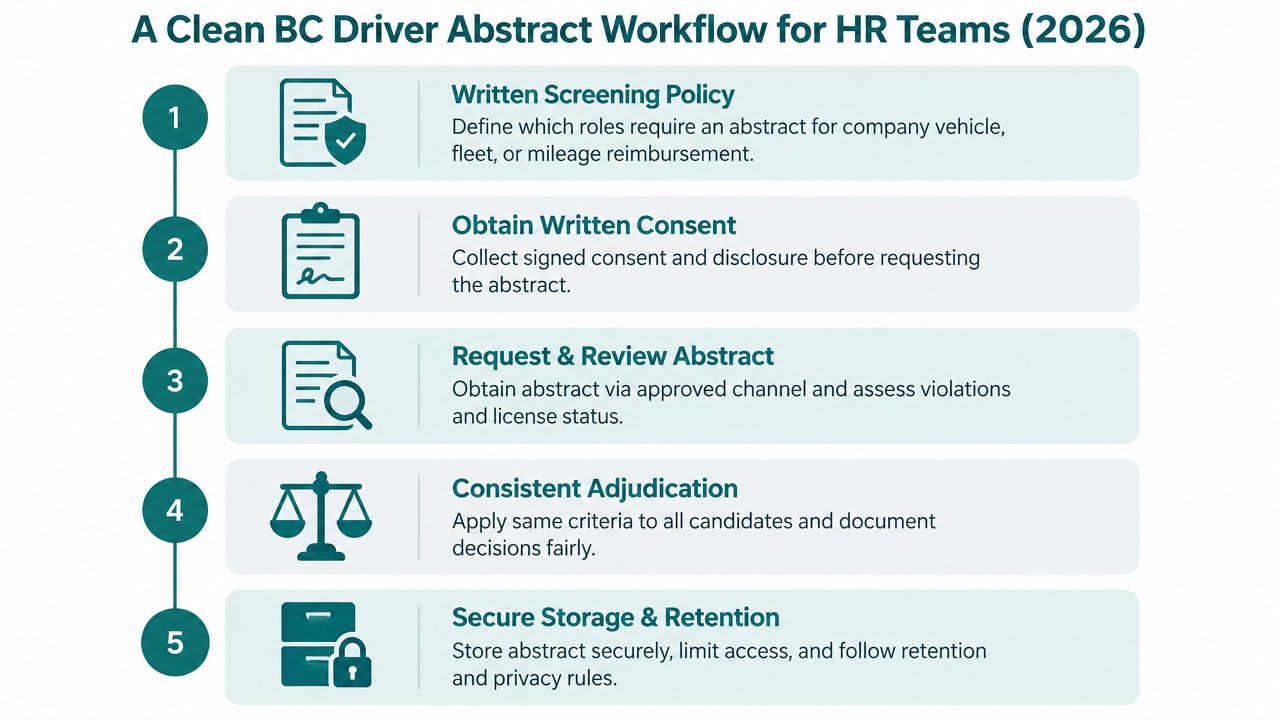
A defensible 2026 workflow starts with a written screening policy. The policy should identify roles that require an abstract because they involve a company vehicle, fleet access, or reimbursable mileage above a defined internal threshold.
Recruiters should initiate the request after a conditional offer, not at the earliest application stage. Use a role-specific consent form that names the purpose, explains the retention period, and tells the candidate how to request access to the result. Then select the request channel that fits the hiring volume.
The minimum viable process
- Write the policy: Define which positions require a driver abstract and identify the decision criteria before reviewing candidates.
- Obtain written consent: Capture the candidate's authorisation and disclose the purpose, handling, and retention period.
- Request and review: Use the candidate's ICBC request for an ad hoc hire or My ICBC for authorised employer requests. Add a CRC or VSC only where the role supports it.
- Apply consistent adjudication: Compare the record with the same criteria used for other applicants. Document the job-related reason for a pause, clarification, or decision.
- Secure and delete: Store the abstract in a separate, access-controlled folder. If the candidate isn't hired, auto-delete it within 12 months as an internal retention rule, and apply your approved schedule to hired employees.
Don't let a recruiter's inbox become the system of record. Restrict access, record who reviewed the document, and retain only the information needed to support the decision. If the abstract raises a concern, speak with the applicant before finalising an adverse outcome.
Start with three actions: draft the policy, update the consent template, and audit current driver-role files for stale abstracts. That short exercise usually exposes duplicate records, missing authorisations, and documents that have outlived their business purpose.
Alero Background & Identity supports Canadian employers with provincial driver's abstracts, criminal record checks, identity verification, and consent-based screening workflows. Visit Alero Background & Identity to organise BC driver abstract requests within a more consistent, candidate-friendly hiring process.