A candidate accepts your offer on Friday, completes the intake form that evening, and then waits. The criminal record check is moving, but an identity document is missing, the consent wording doesn't match the province, and nobody can tell the hiring manager whether the delay is normal. By the following week, the candidate has stopped replying, while HR is piecing together updates from email, spreadsheets, and a vendor portal.
That's the operational problem background screening software should solve. It isn't a database search. The right platform controls the order of consent, identity verification, screening, review, disclosure, retention, and reporting. It also affects turnaround time, report accuracy, privacy compliance, recruiter workload, and candidate confidence.
Canadian employers need a Canada-specific evaluation. PIPEDA may apply differently depending on the employer's regulatory jurisdiction, provincial police-check rules can change the required consent sequence, and data residency may matter to procurement and security teams. Ontario employers, for example, need software that distinguishes among three police record check types rather than treating every criminal check as interchangeable.
The market has also moved beyond single-purpose verification. A Canadian background-screening whitepaper reports that potential-employee screening rose from 7% in 2010 to a much higher level by publication, while combined screening packages represented 42.48% of background verification requests and individual tools represented 57.52% (Canadian screening whitepaper). That mix reflects how employers now combine identity, criminal-record, education, employment, and reference checks within one hiring workflow.
This guide compares software through that practical lens. The question isn't which platform has the longest feature list. It's whether the system can apply the right Canadian legal workflow, return useful results at a predictable pace, integrate with your hiring stack, and make the process clear for candidates. Alero Background & Identity is one Canadian option, alongside other vendors, for teams that need screening and identity verification designed around domestic hiring requirements.
Table of Contents
- Introduction Why Choosing the Right Screening Software Matters Now
- Understanding Background Screening Software in Canada
- Core Features That Separate Leading Platforms
- Integrations Compliance and Candidate Experience Compared
- Pricing Models Turnaround Times and Total Cost Analysis
- Which Software Fits Your Hiring Scenario
- Buyer Checklist and Final Recommendation for Canadian Employers
Introduction Why Choosing the Right Screening Software Matters Now
A screening platform earns its place in your hiring process by reducing uncertainty without creating new risk. A fast report that lacks a defensible consent trail isn't efficient. A compliant workflow that leaves candidates waiting without status information can still damage acceptance and recruiter productivity.
The most effective setup starts before anyone orders a check. It defines which roles require which checks, presents the correct disclosure, captures consent for the specific screening activity, verifies identity, routes exceptions to a human reviewer, and records what happened. The platform should also make it obvious when a result is complete, when a case needs attention, and when the employer must not proceed without another step.
Practical rule: Choose the workflow before choosing the vendor. If your process can't explain why a check is required, the software can't make that decision defensible.
A Canada-focused review should test five operational questions:
- Legal fit: Can the system support federal and provincial privacy requirements instead of applying one generic flow?
- Check precision: Can recruiters order the correct criminal, judicial matters, or vulnerable sector check for the role?
- Identity assurance: Does the platform establish that the applicant is the person connected to the records being searched?
- Operational speed: Does it show where a case is stalled and distinguish routine processing from police or manual escalation?
- Candidate clarity: Can applicants complete consent and verification on a phone, understand the next step, and get meaningful status updates?
Alero fits naturally into this conversation because its Canadian service model combines background checks, identity verification, credential and employment verification, and HRIS or ATS connectivity. That doesn't eliminate the employer's responsibility to define role requirements and review results fairly. It can, however, give teams a structured environment for carrying out those decisions.
The comparison ahead focuses on what works in Canadian hiring and what tends to fail. Generic checklists often reward a platform for offering more services. A better test is whether each service is connected to the right purpose, consent record, jurisdiction, data location, and escalation path.
Understanding Background Screening Software in Canada
A hiring manager in Ontario can order a check in minutes, then discover the workflow used the wrong screening type or captured consent too broadly. The software may have processed the request quickly, but the employer still faces a compliance and candidate-trust problem. Canadian selection should begin with the type of check, the role, and the applicable privacy workflow, not with a vendor's package name.
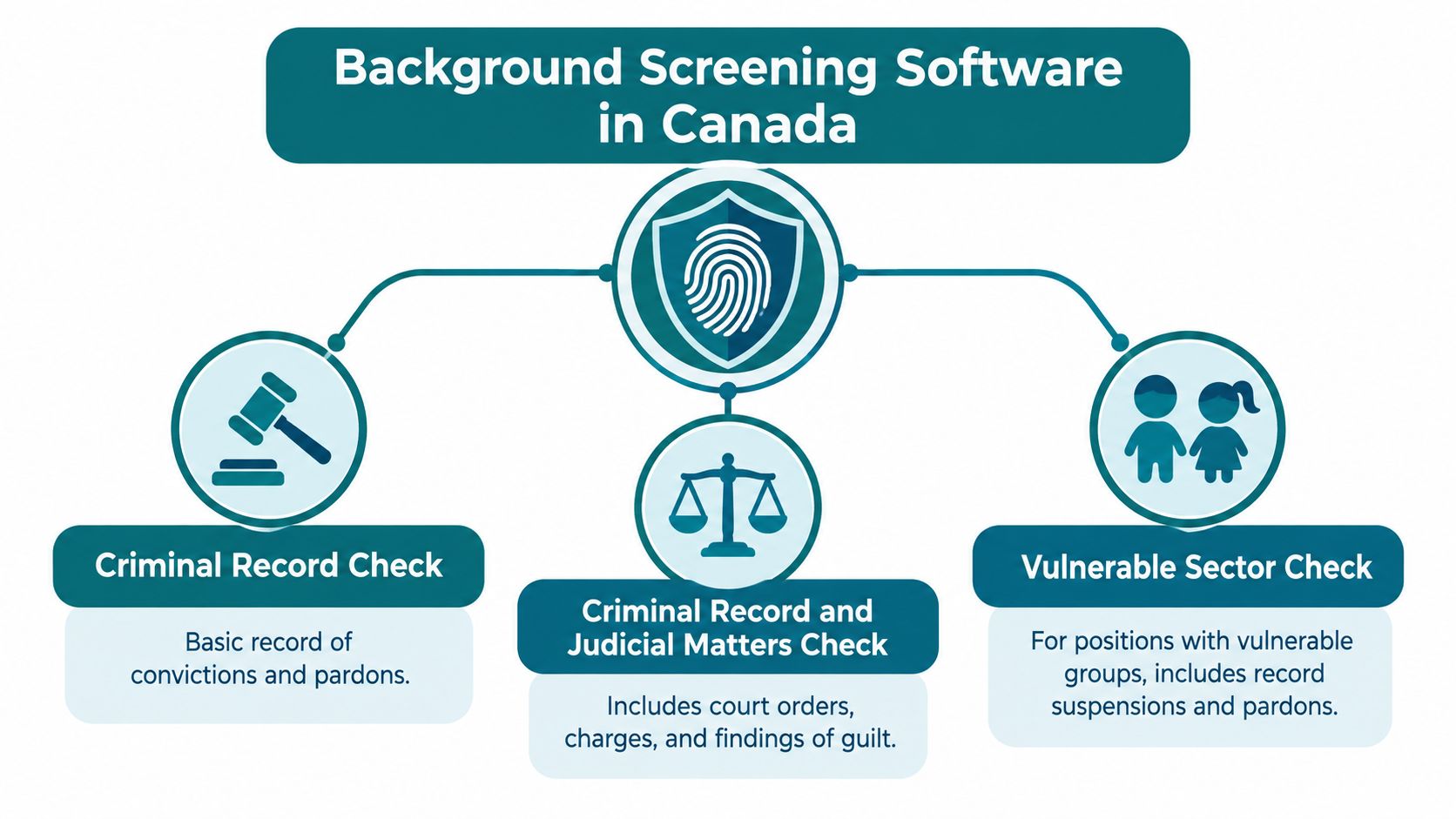
Ontario's Police Record Checks Reform Act distinguishes three employment-screening checks: a criminal record check, a criminal record and judicial matters check, and a vulnerable sector check. The Act also requires written consent for the specific check requested (Ontario police-check framework).
Match the check to the role
A Criminal Record Check, or CRC, is the basic option for identifying releasable criminal-record information through the applicable police process. A Criminal Record and Judicial Matters Check, or CRJMC, also addresses criminal convictions and judicial matters such as outstanding charges, warrants, and certain court orders, subject to the governing disclosure rules.
A Vulnerable Sector Check, or VSC, follows a different purpose. The RCMP describes it as a police information check plus a search for record suspensions involving sexual offences listed in Schedule 2 of the Criminal Records Act. The applicant must provide informed written consent before the check is conducted (RCMP policy on police dissemination).
Police guidance limits VSCs to positions involving vulnerable people, including children, seniors, or persons with disabilities. The employer or volunteer organisation should explain the requirement to the applicant, and police initiate the check in the jurisdiction where the applicant lives (RCMP vulnerable sector guidance). Ontario human-rights guidance supports requesting police checks only where they relate to a bona fide job requirement (Ontario screening guidance).
Build privacy into the workflow
The Office of the Privacy Commissioner explains that PIPEDA applies to personal information collected during commercial activities and helps identify the governing privacy law. Federally regulated employers also have requirements for employee-applicant information. PIPEDA generally does not govern employee information for provincially regulated employers in Ontario, so the platform should let HR configure federal and provincial hiring flows separately (Office of the Privacy Commissioner on PIPEDA).
Assess whether the software supports:
- Meaningful consent: The applicant understands what information is collected and why.
- Purpose limitation: The employer orders checks tied to a legitimate role requirement.
- Controlled retention: The organisation keeps records according to documented legal and operational needs.
- Disclosure controls: The system records what was disclosed, to whom, and under which consent.
- Audit evidence: HR can retrieve the consent, identity, order, result, review, and decision history.
Ontario law also separates the treatment of non-conviction information. A CRC or CRJMC cannot disclose it, while a VSC may disclose it only when the statutory exceptional-disclosure test is met (Ontario Police Record Checks Reform Act). Software that labels every result “criminal” without identifying the check type and disclosure basis leaves recruiters without enough control. Canadian screening compliance resources offer a practical reference for configuring these requirements.
Alero Background & Identity combines background checks, identity verification, credential and employment verification, and HRIS or ATS connectivity. The employer remains responsible for defining role requirements and reviewing results fairly. The platform's value is a structured workflow that ties each order to the right consent record, jurisdiction, data handling rule, and escalation path.
Core Features That Separate Leading Platforms
A platform's value becomes visible when a candidate's file isn't perfectly clean. Someone may have a name variation, an incomplete address history, a credential that requires direct confirmation, or a police process that needs manual handling. Strong software separates those cases from routine clears without hiding the reason for the difference.
| Evaluation Criteria | What Good Looks Like in Canada | Why It Matters for Hiring |
|---|---|---|
| Identity verification | Government-document checks, selfie or live verification, and a clear exception path | Confirms that the applicant matches the person being screened |
| Criminal and judicial checks | Distinct CRC, CRJMC, and VSC ordering with role-based controls | Prevents over-collection and incorrect disclosure |
| Credential verification | Direct education, licence, and professional credential confirmation | Tests qualifications that a criminal search can't validate |
| Employment and reference checks | Structured requests, reminders, source documentation, and human review | Reduces manual chasing and exposes material discrepancies |
| Social and financial screening | Purpose-specific ordering, consent controls, and restricted access | Limits privacy, relevance, and fairness risks |
| Reporting | Plain-language statuses, source details, review notes, and exportable audit records | Helps recruiters act quickly while preserving defensibility |
Identity is the first accuracy test
A criminal search can be technically accurate and still produce the wrong outcome if the applicant's identity hasn't been established. The risk is especially clear in remote recruitment, where an impersonator can submit documents, complete assessments, and receive access before anyone confirms the person's identity.
Canadian public-sector security guidance requires at least one photo ID and one supporting identity document, consistency checks across the documents, and retention of identity evidence for audit purposes in personnel screening files (Canadian identity-verification requirements). Look for repeated verification points, not only an intake check. Re-verification before assessment, onboarding, and system access can address the possibility that the person at one stage isn't the person screened at another.
Reporting should help people decide
A report shouldn't force a hiring manager to decode raw records. It should show whether the file is complete, whether a result needs review, which source supplied the information, and what action is permitted next. Human review remains important when names, dates, or records don't align.
Accuracy differentiator: The best report isn't the one with the most data. It's the one that clearly separates verified information, unresolved discrepancies, and employer decisions.
Employment, education, licence, reference, social, and financial checks have different relevance and consent considerations. A platform that bundles them without role-based policies may increase administrative convenience while weakening proportionality. A platform that lets you create role-specific packages, restrict access, and document the reason for each check gives HR a stronger operating model.
Integrations Compliance and Candidate Experience Compared
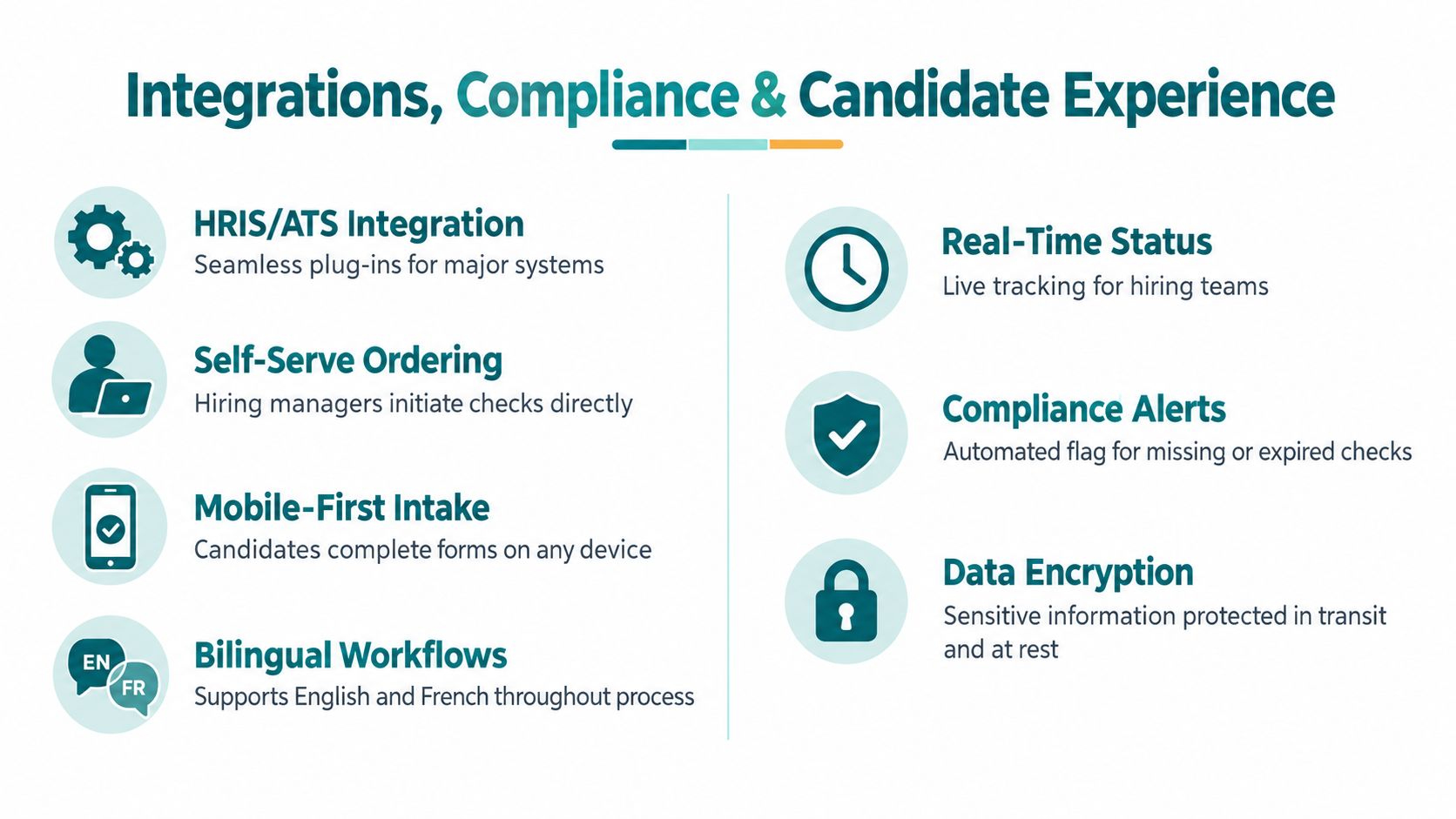
A screening platform can have excellent search capability and still fail operationally if recruiters must copy candidate data between systems. The useful integration is more than a button that opens a vendor portal. Candidate information should move from the ATS or HRIS into the screening order, status changes should return to the hiring system, and completed reports should be available to authorised users without duplicate entry.
Ask vendors to demonstrate the complete path with a real requisition. A good demonstration includes a conditional-offer trigger, candidate invitation, incomplete-form reminder, identity exception, police delay, result review, and final status in the ATS. If the vendor only shows a successful order, you haven't seen the workflow that consumes most HR time.
Compliance architecture is part of the product
PIPEDA-sensitive information demands more than a security badge on a sales page. You need consent records, purpose controls, role permissions, retention settings, disclosure history, and an audit log that can be retrieved without reconstructing events from email.
Data residency deserves a specific question: where is production applicant data stored, and can subprocessors move it elsewhere? One Canadian vendor states that all production data is hosted in AWS ca-central-1 and remains within Canadian infrastructure unless a subprocessor requires otherwise (Canadian cloud-hosting disclosure). That is a concrete architectural position, not a general promise of “secure hosting.”
Candidate experience affects completion
Candidates shouldn't need a desktop computer, multiple email exchanges, or a call to understand a straightforward request. A mobile-first intake flow, plain-language consent, bilingual English and French support, visible status, and accessible document upload reduce avoidable friction.
The process also needs to explain delays. A candidate may see a quick electronic submission while the police service still needs manual processing. The platform should show whether HR is waiting for the candidate, a third-party verifier, or a police service, rather than leaving everyone with a generic “pending” label.
For integration planning, review how HRIS and ATS screening integrations handle authentication, field mapping, status synchronisation, permissions, report retrieval, and implementation support. A connector that saves clicks but creates duplicate records or weakens access control isn't a successful integration.
Pricing Models Turnaround Times and Total Cost Analysis
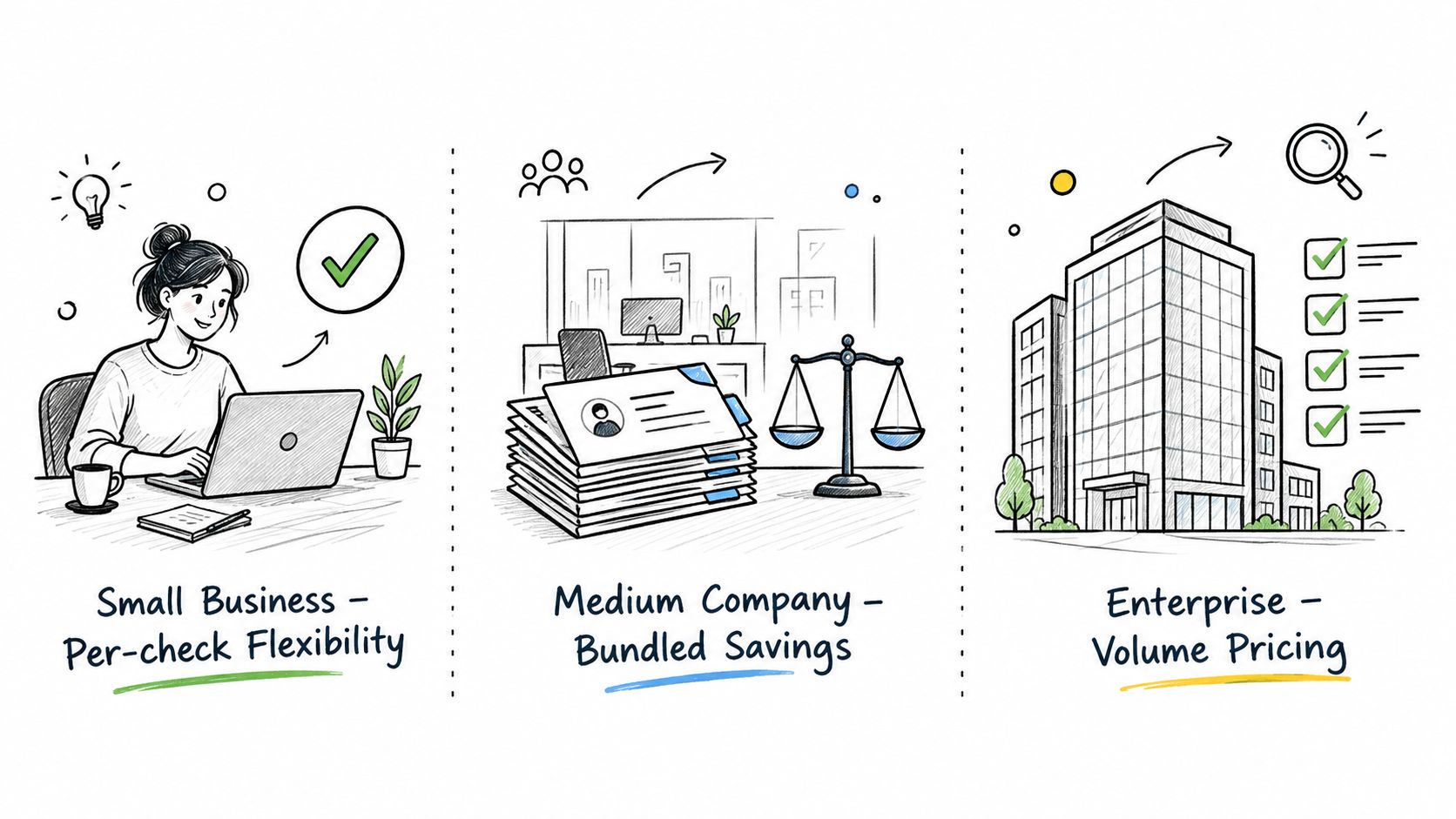
A screening quote can look affordable until setup fees, minimum commitments, add-on services, manual review, or integration work appear on the invoice. Start with the hiring workflow and required checks, then compare the commercial model. Pay-per-check pricing fits variable hiring, while bundled packages can fit repeatable roles that require the same verifications.
Bundle when the same checks recur for a defined role. Order individual checks when risk, jurisdiction, or hiring volume changes between candidates. This approach also keeps Ontario police-check requirements visible, since CRC, CRJMC, and VSC orders should not be treated as interchangeable products.
Turnaround is a workflow variable
A vendor cannot control every police-service or courthouse dependency. It can control whether the candidate receives a complete request, whether documents are validated early, reminders are automatic, and HR can see the precise blocker.
The RCMP states that electronic fingerprint submissions with no criminal-record match are typically processed in 3 business days or less. Cases requiring manual processing or involving a possible match can take up to 120 business days (RCMP processing times and fees). These are different workflows. Set an escalation path for delayed cases instead of promising one completion time for every order.
Cost insight: A low per-check quote can become expensive when HR absorbs manual follow-up, delayed starts, duplicate entry, and candidate drop-off.
Forecast the whole cost
Request a Canadian-dollar price sheet that separates:
- Base checks: CRC, CRJMC, VSC, identity verification, and role-specific searches.
- Verification services: Education, employment, references, licences, driver abstracts, credit, or social screening.
- Operational fees: Setup, implementation, candidate messaging, manual review, and support.
- Commercial terms: Monthly minimums, annual commitments, volume tiers, cancellation rules, and unused credits.
- Integration costs: Native connectors, API access, configuration, testing, and ongoing maintenance.
Data handling also belongs in the cost review. Confirm where candidate information is stored, how PIPEDA consent is captured, and whether the platform can support provincial police-check workflows without forcing HR to manage exceptions outside the system.
Model a normal candidate and an exception case. A missing document, name discrepancy, or delayed fingerprint submission can require recruiter time, candidate support, and hiring-manager intervention. Status reporting and human case support may justify a higher fee if they reduce that work. Ask the vendor to walk through both invoices, then compare the result with Canadian screening pricing information.
Which Software Fits Your Hiring Scenario
The right platform depends on how your organisation hires, not on a universal ranking. A small employer with occasional hiring needs a different commercial model from a staffing agency processing recurring packages. A healthcare employer also has a different evidence burden from a low-risk office environment.
Small businesses need control without administration
A small business owner may order only occasional checks and can't justify a complex implementation project. Pay-per-check ordering, clear CAD invoices, mobile candidate intake, plain-language reports, and responsive human support usually matter more than a large catalogue of international services.
The trade-off is that self-serve simplicity can leave employers to interpret provincial requirements themselves. Before choosing a low-touch platform, confirm that it distinguishes CRC, CRJMC, and VSC orders, captures specific consent, and explains what the employer must do when the result requires review.
Staffing agencies need repeatability
An agency may screen candidates for several clients, with different role profiles and billing arrangements. It needs reusable packages, client-level permissions, candidate status tracking, easy reordering where lawful, and an audit record that shows which client authorised which check.
A bundled workflow can reduce administration when the same checks recur. It can also create waste if the agency applies an identical package to every assignment. Role templates should be adjustable, and the system should prevent an agency from ordering a VSC where the placement doesn't involve vulnerable people.
Regulated employers need evidence depth
Healthcare, finance, government, and other regulated environments may require credential verification, professional licences, identity proofing, references, and carefully controlled access to reports. A criminal record check alone can't validate a licence or prove that a remote applicant is the person whose history was searched.
Repeated identity verification is increasingly relevant for distributed recruitment. Public-sector guidance calls for document consistency checks and retention of identity evidence, while Canadian security coverage has raised concerns about deepfake and impersonation-based applicants. Vendors should demonstrate how identity is verified at intake and how the evidence remains connected to the screening file.
Implementation test: Run a pilot with one small-business role, one regulated role, and one cross-province workflow. A platform that only works for the cleanest case isn't ready for production.
Enterprises should test systems, not promises
Large employers should evaluate native ATS and HRIS integrations, role-based access, Canadian data residency, bilingual communication, audit exports, support coverage, and configuration governance. They'll also need a documented process for changing consent language, retention rules, and check packages without breaking existing requisitions.
Alero Background & Identity offers Canadian criminal record checks, applicable vulnerable sector checks, identity verification, credential and employment verification, a self-serve ordering and tracking portal, and HRIS or ATS integrations. It can be considered alongside other vendors when Canadian hosting, bilingual workflows, and domestic privacy controls are material buying criteria.
Buyer Checklist and Final Recommendation for Canadian Employers
Shortlist software against your actual hiring process. A polished demo isn't enough if the platform can't show what happens when a candidate refuses consent, submits inconsistent identity documents, or triggers a police delay.
Use this checklist during demonstrations and contract review:
- Map jurisdictions: Ask how the platform separates federally regulated and provincially regulated employers, including Ontario-specific flows.
- Confirm check types: Verify that CRC, CRJMC, and VSC orders are distinct, role-restricted, and tied to specific written consent.
- Test disclosure controls: Ask how the system handles non-conviction information and exceptional disclosure rules for vulnerable sector checks.
- Inspect residency: Obtain a written explanation of production hosting, subprocessors, backups, and cross-border transfers.
- Review identity proofing: Test photo ID, supporting documents, liveness or selfie matching, consistency checks, and re-verification.
- Measure turnaround: Build separate expectations for electronic submissions, manual reviews, possible matches, fingerprints, and third-party verifications.
- Walk through the candidate view: Check mobile completion, English and French content, accessibility, reminders, status visibility, and support escalation.
- Validate integration depth: Confirm whether the ATS or HRIS receives order status, exceptions, completed reports, and audit data without duplicate entry.
- Price exception cases: Request the full cost of normal and delayed files, including setup, minimums, manual review, verification add-ons, and support.
- Run a pilot: Use real role profiles and cross-province scenarios before standardising the workflow.
My recommendation is to score vendors on accuracy, speed, compliance, and candidate experience together. Don't let a fast turnaround excuse weak identity controls. Don't let a compliance dashboard excuse a confusing candidate portal. Don't accept Canadian data residency as an assumption, get the architecture and subprocessor position in writing.
For many employers, the best first step is a controlled pilot rather than a broad rollout. Select representative roles, define the required check types, document the consent and disclosure flow, measure recruiter effort, and review the candidate experience. Then standardise only what survives that test.
Alero Background & Identity provides Canadian criminal record checks, identity verification, credential and employment verification, vulnerable sector checks where applicable, and HRIS or ATS workflows designed for Canadian employers. Visit Alero Background & Identity to evaluate a Canada-focused screening process and discuss the checks, integrations, residency controls, and support model your hiring operation requires.