You're probably dealing with this right now. One hiring manager wants an offer out today, another wants a police check, payroll wants documents before Friday, and nobody agrees on what “background screening” means in Canada.
That's where most hiring risk starts. Not with a bad candidate, but with a sloppy process.
In Background Screening Canada, the job isn't collecting the most data. It's building a screening system you can defend later. Every check should tie to a role, a risk, a consent form, and a privacy rule. If you can't explain why you asked for it, you probably shouldn't be collecting it.
Table of Contents
- Why Canadian Hiring Decisions Need a Screening System
- The Three Levels of Canadian Criminal Record Checks
- PIPEDA and Provincial Privacy Rules That Shape Every Check
- Provincial Differences HR Teams Get Wrong
- Identity Verification as the Front Door of Screening
- Matching the Right Check to the Role
- Choosing a Canadian Screening Partner and Building a Repeatable Workflow
Why Canadian Hiring Decisions Need a Screening System
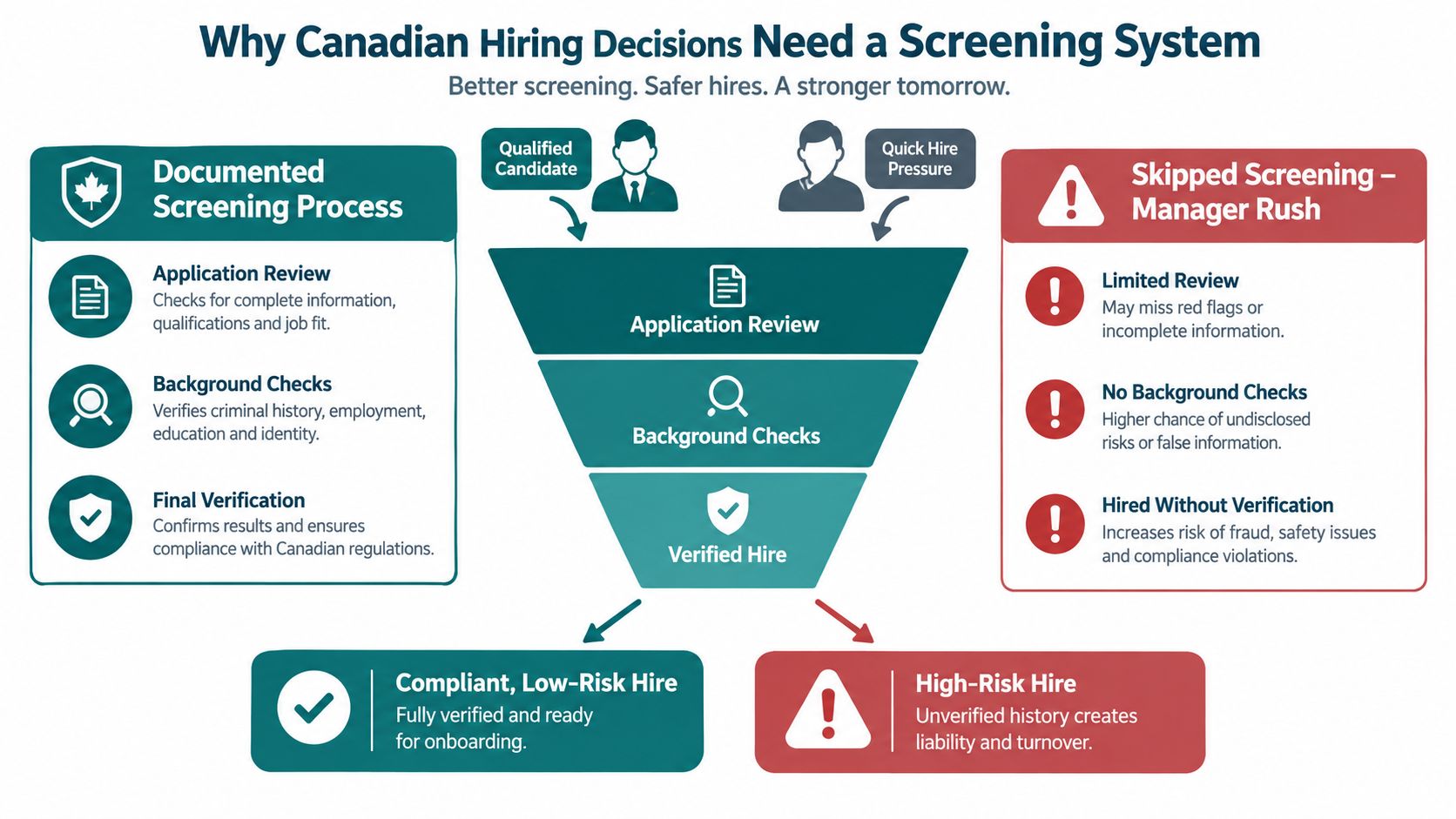
A district manager in Alberta rushes a retail supervisor into the job because the store is short-staffed. A week later, HR in Ontario hires for the same role and follows the approved process: identity verified, written consent collected, and a role-based check matched to the job. Same company. Same risk profile. Two different standards.
That is not a hiring process. It is a liability pattern.
When an incident happens, the question is rarely whether HR screened someone at all. It is whether the company can show a consistent decision system. In Canada, that means every step needs a reason you can defend later: why you verified identity, why you requested a particular check, why you collected consent at that point, and which privacy rule allowed you to collect and use that information.
The file that holds up under scrutiny is the one with a clear chain of decisions. HR identified the job risk, used the least intrusive check that fit that risk, reviewed any result for relevance, and documented the outcome. That is how you justify a hiring decision to leadership, counsel, a client, or a privacy regulator.
Ad hoc screening creates avoidable liability
If managers can decide on their own whether to screen, what to screen, and how late in the process to ask for consent, HR has already lost control.
The risk shows up in predictable places:
- Inconsistent treatment: Similar roles should follow the same screening path. If they do not, your rationale weakens fast when a rejected candidate or internal reviewer compares files.
- Privacy over-collection: Asking for more information than the role justifies creates its own problem. Under PIPEDA and substantially similar provincial private-sector laws, collection must be tied to a reasonable purpose.
- Workplace risk management: Some roles involve cash, property access, driving, patient contact, or work with vulnerable people. Screening will not remove risk, but failing to set a baseline control is hard to explain after an incident.
- Contract and client scrutiny: Many clients expect proof that pre-employment checks were handled in a repeatable way, not left to local manager preference.
- Poor judgment under hiring pressure: Urgent vacancies are where weak process fails first. The faster the hiring cycle, the more discipline you need.
Standardize first. Then allow exceptions only if HR approves them and records the reason.
The goal is a defensible system
Canadian employers do not get one master background report that answers every hiring question. Screening here is fragmented by design. Identity, consent, police information, employment history, education, credit, and driver records all sit under different rules, providers, and practical limits.
That is why checklist thinking fails. A defensible system works better because it forces HR to map each check to a specific purpose and legal basis. If you cannot explain why a warehouse picker needs one check but a finance manager needs another, your process is too loose. If you ask both for everything, your process is too intrusive.
Public Safety Canada notes that criminal record data and record governance are not simple employer screening tools, which is one reason employers need careful identity matching, limited collection, and documented use of results (Public Safety Canada background on criminal records and record governance).
A screening system worth keeping does three things:
- Applies the same rule to the same role across locations and hiring managers.
- Collects only what the role, consent, and governing privacy rule support.
- Leaves a file trail that another HR lead could review and defend without guessing.
That is the standard. Anything less is a patchwork process that breaks as soon as someone asks why one candidate was treated differently from another.
The Three Levels of Canadian Criminal Record Checks
Most employers still talk about “doing a background check” as if there's one Canadian product. There isn't. If you don't separate the check types, you'll either over-collect sensitive information or request the wrong check and delay hiring.
Start with the baseline check
What many people call a CPIC check is officially described by the Government of Canada as a police query of the Identification Data Bank using a person's name and date of birth (Government of Canada guidance on criminal record background checks and CPIC-related terminology).
For HR purposes, think in three levels.
| Check type | Source | Scope of information | Eligible roles | Typical turnaround |
|---|---|---|---|---|
| CRC | Police service or authorised screening channel querying police-held record systems | Baseline criminal record information used for general employment screening | General employment roles where a criminal record check is justified and consented to | Varies by provider and police process |
| CRJMC | Police service record check process | Broader than a basic CRC, including judicial matters relevant to the check type | Roles needing more context than a basic CRC but not a vulnerable sector search | Varies by provider and police process |
| VSC | Local police service or authorised local body under police/RCMP rules | Role-specific disclosure for positions involving vulnerable persons, with narrow exceptional disclosure rules | Positions of trust or authority over children or other vulnerable persons | Often depends on local police workflow and applicant jurisdiction |
If you need a stronger primer on terminology, Alero's guide to criminal record checks in Canada is a useful operational reference.
Where employers get the match wrong
A CRC is your baseline option. It fits lower-risk hiring where the role justifies checking for criminal record information, but the person won't be working in direct trust with vulnerable people and doesn't need a more expanded judicial review.
A Criminal Record and Judicial Matters Check sits in the middle. London Police describes this type of check as appropriate for employment or volunteer roles where a sex-offender-with-record-suspension search is not required, and explicitly says it isn't intended for applicants working with vulnerable persons. It also gives practical examples such as board members, IT staff, and construction staff at daycares, schools, hospitals, and long-term care facilities when the person is not directly in a position of trust or authority over the vulnerable population (London Police record check descriptions).
A Vulnerable Sector Check is not an “enhanced check” you can use whenever you feel nervous. It's restricted. In Ontario, it's a separate police-service-specific process used only where a person will be in a position of trust or authority over children or other vulnerable persons, and exceptional disclosure of non-conviction information is tightly limited under the Police Record Checks Reform Act (Ontario police record checks guidance).
Order a VSC for a back-office accountant and you may get denied, delayed, or asked to justify the request. That's not better screening. That's bad workflow design.
My recommendation
Map every role in your organisation to one default police check type. Don't let each hiring manager choose. HR should set the threshold once, document it, and apply it consistently.
PIPEDA and Provincial Privacy Rules That Shape Every Check
A recruiter in Toronto sends the same background check package to a software engineer in Vancouver, a sales manager in Calgary, and a payroll lead in Montreal. Same consent form. Same broad language. Same retention habit. That is how HR teams create privacy risk they cannot defend later.
Canadian screening works best when you treat it as a decision system. Every question, every check, and every consent step should map to a rule you can point to and a job requirement you can explain.
Consent must be specific, and collection must match the role
Under PIPEDA, organisations need meaningful consent and can collect, use, or disclose personal information only for purposes a reasonable person would consider appropriate. The Office of the Privacy Commissioner's guidance is clear on that point. Broad “background check authorization” language is lazy drafting and poor compliance practice (OPC guidance on PIPEDA and employee privacy).
Set up your process so each step is defensible:
- Use a separate screening consent form. Do not bury consent in offer paperwork or general onboarding documents.
- Name each check. Say exactly what you are ordering: identity verification, criminal record check, credit check, licence verification, education verification.
- State the purpose beside the check. If you cannot explain why the role needs it, remove it.
- Give candidates a correction path. If a result is wrong or incomplete, HR needs a documented way to pause and review.
For a practical HR-focused explanation of how these rules apply in hiring, keep this guide to PIPEDA and background checks in Canada in your process file.
Federal rules are the baseline. Provincial rules decide the details.
National employers get into trouble when they assume PIPEDA gives them one standard form for the whole country. It does not.
The Office of the Privacy Commissioner explains that PIPEDA applies to federally regulated employers and to personal information in commercial activities, while Alberta, British Columbia, and Quebec have their own private-sector privacy laws that can govern employee information directly (OPC overview of PIPEDA and substantially similar provincial laws).
That changes how you should build your screening workflow.
- Federally regulated employers: Use PIPEDA as the operating rule set for consent, purpose, and limits on collection.
- Alberta, BC, and Quebec: Review provincial requirements before you roll out forms, disclosures, and retention practices.
- Ontario and other provinces: Do not mistake the absence of a private-sector employee privacy statute for permission to over-collect. Police record rules, human rights obligations, and general reasonableness still apply.
A national policy should set principles. The forms, scripts, and retention rules still need provincial tuning.
What a defensible process looks like
Good screening design is disciplined. The role determines the check. The check determines the consent language. The consent language determines what you can collect and keep.
Working standard: If the role changes, update the purpose statement. If the check changes, update the consent form.
Keep the result you need for the hiring decision and the audit trail. Drop the rest. Separate consent for intrusive checks. Short retention periods. Clear dispute handling. If your team cannot explain why it asked for a piece of information under PIPEDA or a provincial privacy rule, the process is wrong.
Provincial Differences HR Teams Get Wrong
Most national screening policies look polished on paper and fall apart at the provincial level. The mistakes are usually quiet. Wrong consent language in Quebec. Wrong police check for Ontario roles. A national template that assumes all provinces treat privacy and disclosure the same way.
They don't.
Ontario, Quebec, Alberta, and BC aren't interchangeable
A Canadian screening policy should never say “all candidates complete the same background check package.” That's lazy drafting, and in practice it creates over-collection.
Current Canadian guidance points to three issues that should already be on your radar: PIPEDA remains the federal baseline, Quebec's Law 25 is the strictest private-sector regime, and Ontario employers with 25+ workers must disclose AI use in public job postings starting January 1, 2026 if AI screens, assesses, or selects applicants (Canadian province-by-province screening law overview).
| Province | Key Rule | Practical Impact on HR |
|---|---|---|
| Ontario | VSCs are restricted to trust or authority roles involving vulnerable persons | Don't request a VSC for general staff roles. Match check type tightly to duties |
| Quebec | Stricter private-sector privacy expectations | Use clear, role-specific consent and pay close attention to language and data handling |
| Alberta | Own private-sector privacy law | Review your consent and retention language instead of relying on a federal-only template |
| British Columbia | Own private-sector privacy law | Apply province-specific privacy review to collection and storage practices |
Where one-size-fits-all breaks
Ontario is the province where many employers misuse police checks. If the role doesn't involve trust or authority over vulnerable persons, don't force a VSC request and hope the police sort it out.
Quebec is where consent quality matters most operationally. If your forms are vague, overly broad, or disconnected from purpose, your process will look weak quickly.
Alberta and BC require the same discipline for a different reason. Their private-sector privacy statutes mean your collection logic, notification approach, and retention practices need to be deliberate, not copied from a generic national vendor form.
National consistency matters. National uniformity doesn't. Those are different things.
Identity Verification as the Front Door of Screening
If you verify identity last, your whole screening program is backwards.
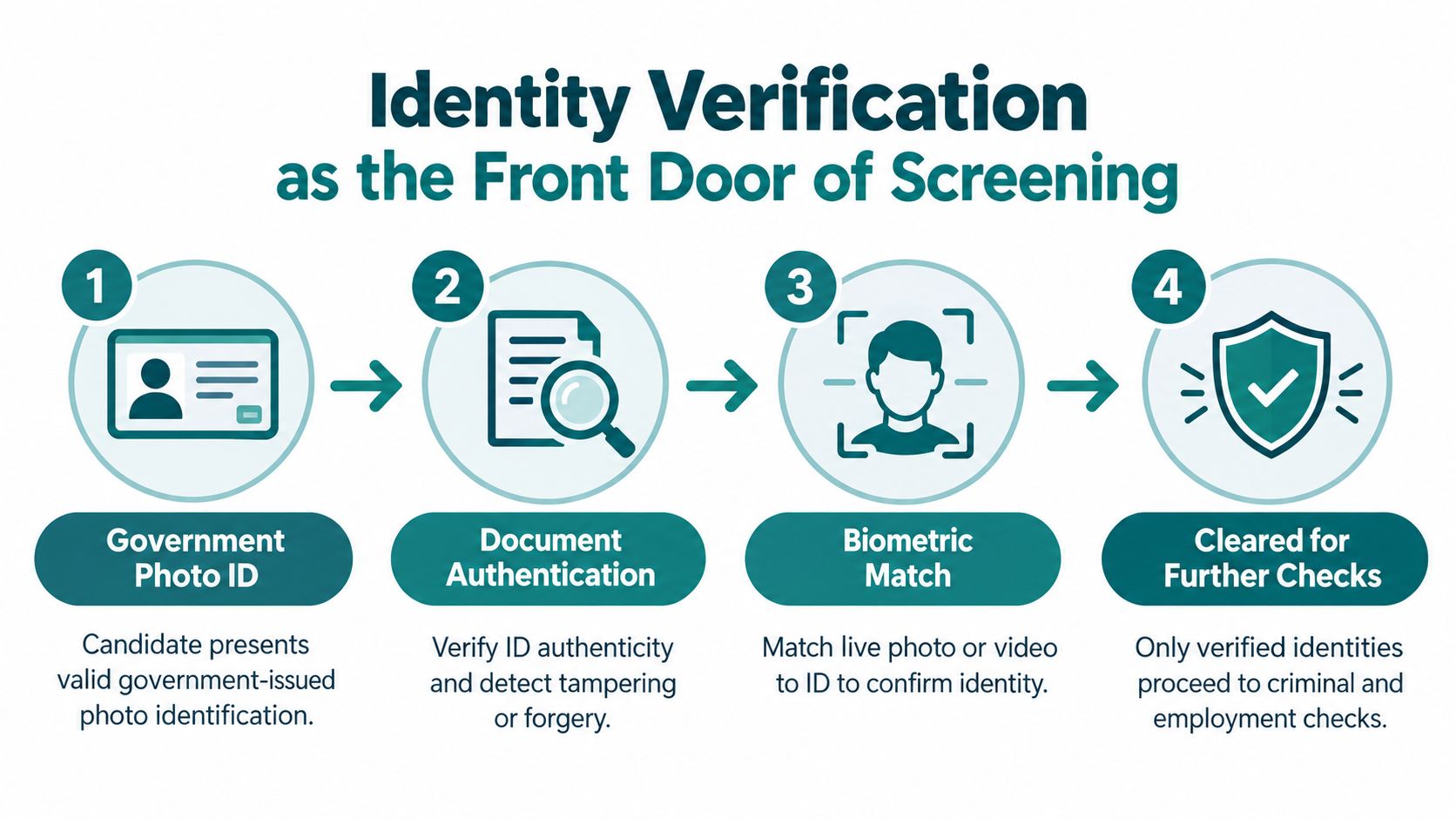
Every downstream check depends on the applicant being the right person. If the identity is wrong, the criminal record search may be irrelevant, the education confirmation may be tied to someone else, and your onboarding controls have already failed before day one.
Why this step belongs at the beginning
Canada-focused reporting has been blunt about the shift. Identity verification has moved to the “front door” of criminal record checks. The same coverage cites a 2026 survey in which 5.1% of companies do not formally verify identity before hiring and 22.3% are unsure what their process covers (Credibled coverage on identity verification trends and the cited survey figures).
Those numbers should bother any HR team running remote or hybrid hiring.
A practical sequence works better:
- Offer-stage ID collection using government-issued photo identification.
- Document authentication before you request criminal or credential checks.
- Biometric or live-match confirmation where fraud risk is higher.
- Only then run the rest of the screening stack.
If you're reviewing tools, Canadian identity verification services should support this sequence rather than bolting identity review onto the end.
Friction is real, but fraud is more expensive
Some employers avoid strong identity proofing because they worry about candidate drop-off. Fair concern. But the fix isn't to skip the step. The fix is to make the step cleaner.
Use mobile-first intake. Tell candidates exactly what ID they need. Give them a clear status view. Don't make them upload the same document twice because HR and security work in different systems.
A short explainer helps many candidates understand what's being checked and why:
The strongest Canadian screening programs treat identity verification as the gate. If identity doesn't clear, nothing else proceeds.
Matching the Right Check to the Role
The right screening package depends on access, proximity, and consequence. Who will this person be near? What will they touch? How hard is it to contain the damage if something goes wrong?
That's the decision framework. Not habit. Not fear. Not whatever your last vendor happened to sell.
Use role risk tiers, not job title guesses
A receptionist in a clinic and a receptionist in a software company don't carry the same exposure. A finance clerk with payment authority creates a different risk profile than an office coordinator with no system access.
Build your policy around risk tiers like these:
| Risk Tier | Role Examples | Required Checks |
|---|---|---|
| Low | General office staff, internal admin support, junior back-office roles | Identity verification, employment confirmation where relevant, CRC only if justified by role |
| Moderate | Customer-facing staff, staff with cash handling, payroll access, procurement access, field roles entering client sites | Identity verification, CRC or CRJMC depending on duties, employment verification, licence check if driving is required |
| High | Roles in authority or trust over children or vulnerable persons | Identity verification, VSC where the role legally fits, employment verification, credential review where applicable |
| Elevated trust or safety-sensitive | Senior leaders, controlled-access operations, regulated functions, roles with broad system or financial authority | Identity verification, role-appropriate criminal check, employment and education verification, licence or credit-related screening where duties justify it |
What each tier should trigger
For low-risk office roles, don't overbuild the package. Identity comes first. Then ask whether a criminal record check is proportionate. A blanket CRC for every single hire often creates noise without improving decisions.
For customer-facing or financial access roles, move up a level. If the person handles money, enters client premises, or can create account or payment risk, a stronger package is easier to defend. In many cases, a CRJMC makes more sense than either a minimal check or an unnecessary VSC.
For vulnerable population roles, be precise. The RCMP's dissemination policy says only the police agency or authorised local body where the applicant lives can conduct a vulnerable sector verification, and the applicant is responsible for requesting it from that local jurisdiction (RCMP dissemination policy for vulnerable sector verifications). Ottawa Police also states that a VSC is restricted to applicants seeking employment or volunteering in a position of authority or trust relative to vulnerable persons in Canada, and that non-conviction information is released only when it meets the Exceptional Disclosure Assessment (Ottawa Police police record check descriptions).
The rule most employers need to hear
More checks don't make you safer. Better matching does.
The best screening policy is proportionate. It asks for the least intrusive package that still lets you defend the hiring decision.
If your policy can't explain why a role gets a CRC instead of a CRJMC, or a CRJMC instead of a VSC, it isn't finished.
Choosing a Canadian Screening Partner and Building a Repeatable Workflow
A screening partner shouldn't just return reports. It should support a process your HR team can run the same way every time, in every province you hire in.
If the vendor can't explain consent handling, local police check routing, dispute handling, data storage, and candidate communications in plain language, keep looking.
What to look for in a Canadian provider
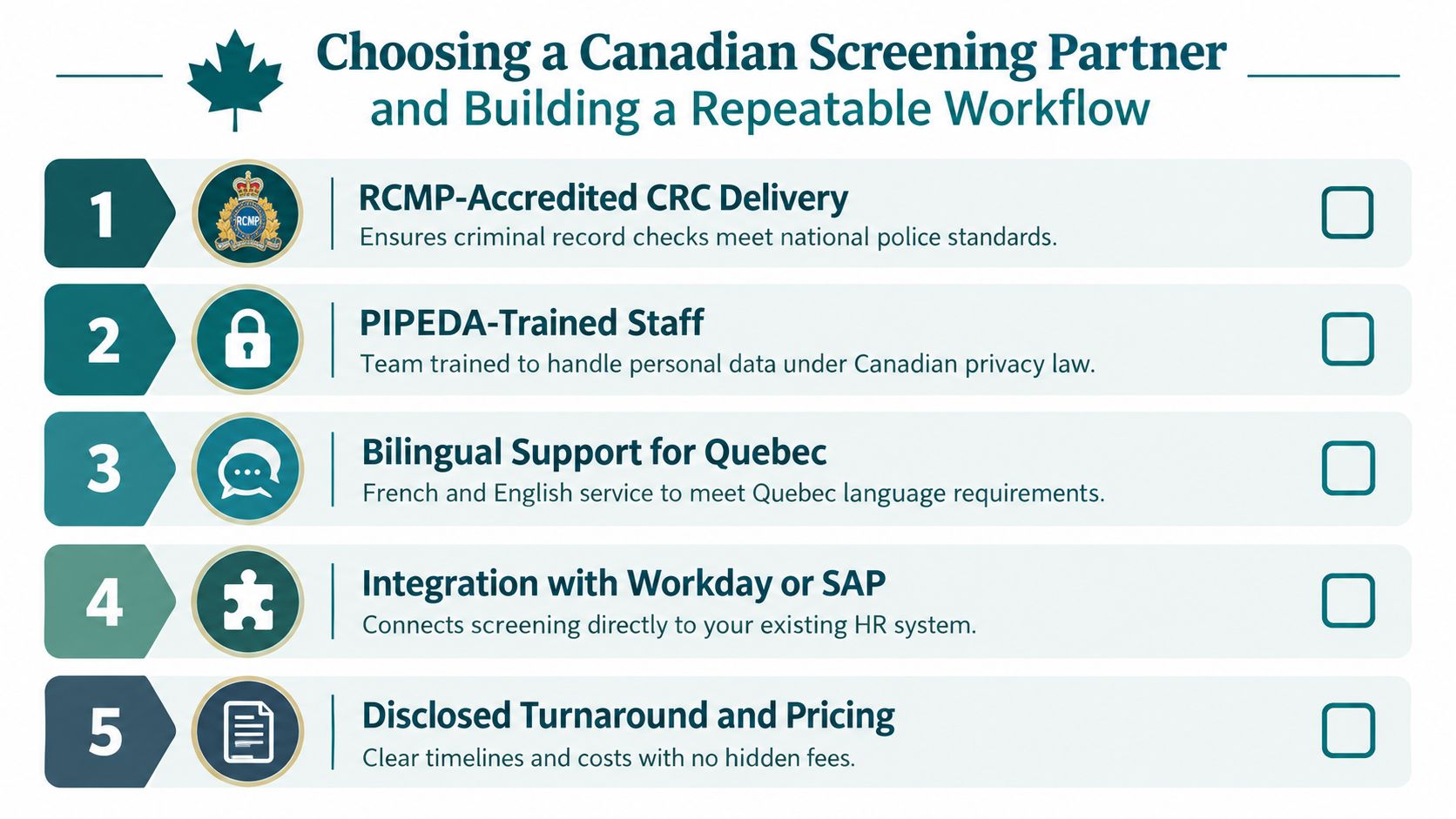
I'd screen vendors against five practical criteria:
- Canadian criminal screening capability: They should be able to support the right criminal check pathways for Canadian hiring, including the limits around vulnerable sector processes.
- Privacy-operational maturity: Ask how they collect consent, how long they retain records, and how they handle corrections or disputes.
- Quebec readiness: Bilingual workflows matter if you hire in Quebec. So does clarity on where data is stored and who can access it.
- System integration: If your ATS or HRIS can't pass status cleanly, your recruiters will end up chasing PDFs and email threads.
- Candidate experience: A clunky intake form creates avoidable delays and abandoned checks.
One example in the Canadian market is Alero Background & Identity, which offers Canadian criminal record checks, identity proofing, credential verification, bilingual workflows, HRIS or ATS integrations, and stores applicant data within Canada. That's the kind of operational profile to look for, whether you use Alero or another provider with similar Canadian controls.
Build the workflow once, then stop improvising
A repeatable model usually works best in five steps:
Classify the role before posting it
Decide the risk tier and approved check stack before recruiters start sourcing. Don't build the package after the finalist is chosen.Capture written consent at the offer stage
Use role-specific forms. A general “background check may be required” clause is weak. Name the checks.Run identity verification before the rest
This should be your gate, not your clean-up step.Execute checks in layers
Start with the minimum package tied to the role. Escalate only where policy already supports it. Give candidates a fair path to address issues.Retain records on a schedule
Keep enough for auditability, then dispose of what you no longer need. If nobody can explain why an old report is still sitting in a shared drive, that's a governance failure.
Contract terms that matter more than the sales demo
Don't get distracted by portal screenshots. Read the service terms.
Focus on:
- Purpose limitation: The vendor should process data only for the agreed hiring purpose.
- Subcontractor disclosure: If data touches other providers, you should know who they are and what they do.
- Correction handling: Ask what happens when a candidate disputes a result.
- Data location: Canadian employers often need clarity on whether applicant data stays in Canada.
- Clear status design: Recruiters need simple report outcomes they can act on without over-interpreting raw data.
Speed matters, but not at the expense of control
The best hiring workflows feel fast because they're organised. Candidates know what's needed. Recruiters know what to order. Hiring managers don't get to freelance new requirements midway through the process.
That's the balance in background screening Canada. Speed, depth, and compliance are not equal in every role. Your job is to choose the lightest defensible package, run it consistently, and leave a clean record of why you made the decision you made.
If your team wants a cleaner way to run Canadian screening, Alero Background & Identity offers criminal record checks, identity verification, credential screening, and Canadian-hosted workflows built for the privacy and consent standards that govern hiring here. It's a practical fit for employers that need faster turnaround, clearer status tracking, and a screening process they can defend across provinces.