You've found the right candidate, the hiring manager wants an offer out today, and someone remembers that the role involves driving, handling personal information, or working near vulnerable people. Then the screening question appears: which check should you order, what consent do you need, and where will the candidate's information go?
That pressure creates avoidable risk. Background checks on employees aren't a box to tick after the hiring decision. They're a controlled workflow involving role design, consent, identity verification, privacy, human rights, record handling, and a fair opportunity for the candidate to respond. A fast process is useful only when it produces the right result through a defensible method.
Table of Contents
- The Reality of Pre-Employment Screening in Canada
- Matching Police Record Checks to Specific Roles
- Navigating PIPEDA and Provincial Privacy Frameworks
- Beyond Criminal Records and Identity and Credential Verification
- Integrating Screening into Modern HRIS and ATS Workflows
- Designing a Compliant and Candidate-Friendly Policy
- Building a Secure and Efficient Hiring Foundation
The Reality of Pre-Employment Screening in Canada
Canadian employers use screening because criminal history and identity misrepresentation can create real operational risk. They also need to recognise the other side of the decision. A criminal record can create a lasting barrier to employment. A federal Public Safety study found that only about half of people released from federal institutions found employment after an average of 14 years, while the same evidence base estimates that roughly 3.8 million Canadians, about 1 in 9 people, have a criminal record. It also notes that criminal records can reduce employment likelihood by at least 50%. These findings make careless or blanket exclusion particularly damaging, as well as legally risky. Public Safety Canada's research on criminal records and employment provides the relevant Canadian context.
A hiring manager may see a result that appears concerning and move straight to rejection. A responsible HR process pauses. Was the correct check ordered for the role? Did the candidate give meaningful consent? Does the information relate to the actual duties? Is the report accurate and current? Has the candidate had a fair chance to explain or dispute it?
Why the checkbox approach fails
Screening is common in Canadian workplaces. Research summarised by the John Howard Society found that 73% of business representatives said they conducted background checks before hiring, while only 18% had a formal policy explicitly prohibiting the hiring of applicants with a criminal record. The same evidence reports that about 60% of employers wanted criminal record checks for all new hires, 54% required checks for some or all new employees, and 72% had a formal written policy on criminal record checks. The Canadian employer screening evidence also identifies especially high use in health and finance, where 72.7% and 73% of employers respectively required some form of criminal record check for all staff.
Those figures don't justify ordering the most intrusive check for every applicant. They show why employers need a consistent decision process. A generic request can delay a suitable hire, collect information the organisation doesn't need, or create a record that hiring managers later use for an unrelated purpose.
Practical rule: Start with the job risk, not the candidate's personal history. Define what the role requires, then collect only the information needed to assess that requirement.
A sound workflow assigns responsibility clearly. The hiring manager identifies duties and risk factors. HR or a designated privacy lead chooses the screening package. The candidate receives a plain-language explanation and gives consent before collection begins. Only authorised reviewers see the result, and the organisation records the decision rationale without circulating unnecessary personal details.
For small businesses, the same principle applies even without a dedicated privacy team. Document the role requirement, use a standard consent process, restrict access to the report, and avoid informal searches through social networks or personal contacts. The practical guide to pre-employment screening for small and mid-sized businesses can help employers turn those principles into a repeatable workflow.
Matching Police Record Checks to Specific Roles
The most common screening mistake is treating every police record check as interchangeable. In Canada, the check type affects the information returned, the verification process, the privacy impact, and whether the role justifies the request.
Begin with the duties. Ask whether the position involves ordinary workplace access, a need for court-related information, or trust and authority over children or vulnerable people. Don't ask for a Vulnerable Sector Check just because it sounds more thorough.
The three checks employers need to distinguish
A Criminal Record Check, often called a CRC, is the basic level. It is suitable where an employer needs criminal conviction information relevant to a legitimate job-related assessment and the role doesn't call for the additional court information in a Judicial Matters Check or the specialised protections of a VSC.
An Ontario Criminal Record and Judicial Matters Check, or CRJMC, goes beyond a basic Criminal Record Check. Ontario says it can include absolute and conditional discharges, outstanding charges, and arrest warrants. It is intended for an organisation that needs more than a basic criminal record check but doesn't require a Vulnerable Sector Check. Ontario's police record check framework sets out this distinction.
A Vulnerable Sector Check is restricted to roles involving trust or authority over children or vulnerable persons. The hiring organisation or volunteer organisation makes the request. The applicant doesn't request a VSC directly, and the RCMP says the decision to request one belongs to the organisation assessing the role. The RCMP's guidance on Vulnerable Sector Checks explains that threshold.
The local process matters too. Only the police agency or authorised body in the jurisdiction where the applicant lives can conduct the vulnerable sector verification. By contrast, an applicant can request a name-based criminal record check through a police agency or third-party company. RCMP policy on the dissemination of criminal record information explains why employers shouldn't treat a VSC as an ordinary online order.
Canadian Police Record Check Selection Matrix
| Check Type | Information Included | Appropriate Roles |
|---|---|---|
| Criminal Record Check | Basic criminal record information relevant to the employment assessment | Roles where the employer has a documented, job-related reason to assess criminal convictions |
| Criminal Record and Judicial Matters Check | The information in the basic check, plus court-related information such as absolute and conditional discharges, outstanding charges, and arrest warrants in Ontario | Roles needing more court-related information than a basic CRC, without the trust or authority threshold for a VSC |
| Vulnerable Sector Check | A specialised police verification for eligible roles involving trust or authority over children or vulnerable persons | Direct-care, education, support, or similar roles that meet the applicable vulnerable-sector threshold |
A simple selection sequence
- Describe the exposure. Does the employee handle money, operate a vehicle, access sensitive systems, supervise children, or provide care? A job title alone isn't enough.
- Choose the least intrusive check that addresses the risk. If a basic CRC answers the legitimate question, don't escalate to a CRJMC or VSC.
- Confirm the jurisdiction and route. Requirements can differ between provinces and police services, especially for a VSC.
- Obtain informed consent before ordering. Ontario guidance says an employer can't request a police record check without the individual's knowledge and consent, and the Ontario Human Rights Commission says police background checks should be requested only where they are a bona fide job requirement. Ontario human rights guidance on job-related sensitive information explains both boundaries.
- Plan for exceptions. A name mismatch, address history issue, or fingerprint requirement should trigger a documented review, not an automatic rejection.
Employers can use a screening provider for ordering and tracking, but the provider doesn't remove the employer's responsibility to choose a proportionate check. A Canadian criminal record check workflow should make the check type, consent event, status, and reviewer visible to authorised staff.
Navigating PIPEDA and Provincial Privacy Frameworks
Privacy compliance starts before the candidate enters a date of birth or uploads identification. Employers need to decide why they're collecting information, explain that purpose clearly, obtain meaningful consent, and limit the collection to what is reasonably necessary for the employment decision.
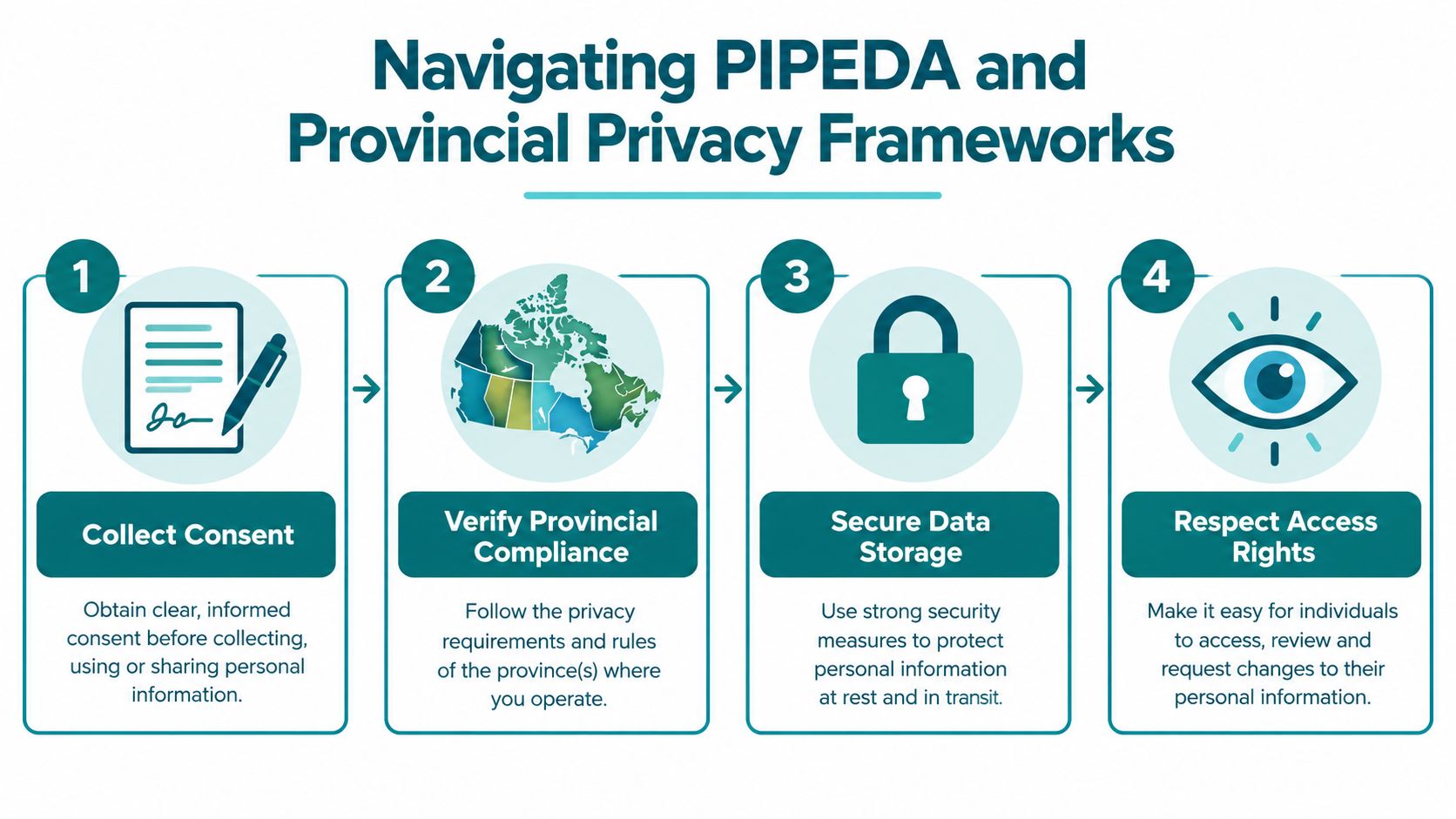
The governing framework can depend on the employer and the province. Federally regulated organisations may operate under PIPEDA, while Alberta, British Columbia, Quebec, and other provinces have their own privacy requirements or distinct applications. A national screening process therefore needs jurisdiction-aware rules rather than one consent page copied across every location.
Engineer purpose limitation into the workflow
Write the purpose in operational language. “To assess whether the applicant meets the documented requirements of the warehouse driving role” is more useful than “for HR purposes.” The purpose should determine the fields collected, the report type ordered, the people who can access it, and the length of retention.
The Office of the Privacy Commissioner of Canada says employers generally need meaningful consent for the collection, use, and disclosure of employee personal information, and that collection must be limited to information reasonably necessary for the employment purpose. The Commissioner's guidance for employers and employees also supports building privacy controls into the process rather than adding them after a vendor has been selected.
A practical control set includes:
- Consent provenance: Record what the candidate agreed to, when they agreed, and which purpose the consent covered.
- Data minimisation: Don't request a VSC, identity document, credit report, or driver abstract unless the role requires it.
- Role-based access: Let recruiters see completion status, while limiting report details to authorised reviewers.
- Audit history: Preserve the ordering event, result, reviewer, decision, and any candidate response.
- Retention timers: Set a deletion or review date by report type and jurisdiction instead of keeping every document indefinitely.
- Fresh authority: Don't reuse screening information for promotion, discipline, unrelated hiring, or another purpose without appropriate authority.
Retention deserves particular attention. One Canadian privacy resource states that when information is used to make a decision about a person, it is generally retained for a year so the individual can request access. That isn't a licence to keep all records for the same period in every situation. Your policy should identify the applicable rule, document the reason for retention, and securely destroy or anonymise information when the purpose ends.
Consent isn't a signature collected once. It's evidence that the candidate understood the purpose, the information involved, and how the organisation would handle it.
Human rights obligations add a second filter. Even where a check is permitted, an employer should assess whether the information is relevant to the role and whether an automatic exclusion could create discriminatory effects. A review process should separate the factual report from the employment decision, require a role-based rationale, and provide a route for correction or explanation.
A PIPEDA-focused background check workflow can help HR teams convert those requirements into consent, access, retention, and audit controls that operate consistently across hiring channels.
Beyond Criminal Records and Identity and Credential Verification
A criminal record check answers a narrow question. It doesn't, by itself, establish that the person submitting the application is the person connected to the record, that a professional credential is valid, or that the candidate held the dates and title listed on a résumé.
That distinction matters in regulated and operationally sensitive work. A healthcare employer may need to validate education and professional standing. A logistics company may need to confirm identity, licence information, and driving history. A financial organisation may need role-specific financial or regulatory screening. The right package depends on the exposure, not on a standard bundle that every candidate receives.
Match the verification layer to the risk
Identity proofing confirms that the applicant is a real person and helps connect the person completing the process to the submitted identity document. Basic knowledge-based questions may be convenient, but they can be unsuitable where the risk of impersonation is high. A live selfie match, manual video identification, or another stronger identity workflow can provide greater assurance, provided the employer has a legitimate purpose and handles biometric or highly sensitive information carefully.
Credential verification should go to the source wherever possible. Contacting an educational institution to confirm a qualification is stronger than accepting a scanned certificate. Employment verification with a prior employer can test job title and dates, while a structured reference check can gather job-related evidence about performance and conduct. The questions should stay tied to the position and avoid collecting gossip or irrelevant personal information.
Driver verification is different from a criminal record search. If driving is an essential duty, confirm the licence and obtain the appropriate provincial driver abstract through a lawful, consent-based process. A criminal record check won't tell you whether the candidate is currently authorised or suitable to drive for work.
Compare assurance, friction, and evidence
| Verification layer | What it helps establish | Main operational trade-off |
|---|---|---|
| Basic identity check | That supplied identity details are consistent | Faster and easier, but may provide less assurance against impersonation |
| Enhanced identity verification | Stronger connection between the candidate and the identity presented | More candidate effort and more sensitive data handling |
| Direct credential check | That a qualification or employment claim can be confirmed at source | Dependent on response times and the source's disclosure process |
| Reference check | Job-related observations from a previous employer or referee | Requires careful questions and consistent documentation |
| Driver abstract or licence verification | Driving authorisation and relevant driving information | Must be tied to a genuine driving requirement and provincial process |
The strongest workflow doesn't automatically use every layer. It uses a risk-based package. For a desk role with no regulated duties, identity and employment verification may be enough. For a role involving vulnerable people, the employer may need the legally appropriate police check plus identity, credential, and reference verification. For a driver, a licence and abstract may matter more than a broader check that doesn't answer the operational question.
Screening reports should also distinguish a clear result from a result requiring human review. A status such as “Review” should never mean “Reject.” It should send the case to an authorised reviewer who checks identity matching, relevance, accuracy, and the candidate's opportunity to respond.
Integrating Screening into Modern HRIS and ATS Workflows
Manual screening often begins with an email, continues through a spreadsheet, and ends with a PDF saved in a shared drive. That arrangement makes it difficult to know whether the candidate consented to the correct check, who accessed the report, whether a result belongs to the right person, and when the record should be deleted.
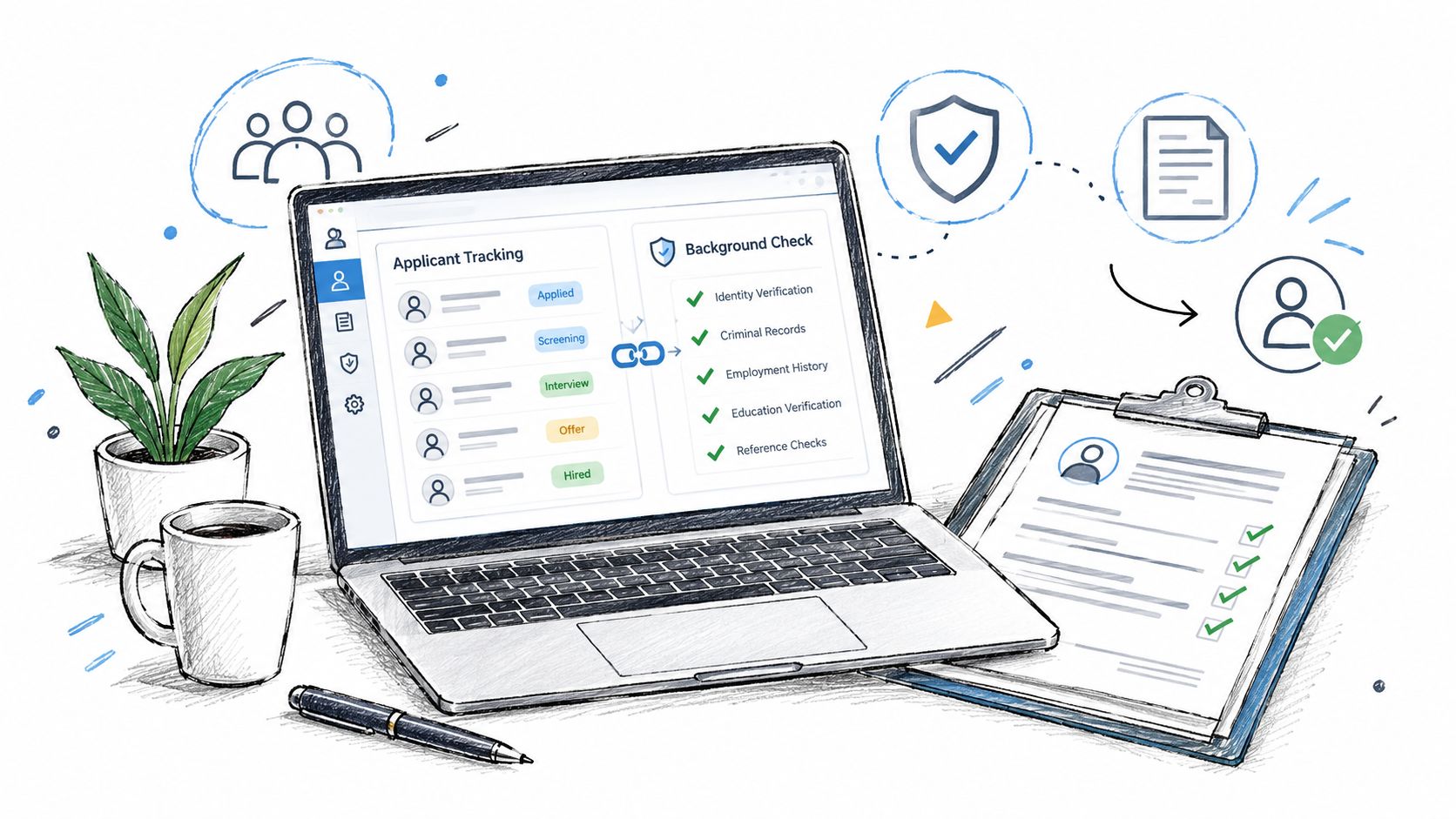
An HRIS or ATS integration creates a controlled handoff. The system can trigger screening after the appropriate hiring stage, pass only the necessary candidate fields, send the applicant to a secure self-serve portal, and return a status to the recruiter without exposing the full report to everyone involved.
Build the integration around controls
Automation should enforce policy, not accelerate bad decisions. Configure separate workflows for a basic CRC, CRJMC, VSC, identity verification, driver screening, and credential checks. The system should prevent a recruiter from selecting a VSC for a role that hasn't been classified as eligible, or from ordering a report before the consent event is complete.
Useful controls include:
- Conditional triggers: Launch screening only when the candidate reaches the documented stage and the role requires it.
- Candidate self-service: Let applicants enter their own information securely, reducing transcription errors and unnecessary email traffic.
- Status separation: Show “invited,” “in progress,” “clear,” or “review” without displaying sensitive details to unauthorised users.
- Exception routing: Send name mismatches, incomplete information, and disputed results to trained reviewers.
- Retention automation: Apply the relevant timer and create a deletion task when the purpose ends.
- Audit logs: Capture who ordered, viewed, reviewed, and changed the status.
Canadian data residency should be a procurement requirement for employers whose security policy or privacy assessment requires applicant information to remain in Canada. Ask where the data is stored, where backups are maintained, who can access it, how subprocessors are managed, and what happens when the contract ends. A vendor that offers an integration but can't answer those questions creates a gap between technical convenience and governance.
The right platform also reduces candidate friction. Mobile-first forms, plain-language instructions, bilingual support where needed, and clear explanations of why information is requested can prevent abandoned invitations. Speed still matters, but the objective isn't to return a result quickly. It's to move a complete, accurate, properly authorised case to the right decision-maker.
The following overview shows how an integrated screening experience can fit into a modern hiring process.
Before selecting a provider, test the workflow with a real role. Follow the candidate invitation, consent capture, correction process, reviewer access, adverse decision controls, and deletion path from beginning to end. A polished dashboard is not enough if the underlying process can't demonstrate necessity and accountability.
Designing a Compliant and Candidate-Friendly Policy
A good policy tells managers what to do before a candidate enters the screening portal. It defines which roles require which checks, who approves exceptions, how HR reviews information, and how the organisation communicates with the applicant.
Start with a role inventory. For every position, record the duties that create screening relevance, the information required to assess those duties, the lawful check route, the approval owner, and the retention rule. Review the inventory when duties change. A title such as “support worker” or “operations coordinator” doesn't automatically establish eligibility for a particular police check.
Four policy decisions that prevent avoidable disputes
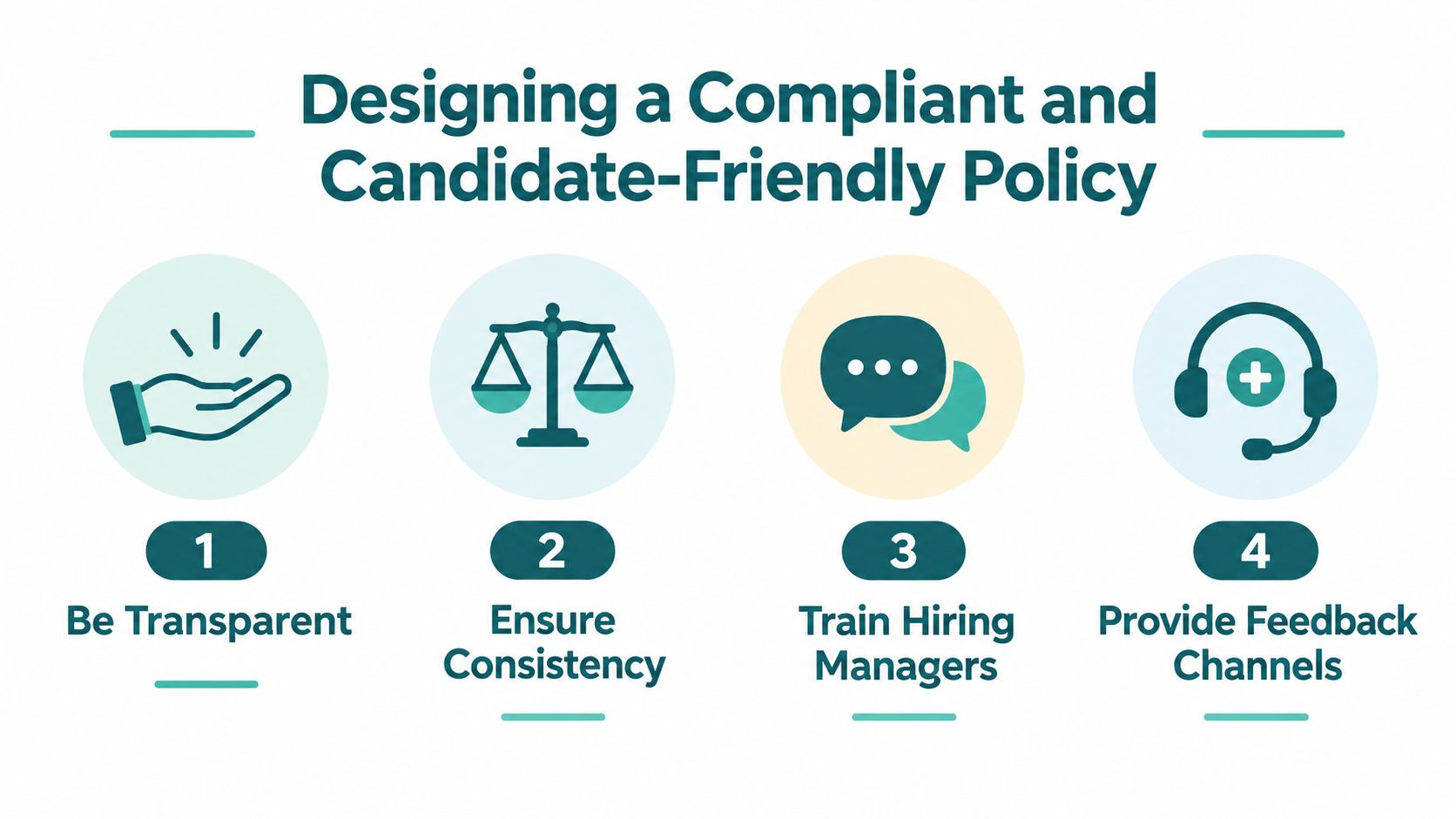
1. Explain the requirement early. Tell candidates during the hiring process that the offer or appointment may depend on a specified, job-related check. Describe the information requested, the reason for it, the provider involved, and how the candidate can ask questions. Don't hide the requirement in a dense policy document.
2. Apply the same rule to comparable roles. Consistency protects candidates and the employer. If two positions carry the same duties and risk, managers shouldn't select different screening levels based on personal preference or the candidate's background.
3. Separate screening from automatic exclusion. A report should trigger a structured review, not a predetermined outcome. The reviewer should assess accuracy, relevance, role duties, timing, and any information the candidate provides. Document the reason for the final decision in job-related terms.
4. Give candidates a usable response channel. Tell the applicant how to correct identity information, dispute a report, explain context, or request an accommodation. A mobile-friendly process helps, but accessibility also depends on plain language, reasonable response times, and human support when an automated flow doesn't fit.
Write the adverse decision procedure before you need it
Your policy should set out who receives a report marked for review, who can make the employment decision, what notice goes to the candidate, and how the organisation handles a correction. The decision-maker shouldn't rely on an informal message from a recruiter when the report contains sensitive information.
Train hiring managers not to ask candidates for unnecessary criminal history details in interviews or to share report contents with colleagues who don't need access. Give them a short decision guide with examples of role relevance, escalation points, and prohibited shortcuts. Training should also cover unconscious bias, the difference between a record and a finding of current risk, and the need to document objective reasons.
Review the policy with provincial coverage in mind. A national employer may need different consent language, storage decisions, police-check routes, and human rights analysis depending on where the applicant works and which privacy regime applies. A single national standard can still exist, but it should contain jurisdiction-specific rules rather than pretend that every location operates identically.
Building a Secure and Efficient Hiring Foundation
Effective screening protects more than the employer. It gives candidates a clear process, limits unnecessary collection, and creates a fair opportunity to correct inaccurate information. It gives HR teams a defensible record showing why a check was requested, what consent was obtained, who reviewed the result, and how the organisation reached its decision.
The practical foundation is straightforward:
- Classify the role first, then select the least intrusive check that answers the documented risk question.
- Use the correct Canadian police-check route, especially where a CRJMC or VSC may be under consideration.
- Capture meaningful consent and keep the purpose connected to the information collected.
- Verify identity and credentials separately when the role requires more than criminal-record information.
- Integrate the workflow so status, access, audit, and retention controls don't depend on individual memory.
- Keep candidate communication clear, with a genuine path for questions, corrections, and review.
The employer that treats screening as data governance can move quickly without turning speed into carelessness. Audit your current role matrix, consent form, vendor access, storage location, report-review process, and retention schedule. Then close the gaps before the next urgent hire exposes them.
Alero Background & Identity provides Canadian criminal record checks, identity proofing, credential and employment verification, driver screening, and HRIS or ATS workflow support, with consent and applicant data handled through Canadian-focused processes. Visit Alero Background & Identity to review screening options and build a role-appropriate hiring workflow.